When does grace become enabling sin?
6 min read
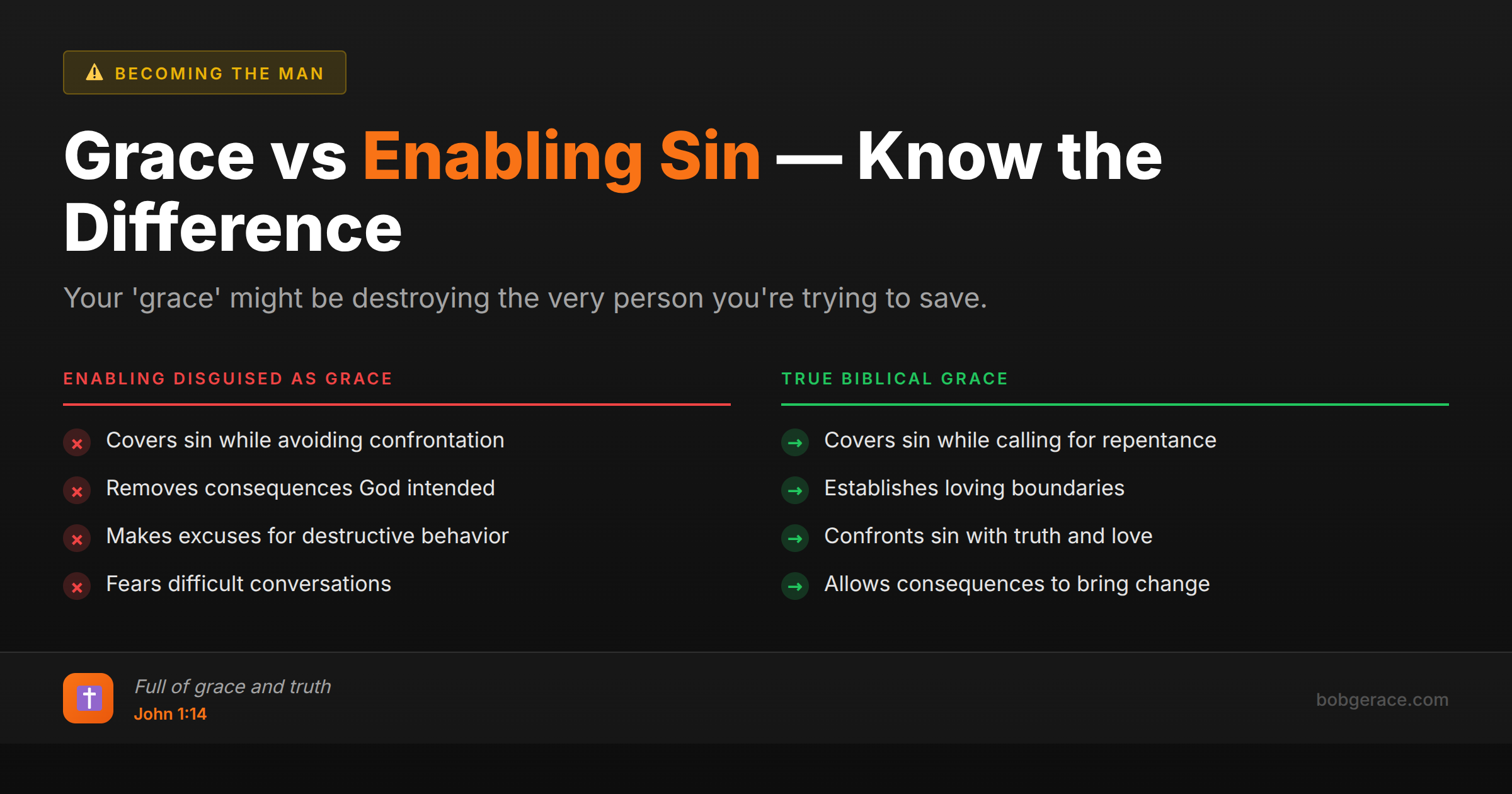
Grace becomes enabling when it removes consequences that God intended to bring about repentance and change. True biblical grace doesn't eliminate boundaries—it establishes them with love. When your 'grace' allows destructive patterns to continue unchallenged, you're no longer showing Christ-like love but rather participating in the destruction. The key difference is this: grace covers sin while calling for repentance, while enabling covers sin while avoiding the discomfort of confrontation. If your husband is involved with another woman and you're avoiding difficult conversations or consequences 'in the name of grace,' you're actually enabling his sin to continue and preventing the very thing that could lead to his restoration.
The Full Picture
Here's what I see happening in marriages where this confusion exists: wives who genuinely love Jesus and want to reflect His character end up tolerating destructive behavior because they've been taught that 'grace' means never confronting sin or setting firm boundaries.
This is not biblical grace—it's a distortion that actually works against God's purposes.
True grace is unmerited favor, but it's never separated from truth and righteousness. When Jesus showed grace to the woman caught in adultery, He didn't condemn her—but He also clearly told her to 'go and sin no more.' That's grace with boundaries.
The confusion often comes from well-meaning church teaching that emphasizes forgiveness and grace without equally emphasizing the call to repentance and transformation. But grace without the expectation of change isn't grace—it's permission.
When you enable sin in the name of grace, several things happen:
- Your husband never faces the natural consequences of his choices - He doesn't experience the 'godly sorrow that leads to repentance' (2 Corinthians 7:10) - You become an unwitting participant in his destruction - Your marriage deteriorates while you both pretend everything is fine - Your children learn that marriage doesn't require faithfulness or integrity
Real grace says: 'I love you too much to let you destroy yourself and our family without consequences. I forgive you, but I won't enable your sin to continue.'
What's Really Happening
From a clinical perspective, enabling behavior often stems from the betrayed spouse's own trauma response and fear of abandonment. When a woman discovers her husband's infidelity, her nervous system activates survival mode. Sometimes this manifests as people-pleasing and avoiding conflict at all costs—even when confrontation is exactly what the situation requires.
The psychological term for this is 'trauma bonding' combined with 'codependent enabling.' The betrayed spouse becomes hypervigilant about keeping peace and avoiding any action that might cause the unfaithful partner to leave. Ironically, this behavior often prolongs the affair and deepens the betrayal.
Enabling behaviors I frequently observe include: - Making excuses for his behavior to family and friends - Avoiding conversations about the affair to 'keep peace' - Taking on extra responsibilities so he doesn't face consequences - Accepting minimal effort toward recovery as 'progress' - Suppressing your own emotional needs to accommodate his comfort
True therapeutic intervention requires helping the betrayed spouse understand that healthy boundaries aren't punishment—they're protection. They protect the marriage, the children, and even the unfaithful spouse from the progressive destruction that unchecked sin always brings. When we remove natural consequences, we remove powerful motivators for change.
What Scripture Says
Scripture is crystal clear about the relationship between grace, truth, and accountability. Jesus Himself modeled this perfectly—full of grace and truth (John 1:14), never one without the other.
Grace includes accountability: *'If your brother sins against you, go and tell him his fault, between you and him alone. If he listens to you, you have gained your brother.'* (Matthew 18:15). Notice Jesus doesn't say 'just forgive and ignore it'—He commands direct confrontation.
Love requires boundaries: *'Better is open rebuke than hidden love. Faithful are the wounds of a friend; profuse are the kisses of an enemy.'* (Proverbs 27:5-6). Sometimes the most loving thing you can do is wound someone with truth rather than enable them with false comfort.
Consequences serve God's purposes: *'For the moment all discipline seems painful rather than pleasant, but later it yields the peaceful fruit of righteousness to those who have been trained by it.'* (Hebrews 12:11). When you remove consequences, you interfere with God's disciplinary process.
Grace demands repentance: *'The goodness of God leads you to repentance.'* (Romans 2:4). God's grace isn't passive—it actively works to produce change. If your 'grace' isn't leading your husband toward repentance, it's not biblical grace.
Truth and grace work together: *'Speaking the truth in love, we are to grow up in every way into him who is the head, into Christ.'* (Ephesians 4:15). Love without truth is enabling; truth without love is harsh. Both together create the environment for real transformation.
What To Do Right Now
-
1
Stop making excuses for his behavior to others—let his choices speak for themselves
-
2
Have the hard conversation about consequences if the affair continues—and mean it
-
3
Implement practical boundaries that protect you and your children from ongoing harm
-
4
Require visible, measurable steps toward change—not just promises or explanations
-
5
Get support from others who will help you maintain boundaries rather than guilt you into enabling
-
6
Pray for the courage to love him enough to let him face the consequences of his choices
Related Questions
Ready to Stop Enabling and Start Healing?
You don't have to navigate the line between grace and enabling alone. Get clear guidance on setting biblical boundaries that actually work.
Get Help Now →