How do I pursue reconciliation while refusing to participate in sin?
6 min read
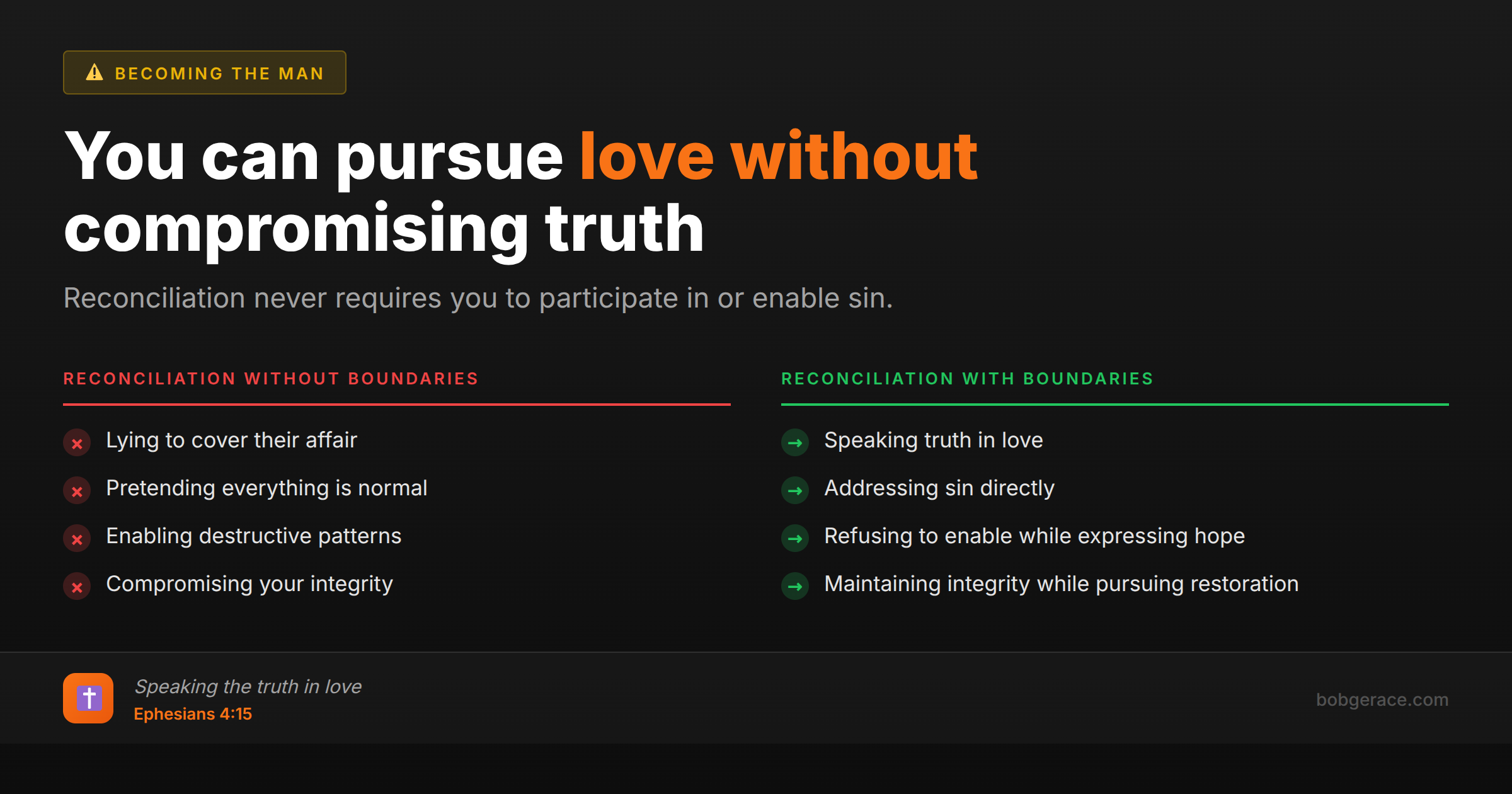
Pursuing reconciliation while refusing to participate in sin requires understanding that love and boundaries aren't opposites—they work together. You can actively pursue your spouse's heart through prayer, consistent kindness, and faithful actions while firmly saying no to behaviors that compromise your integrity or enable destructive patterns. This means you might attend counseling together but refuse to lie to cover their affair. You might express love and hope for restoration while declining to pretend everything is normal when it's not. Biblical reconciliation never requires you to sin or enable sin—it requires you to love courageously with wisdom.
The Full Picture
When your marriage involves another man, you're facing one of the most complex relational situations possible. Your heart wants restoration, your faith calls you to forgive and reconcile, but your conscience won't let you participate in or enable ongoing sin. This tension feels impossible, but it's actually the path to authentic healing.
The false choice many Christians accept is this: either pursue reconciliation by overlooking sin and maintaining peace at any cost, or protect yourself by building walls and giving up on restoration. Both options miss the mark entirely.
True biblical reconciliation requires both parties to acknowledge reality, repent of sin, and commit to change. Your role isn't to make reconciliation happen by lowering your standards or ignoring destructive behavior. Your role is to create an environment where authentic reconciliation can occur while protecting yourself and others from ongoing harm.
This means you'll love your spouse deeply while refusing to pretend her relationship with another man is acceptable. You'll express hope for your marriage while declining to act as if everything is normal. You'll work toward restoration while maintaining boundaries that protect both of your souls from further damage. This approach often feels harder initially because it requires you to hold two truths simultaneously: love and boundaries, hope and reality, grace and consequences.
What's Really Happening
What you're experiencing is called 'moral injury'—the psychological wound that occurs when you're pressured to act against your values. Many spouses facing infidelity feel trapped between their desire to save the marriage and their need to maintain personal integrity.
This internal conflict creates what we call 'competing attachments.' Your attachment to your spouse battles against your attachment to your values, faith, and self-respect. When well-meaning people tell you to 'just forgive and move forward' or 'do whatever it takes to save your marriage,' they're asking you to sacrifice one attachment for another. This always backfires.
Healthy reconciliation requires what's called 'differentiation'—the ability to maintain your own values and identity while staying emotionally connected to your spouse. You can love someone deeply while refusing to participate in their destructive choices. In fact, this kind of principled love often serves as a catalyst for genuine change because it demonstrates that real consequences exist for harmful behavior.
People change when the cost of staying the same becomes greater than the cost of changing. By maintaining loving boundaries, you create appropriate consequences that can motivate authentic transformation rather than just behavioral compliance.
What Scripture Says
Scripture never asks us to choose between love and truth, grace and boundaries, or reconciliation and righteousness. God models perfect integration of these qualities.
Ephesians 4:15 tells us to speak "the truth in love." This means addressing sin directly while maintaining a heart of compassion. You're not being unloving when you refuse to participate in or enable destructive behavior.
Matthew 18:15-17 outlines Jesus' approach to sin in relationships: address it directly, involve others if needed, and maintain appropriate boundaries if repentance doesn't occur. Notice that love drives the entire process, including the boundary-setting.
1 Corinthians 5:11-13 instructs believers not to associate with those who claim faith but persist in destructive sin. This isn't about hatred—it's about refusing to enable behavior that destroys souls.
Galatians 6:1 calls us to restore those caught in sin "in a spirit of gentleness," but restoration implies that sin is acknowledged and abandoned, not ignored or accommodated.
2 Timothy 2:24-26 describes how to handle difficult situations: "The Lord's servant must not be quarrelsome but kind to everyone, able to teach, patiently enduring evil, correcting opponents with gentleness."
God's love always includes boundaries. His grace never enables sin. Your pursuit of reconciliation should reflect the same integration of love and truth that God demonstrates with us.
What To Do Right Now
-
1
Clearly communicate your position: 'I love you and want to restore our marriage, but I won't participate in or enable the relationship with [other person].'
-
2
Identify specific behaviors you will and won't accept, then communicate these boundaries clearly and kindly to your spouse.
-
3
Continue expressing love through actions that don't compromise your values—prayer, appropriate affection, acts of service when they don't enable sin.
-
4
Refuse to lie, cover, or make excuses for your spouse's choices while maintaining a respectful, non-condemning attitude.
-
5
Seek support from a pastor or Christian counselor who understands both grace and boundaries—you need wisdom for this complex situation.
-
6
Focus on your own spiritual and emotional health so you can love from strength rather than desperation or fear.
Related Questions
- What does loving confrontation look like biblically?
- When does grace become enabling sin?
- How do I hold boundaries without hardening my heart?
- What is redemptive discipline vs. punitive discipline?
- What does 'speaking truth in love' look like?
- How do I set boundaries without controlling?
- What does biblical forgiveness require of me?
- What's the difference between forgiveness and reconciliation?
- Can I forgive and still have boundaries?
- What boundaries should I set?
Also find Bob on
Subscribe for weekly videos on Christian marriage.
This Gets Complicated Fast in Real Life
Knowing the principle is one thing. Applying it to your actual marriage—where emotions run hot and the stakes are real—is another. A coach who knows your specific situation can help you hold the line without losing your heart.
Talk to Bob →