What is 'differentiation' and why does it matter now?
5 min read
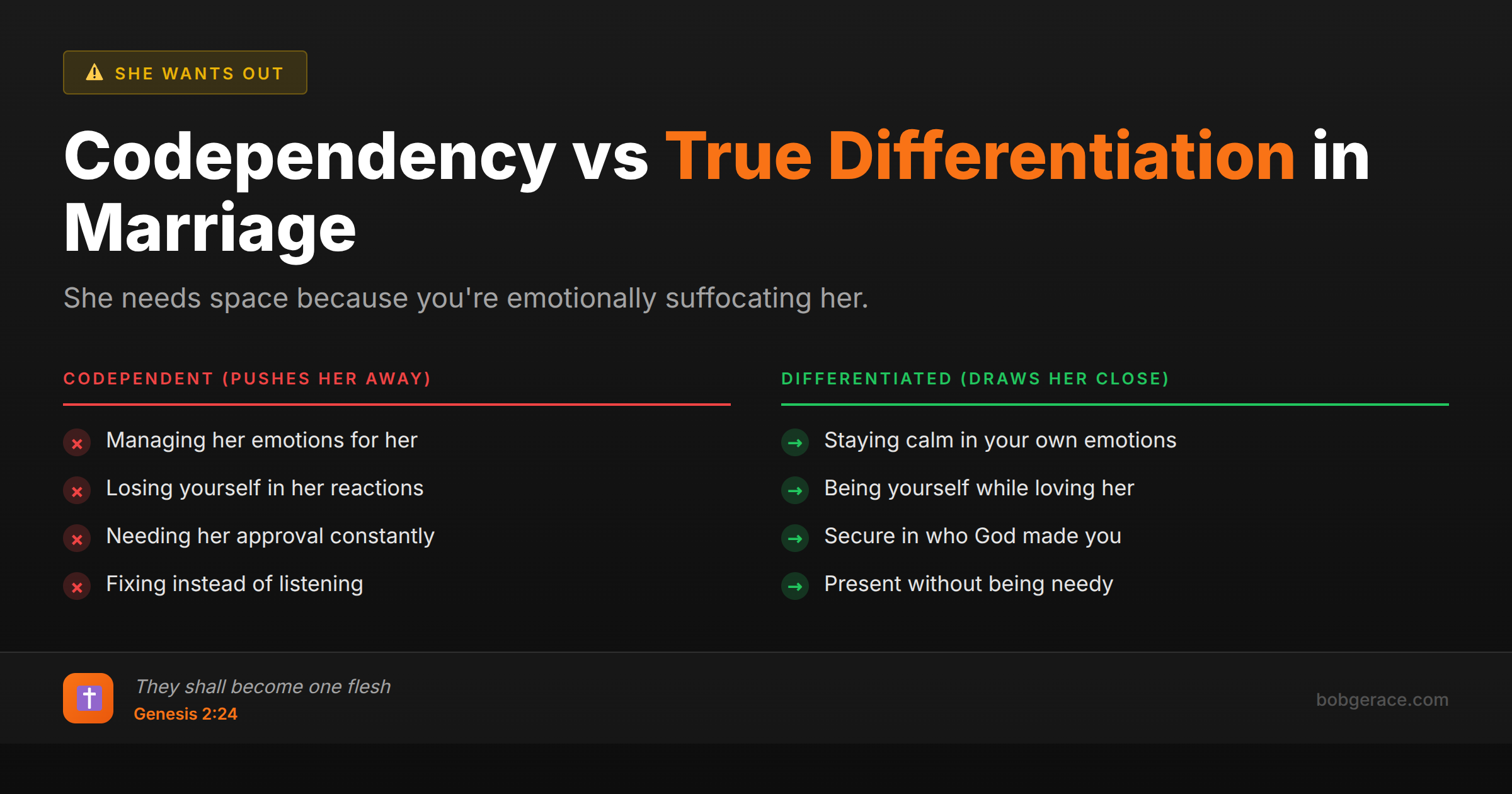
Differentiation is your ability to be yourself - your own person with your own thoughts, feelings, and values - while staying emotionally connected to the people you love. It's not about becoming cold or distant. It's about developing enough emotional maturity that you don't lose yourself trying to manage other people's emotions or reactions. This matters now because when your wife says she wants space, she's often saying she can't breathe around your anxiety, your need for her approval, or your attempts to fix her feelings. Differentiation allows you to love her without suffocating her, to be present without being needy, and to stay connected while giving her room to figure out what she needs.
The Full Picture
Think of differentiation as emotional adulthood. It's the difference between reacting and responding, between taking things personally and staying curious, between trying to control outcomes and focusing on what you can actually influence.
Most men I work with have spent years in fusion with their wives - where her mood becomes his mood, her stress becomes his crisis to solve, and her withdrawal feels like a personal attack on his worth as a husband. This isn't love - it's anxiety masquerading as care.
Here's what low differentiation looks like: • You can't sleep when she's upset • You try to talk her out of her feelings • You take responsibility for emotions that aren't yours • You lose yourself trying to become who you think she wants • You feel rejected when she needs alone time
High differentiation looks different: • You can stay calm when she's activated • You validate her feelings without trying to fix them • You maintain your own interests and friendships • You can disagree without it becoming a crisis • You love her without needing her constant approval
The paradox is this: the more you can be your own person, the more attractive and trustworthy you become. When you stop trying to manage her emotional world, she has space to actually miss you and choose you freely.
Differentiation isn't about becoming selfish or disconnected. It's about becoming the kind of man who can handle the reality of marriage - that two people can love each other deeply while still being separate individuals with different needs, perspectives, and emotional experiences.
What's Really Happening
Differentiation, first developed by family systems theorist Murray Bowen, measures our ability to maintain autonomous functioning while remaining emotionally connected to important others. In marriage, low differentiation manifests as what we call 'emotional fusion' - where partners lose their individual identity in the relationship system.
Neurologically, when we're poorly differentiated, our partner's emotional state triggers our own threat detection system. The amygdala fires, cortisol floods our system, and we shift into fight-flight-freeze responses. We literally cannot think clearly when our partner is distressed because our nervous system interprets their pain as our own emergency.
Research consistently shows that couples with higher differentiation report greater relationship satisfaction, better conflict resolution, and more stable attachments. This isn't because they avoid conflict - it's because they can engage conflict without losing themselves in the process.
The therapeutic concept of 'self-soothing' is crucial here. When you can regulate your own emotional state independent of your partner's, you become what we call a 'non-anxious presence.' This creates safety for your partner to experience their own emotions without feeling responsible for managing yours.
Many men mistake differentiation for detachment, but they're opposites. Detachment is emotional withdrawal; differentiation is emotional maturity. It's the difference between 'I don't care' and 'I care deeply, and I trust you to handle your own experience while I handle mine.'
The clinical goal isn't independence from your partner - it's interdependence, where two whole people choose each other daily rather than two half-people clinging together out of need.
What Scripture Says
Scripture beautifully illustrates the balance between connection and individual identity. Genesis 2:24 says, 'Therefore a man shall leave his father and mother and hold fast to his wife, and they shall become one flesh.' This isn't about losing your identity - it's about two complete people choosing unity.
Ephesians 5:28-29 instructs, 'Husbands ought to love their wives as their own bodies. He who loves his wife loves himself. For no one ever hated his own flesh, but nourishes and cherishes it.' This assumes you know how to love yourself well first. You can't give what you don't have.
Galatians 6:2-5 presents a powerful paradox: 'Bear one another's burdens, and so fulfill the law of Christ... For each will have to bear his own load.' We're called to support each other while maintaining personal responsibility. This is differentiation in action - helping without rescuing, caring without controlling.
1 Corinthians 7:7 reminds us that Paul actually preferred singleness, saying marriage should be a choice, not a desperate need. When you can be content alone with God, you're free to love your wife from abundance rather than emptiness.
Philippians 2:12 instructs us to 'work out your own salvation with fear and trembling.' Your relationship with God is yours to steward. You can't manage your wife's faith journey or emotional healing - that's between her and the Lord.
Biblical love isn't codependent fusion - it's two people, each secure in their identity as beloved children of God, choosing to walk together in purpose and unity while maintaining the individual calling God has placed on their lives.
What To Do Right Now
-
1
Identify one area where you've been managing her emotions instead of your own - stop doing that today
-
2
Practice staying curious when she's upset instead of immediately trying to fix or defend
-
3
Reconnect with one personal interest or friendship you've neglected during your marriage struggles
-
4
When she expresses a need for space, respond with 'I understand' instead of asking for reassurance
-
5
Spend 10 minutes daily in prayer or reflection focusing on who God created you to be, not just who you are as a husband
-
6
Choose one conflict pattern where you typically react defensively and practice responding calmly instead
Related Questions
- Should I give her space or fight for her?
- How do I fight without pushing her away?
- What's the difference between pursuing and chasing?
- How do I show love without activating her withdrawal?
- How do I hold tension without collapsing or attacking?
- What is 'anxious protest behavior' and am I doing it?
- How do I lead without controlling?
- What does healthy self-respect look like right now?
- How do I set boundaries without controlling?
- What does mature masculine look like?
Also find Bob on
Subscribe for weekly videos on Christian marriage.
Get a Coach Who Knows Your Marriage
Differentiation looks different in your specific situation. A coach helps you see what you can't see alone—where you're still fused, where you're pulling away too far, what your wife actually needs from you right now.
Talk to Bob →