What is 'anxious protest behavior' and am I doing it?
6 min read
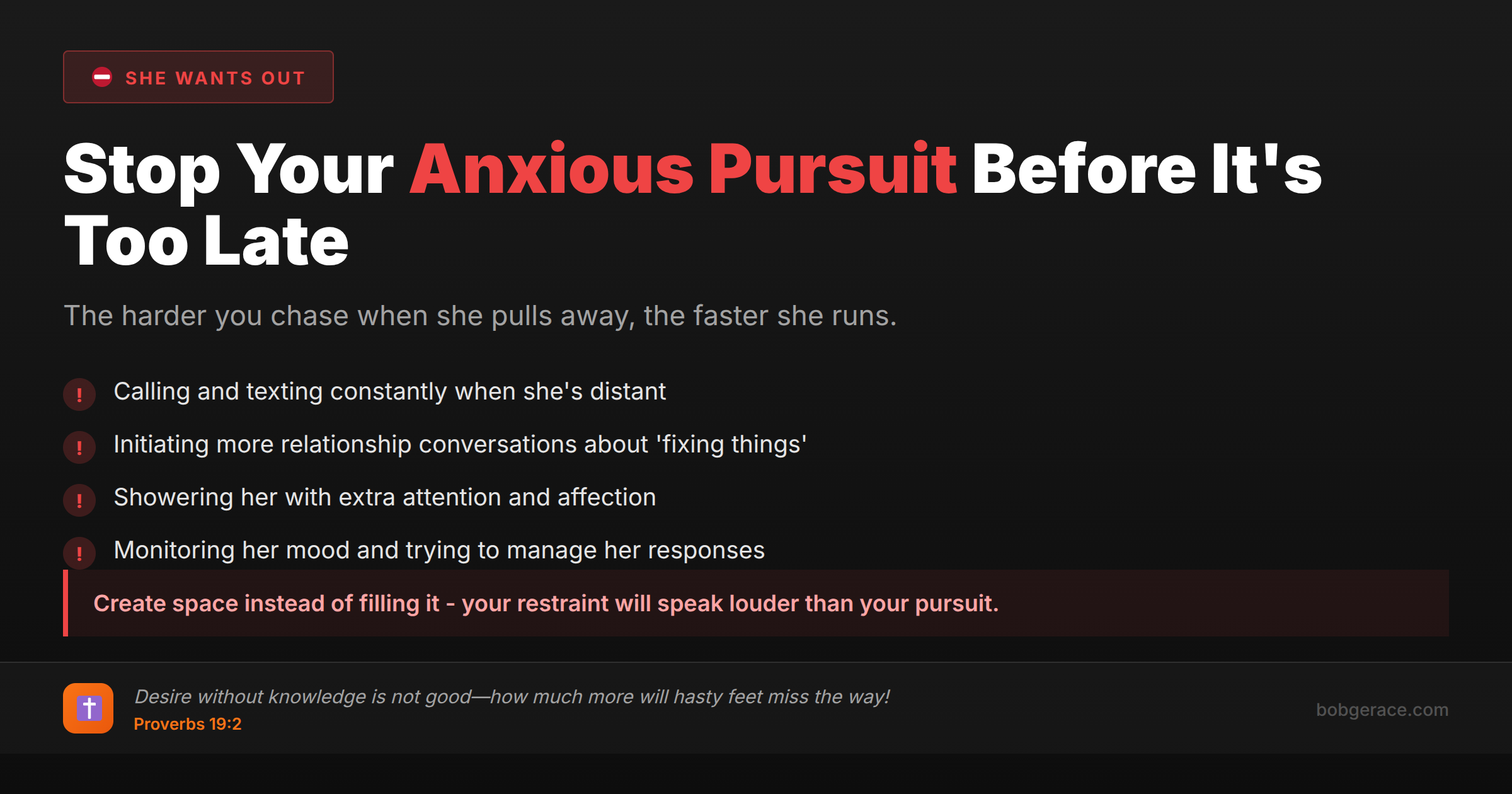
Anxious protest behavior is what happens when you sense your wife pulling away and you respond by pursuing harder - calling more, texting constantly, initiating more conversations about the relationship, or trying to 'fix' things through increased attention and affection. It's your attachment system going into overdrive, desperately trying to reconnect. Here's the brutal truth: if you're reading this question, you're probably doing it. Most men whose wives want space fall into this trap because it feels logical - if she's distant, shouldn't more love and attention bring her back? But anxious protest behavior creates the opposite effect, pushing her further away and confirming her belief that space is exactly what she needs.
The Full Picture
Anxious protest behavior stems from your attachment system activating under threat. When you sense disconnection from your wife, your brain triggers the same response it would to any survival threat - panic, desperation, and hypervigilance.
Common signs you're in anxious protest mode: • Texting her multiple times when she doesn't respond quickly • Asking repeatedly "Are we okay?" or "What's wrong?" • Initiating more physical affection when she's already pulling back • Analyzing every conversation for signs of rejection • Bringing up relationship problems more frequently • Feeling compelled to "fix" things immediately • Following her around the house trying to connect
This behavior makes perfect sense from a biological standpoint. Your nervous system interprets her distance as abandonment and floods you with stress hormones. You're not weak or pathetic - you're human.
But here's what's happening on her end: your increased pursuit confirms her need for space. She's already feeling suffocated or overwhelmed, and your anxious responses prove her point. The more you chase, the more justified she feels in running.
The cruel irony is that anxious protest behavior destroys the very thing you're trying to preserve. Your desperation to connect creates more disconnection. Your attempts to show love feel like pressure to her. Your need for reassurance becomes another burden she carries.
Understanding this dynamic is the first step to breaking it. Recognition allows you to interrupt the pattern before it spirals.
What's Really Happening
From a clinical perspective, anxious protest behavior represents an activated attachment system responding to perceived threat. Attachment theory, developed by John Bowlby, explains that humans have an innate drive to maintain close bonds with significant others, and when those bonds feel threatened, we engage in protest behaviors.
What's fascinating is that anxious protest follows a predictable escalation pattern: first comes increased attention-seeking, then more intense emotional displays, followed by desperate attempts at reconciliation, and finally, if unsuccessful, a shift toward anger or withdrawal.
Neurobiologically, your amygdala hijacks your prefrontal cortex during these episodes. The emotional brain takes over, making rational responses nearly impossible. This is why logical discussions about 'giving space' often fail in the moment - you're literally not operating from your thinking brain.
Research shows that anxious attachment styles are particularly vulnerable to this pattern. If you experienced inconsistent caregiving as a child, your nervous system learned to escalate behaviors to get needs met. This same pattern now activates with your wife.
The pursuer-distancer dynamic creates what therapists call a 'negative feedback loop.' Your pursuit triggers her avoidance, which triggers more pursuit, creating an escalating cycle of disconnection.
Clinical intervention focuses on nervous system regulation first, then cognitive awareness, and finally behavioral change. You can't think your way out of an activated attachment system - you must learn to calm your nervous system before implementing new responses.
Understanding that this is neurobiological, not character-based, helps reduce shame and creates space for compassionate self-awareness and genuine change.
What Scripture Says
Scripture addresses anxious pursuit and relational desperation with profound wisdom. Proverbs 19:2 reminds us: "Desire without knowledge is not good—how much more will hasty feet miss the way!" Your desire to reconnect isn't wrong, but pursuing without understanding her need for space leads you off course.
1 Peter 3:7 instructs husbands to "live with your wives in an understanding way," which means learning to read her signals correctly rather than projecting your needs onto her. When she pulls back, understanding demands space, not more pursuit.
The principle of self-control appears throughout Scripture. Galatians 5:22-23 lists it as fruit of the Spirit: "But the fruit of the Spirit is love, joy, peace, forbearance, kindness, goodness, faithfulness, gentleness and self-control." Anxious protest behavior lacks this self-control, driven by fear rather than Spirit-led wisdom.
Philippians 4:19 declares: "And my God will meet all your needs according to the riches of his glory in Christ Jesus." Your desperate pursuit suggests you're looking to your wife to meet needs that only God can fulfill. This puts unbearable pressure on your marriage.
Isaiah 30:15 offers the antidote to anxious striving: "In repentance and rest is your salvation, in quietness and trust is your strength, but you would have none of it." God calls you to find strength in stillness, not frantic pursuit.
Finally, 1 Corinthians 13:5 reminds us that love "does not insist on its own way." True love sometimes means stepping back, giving space, and trusting God with outcomes rather than trying to control through increased pursuit.
What To Do Right Now
-
1
Stop all pursuit behaviors immediately - no extra texts, calls, or relationship conversations
-
2
Create a 24-hour rule before responding to any urge to reconnect or seek reassurance
-
3
Practice deep breathing when you feel the urge to pursue - 4 counts in, hold for 4, out for 6
-
4
Write down your anxious thoughts instead of voicing them to her
-
5
Focus on your own activities and interests rather than monitoring her mood or responses
-
6
Pray or meditate when you feel panic about the relationship instead of reaching out to her
Related Questions
- I'm panicking and want to pursue her — is that my attachment style?
- Why does my pursuing make her pull away more?
- What's the pursue-withdraw cycle and how do I stop it?
- What does 'protest behavior' look like and am I doing it?
- Should I give her space or fight for her?
- What's the difference between pursuing and chasing?
- Why do I hurt the person I'm trying to keep?
- What does anxious attachment anger look like?
- Is my anger an attachment cry gone wrong?
Also find Bob on
Subscribe for weekly videos on Christian marriage.
You Need a Coach on This Today
If you're chasing and she's pulling away, the next 30 days matter. A coach who knows your specific situation can help you stop the pattern that's pushing her out the door.
Talk to Bob →