How do I show love without activating her withdrawal?
6 min read
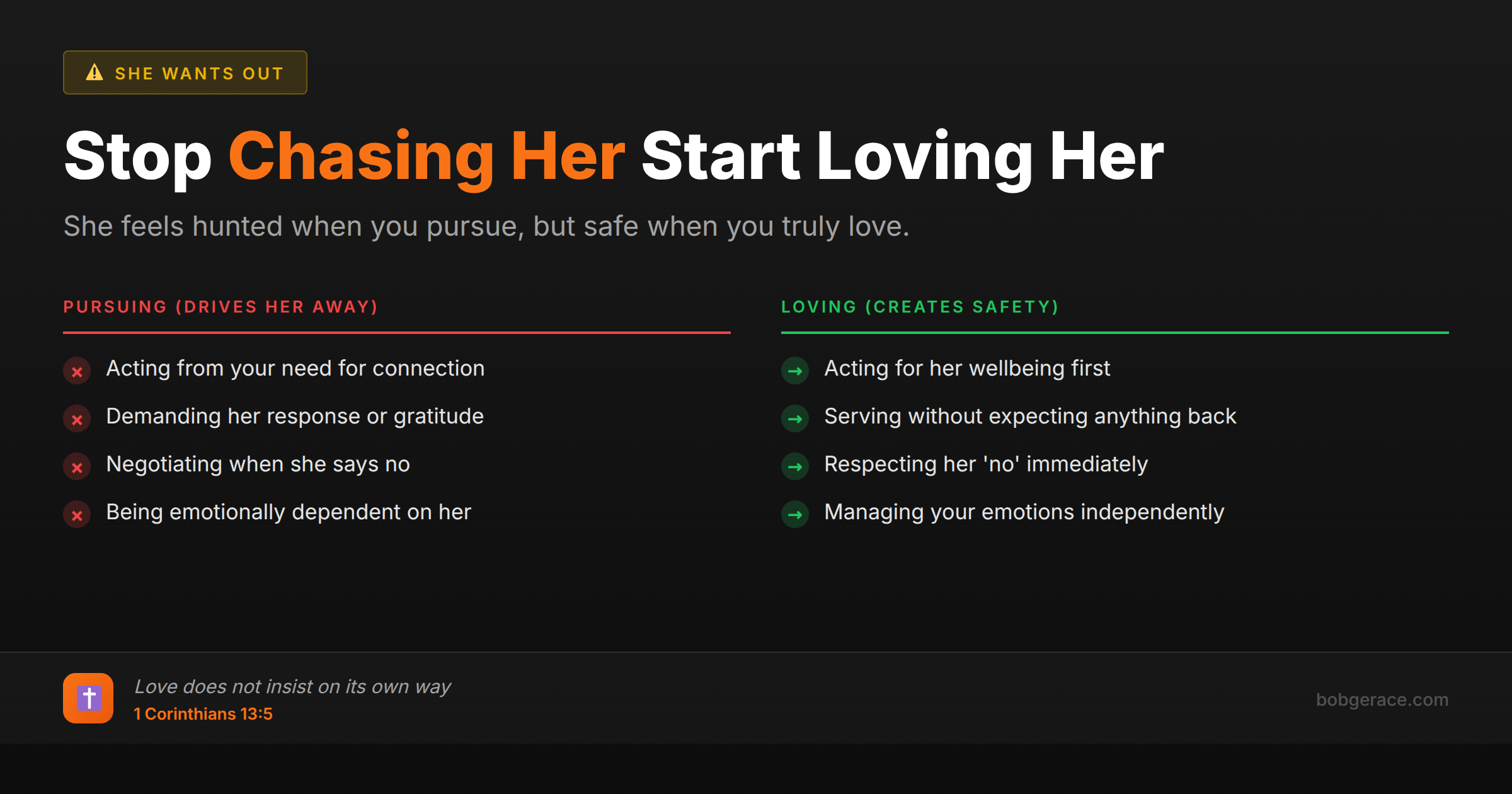
The key is understanding the difference between pursuing and loving. Pursuit is about your need - your need for connection, validation, or relief from anxiety. Love is about her wellbeing. When you pursue, she feels hunted. When you love, she feels safe. Start by asking yourself before every interaction: 'Is this about my need or her wellbeing?' If it's your need driving the action, pause. True love creates space for her to breathe and choose. This doesn't mean becoming cold or distant - it means becoming secure enough in yourself that your love isn't desperate or demanding. The irony is that when you stop pursuing love, you often create the conditions where love can actually grow.
The Full Picture
Most men confuse love with pursuit, and this confusion destroys what they're trying to save. When your wife withdraws and you respond by trying harder to show love, you're actually feeding the very dynamic that's pushing her away.
Here's what pursuit disguised as love looks like: • Bringing her coffee when she's clearly wanting space • Saying 'I love you' and waiting for her response • Planning romantic gestures when she's asked for time • Touching or hugging when her body language says no • Asking 'How are we doing?' repeatedly
These actions feel loving to you, but they feel suffocating to her because they're driven by your anxiety, not her needs.
Real love in this season looks different: • Noticing she needs space and giving it without drama • Handling your own emotions instead of making them her problem • Being genuinely interested in her wellbeing without agenda • Respecting her 'no' the first time • Working on yourself instead of the relationship
The hardest part? Your anxious attachment system will scream that this approach means you don't care. That's the lie. Caring enough to give someone what they actually need, even when it's not what you want to give, is the deepest form of love. When you can love without needing something back immediately, you stop being a source of pressure and become a source of safety.
What's Really Happening
What we're seeing here is a classic pursuer-distancer dynamic that gets intensified when one partner is already in withdrawal mode. The neuroscience is clear: when someone feels pursued or pressured, their autonomic nervous system activates a threat response, even if the 'threat' is someone trying to love them.
The woman's brain is essentially saying 'I need space to regulate' while the man's brain is saying 'I need connection to regulate.' This creates a neurological mismatch where both people are trying to meet their nervous system needs in ways that dysregulate their partner.
Research on attachment styles shows us that anxious attachment (common in pursuers) is characterized by hyperactivation of the attachment system - constantly scanning for threats to the relationship and responding with more connection-seeking behaviors. But when the other person is already overwhelmed, these behaviors trigger their deactivation strategies - emotional and physical withdrawal.
The key intervention is helping the pursuing partner develop what we call secure functioning - the ability to remain emotionally regulated and connected to their own worth independent of their partner's response. This isn't about becoming detached; it's about becoming securely attached to yourself first.
When a man can show love from a place of emotional regulation rather than dysregulation, it completely changes the neurological impact on his wife. Instead of triggering her threat detection system, it allows her nervous system to begin settling, which is the prerequisite for any genuine reconnection.
What Scripture Says
Scripture gives us profound wisdom about love that isn't driven by our own needs. 1 Corinthians 13:5 tells us that love 'does not insist on its own way' - which means real love sometimes looks like not giving what we want to give, but what the other person needs to receive.
Philippians 2:3-4 instructs us to 'do nothing from selfish ambition or conceit, but in humility count others more significant than yourselves. Let each of you look not only to his own interests, but also to the interests of others.' When your wife is withdrawing, her interest is space and safety. Honoring that is biblical love.
1 Peter 3:7 calls husbands to live with their wives 'in an understanding way, showing honor to the woman as the weaker vessel.' This isn't about physical weakness - it's about understanding and honoring her emotional needs, even when they conflict with yours.
Galatians 5:13 reminds us that we were 'called to freedom' and should 'through love serve one another.' True service means giving what serves her wellbeing, not what serves your anxiety.
The ultimate model is Christ's love for the church. Ephesians 5:25 doesn't call husbands to pursue their wives desperately, but to love them 'as Christ loved the church and gave himself up for her.' Christ's love was sacrificial - He gave up His own needs for her good. Sometimes loving your wife means giving up your need for immediate connection so she can heal.
Romans 12:10 calls us to 'outdo one another in showing honor.' In this season, showing honor might mean honoring her request for space more than your need for closeness.
What To Do Right Now
-
1
Stop and ask yourself before every interaction: 'Is this about my need or her wellbeing?'
-
2
Create a daily practice of managing your own emotions without involving her
-
3
Respect her 'no' immediately without negotiating, explaining, or asking why
-
4
Show love through practical service that doesn't require her response or gratitude
-
5
Develop your own life, interests, and relationships so you're not emotionally dependent on her
-
6
When you feel the urge to pursue, redirect that energy into prayer, exercise, or calling a friend
Related Questions
- Should I give her space or fight for her?
- What's the difference between presence and pressure?
- How do I fight without pushing her away?
- What is 'anxious protest behavior' and am I doing it?
- Why does my instinct to pursue backfire?
- What does healthy pursuit look like vs. desperate pursuit?
- What is the 'pursuer-distancer' dynamic?
- How do I pursue without pressuring?
- What does 'protest behavior' look like and am I doing it?
- How do I stay connected while enforcing boundaries?
Also find Bob on
Subscribe for weekly videos on Christian marriage.
You Don't Have to Figure This Out Alone
Coaching means a human who knows your specific marriage—what's working, what's backfiring, where you're stuck. Bob calibrates to your situation, not a script.
Talk to Bob →