What's the difference between space to heal and space to exit?
6 min read
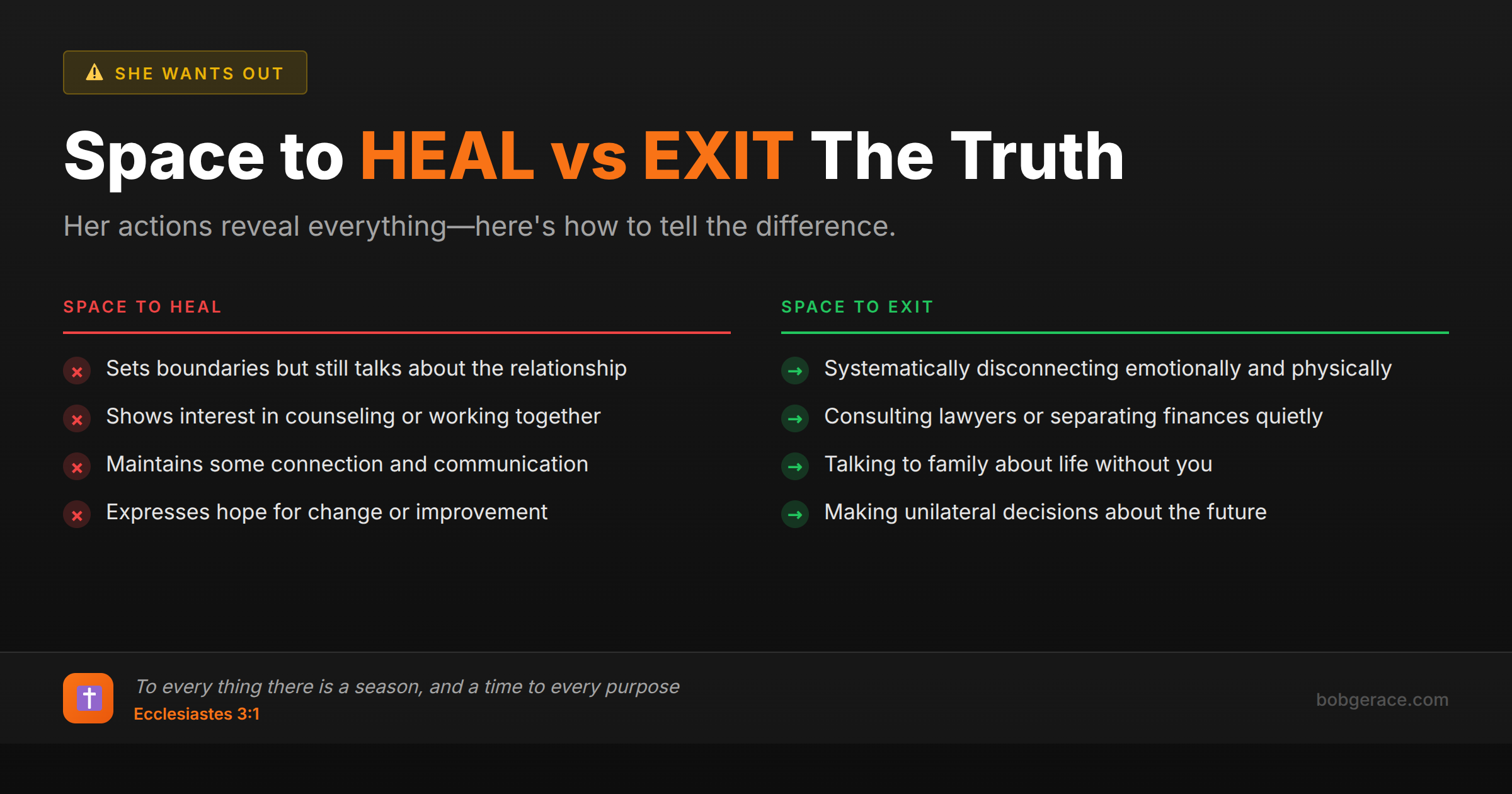
The difference between space to heal and space to exit isn't always in her words—it's in her actions and intentions. Space to heal involves temporary distance while maintaining connection and working toward solutions. Your wife might set boundaries but still engages in conversations about the relationship, shows interest in counseling, or expresses hope for change. Space to exit, however, is emotional and often legal preparation for leaving. She's disconnecting systematically, consulting lawyers, separating finances, or talking to friends and family about life without you. The brutal truth? Many men miss these signals because they're focused on what they want to hear rather than what's actually happening. Understanding which type of space she's seeking determines everything about how you should respond.
The Full Picture
Space to heal is a therapeutic timeout. Your wife is overwhelmed, hurt, or exhausted, but hasn't given up on the marriage. She might say things like "I need time to think" or "I can't do this right now, but I'm not saying never." She's looking for relief from conflict while keeping the door open for reconnection. You'll notice she still wears her ring, mentions future plans that include you, or agrees to structured check-ins.
Space to exit is different entirely. This is when she's mentally and emotionally divorced you already. The physical separation is just catching up to her internal reality. She might use similar language—"I need space"—but her actions tell a different story. She's researching apartments, opening separate bank accounts, or having conversations with divorce attorneys.
Here's what most men miss: the timeline matters. If she's asked for space multiple times over months or years, and nothing has fundamentally changed, she's likely moved from healing space to exit space. Each failed attempt at reconciliation pushes her further toward the door.
The quality of communication during separation is another major indicator. Healing space includes difficult but honest conversations about problems and solutions. Exit space involves surface-level logistics and emotional detachment. She stops fighting about the relationship because she's already left mentally.
Boundary setting also looks different. Healing boundaries are about creating safety: "I need you to stay in the guest room while we work on this." Exit boundaries are about creating distance: "Don't contact me except about the kids." One invites eventual intimacy; the other prevents it.
Understand this: you can't love someone out of exit space. If she's there, your job isn't to convince her to stay—it's to become the man she'd want to come back to, if she ever chooses to.
What's Really Happening
From a therapeutic perspective, these two types of space represent vastly different psychological states. When seeking healing space, a spouse is experiencing what we call ambivalent attachment—they're hurt but haven't severed the emotional bond. Their nervous system is dysregulated from chronic conflict, but they retain hope for repair. This manifests as approach-avoidance behavior: pushing away while simultaneously testing if their partner will fight for the relationship.
Exit space, however, indicates emotional detachment has occurred. Research by Dr. John Gottman shows that emotional withdrawal—what he calls "stonewalling"—is one of the strongest predictors of divorce. When someone moves into exit space, they've typically experienced what psychologists call emotional flooding repeatedly without adequate repair. Their nervous system has essentially shut down the attachment system as a protective mechanism.
The neurobiological difference is significant. In healing space, the person's brain is still responsive to positive changes and gestures from their partner. Mirror neurons are active, allowing for empathy and connection. In exit space, the brain has shifted into self-protection mode. The prefrontal cortex—responsible for long-term thinking and pair bonding—becomes less active, while the limbic system prioritizes individual survival.
Attachment theory provides another lens. Healing space often involves protest behaviors—the attachment system is activated and seeking reconnection through conflict or demands. Exit space represents detachment—the attachment system has deactivated to prevent further injury. This is why logic, pleading, or grand gestures often fail during exit space; you're trying to reach a system that's gone offline.
Clinically, I observe that partners in healing space respond to consistent, small changes over time. Those in exit space require significant systemic transformation and often need to see evidence of change through third parties rather than direct experience, as their trust in the relationship itself has been compromised.
What Scripture Says
Scripture addresses both the heart behind seeking space and our response to it. Ecclesiastes 3:1 reminds us, "To every thing there is a season, and a time to every purpose under the heaven." Sometimes space serves God's purposes of restoration, other times it reveals the true condition of a heart.
When your wife seeks healing space, consider Hosea 2:14: "Therefore, behold, I will allure her, and bring her into the wilderness, and speak comfortably unto her." God sometimes uses separation to create conditions for renewed intimacy. Like Israel needed wilderness time to remember their first love, your marriage might need temporary distance to rediscover what was lost.
However, we must also recognize when someone's heart has grown hard. Matthew 19:8 shows Jesus acknowledging that Moses permitted divorce "because of the hardness of your hearts." Not all separation leads to restoration. Some people's hearts become so hardened that they cannot receive love, correction, or healing.
Your response should reflect 1 Corinthians 13:4-7: "Charity suffereth long, and is kind... beareth all things, believeth all things, hopeth all things, endureth all things." Whether she's seeking healing space or exit space, your character remains the same. Love doesn't manipulate or force; it creates conditions where healing is possible while respecting the other person's choices.
Proverbs 27:14 warns against overwhelming pursuit: "He that blesseth his friend with a loud voice, rising early in the morning, it shall be counted a curse to him." Sometimes our attempts to love actually push people further away. Wisdom knows when to pursue and when to step back.
Finally, 1 Peter 3:1 speaks to influencing others "without the word" through our conduct. Whether your wife returns or not, God calls you to become the man He created you to be. Your transformation serves His purposes regardless of her response.
What To Do Right Now
-
1
Assess the evidence objectively by listing her specific actions (not words) over the past 30 days
-
2
Stop all pursuit behaviors immediately—no texts asking how she's doing, no surprise visits, no grand gestures
-
3
Focus intensively on your own healing and growth rather than monitoring her movements or emotions
-
4
Establish clear boundaries about what you will and won't accept during this separation period
-
5
Seek professional guidance from both a therapist and a lawyer to understand your options completely
-
6
Begin building the life and character you should have regardless of whether she returns
Related Questions
- Should I give her space or fight for her?
- How much space is too much?
- What does 'space' actually mean to her?
- If I give space, won't she think I don't care?
- Is trial separation ever a good idea?
- What factors make separation helpful vs. harmful?
- What boundaries should I set?
- What's the difference between boundary and ultimatum?
- How do I not pursue while also not abandoning?
- What does 'detach with love' actually mean?
Also find Bob on
Subscribe for weekly videos on Christian marriage.
Get a Coach Who Knows Your Marriage
You don't have to decode her signals alone. A coach who hears your specific situation can help you see what's actually happening and what to do next.
Talk to Bob →