What does research say about trial separation outcomes?
6 min read
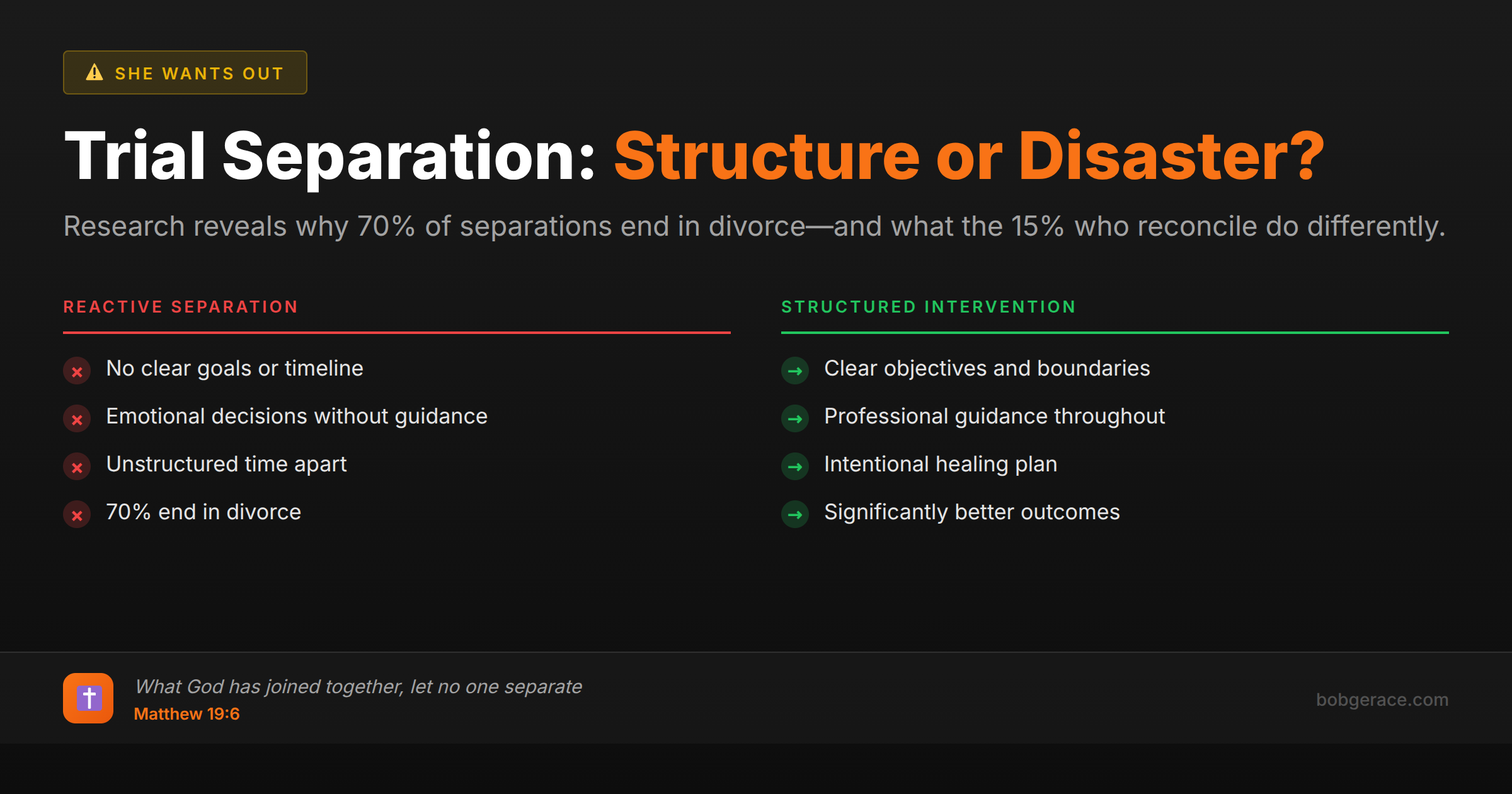
Research shows trial separations produce mixed outcomes, with roughly 10-15% of couples reconciling successfully, 60-70% proceeding to divorce, and 15-25% remaining separated indefinitely. The key factor isn't the separation itself—it's what happens during it. Couples who use separation as a structured intervention with clear goals, professional guidance, and agreed-upon boundaries have significantly better outcomes than those who separate reactively without a plan. The research is clear: separation without intentionality typically accelerates divorce rather than healing the marriage.
The Full Picture
The research on trial separations paints a sobering picture that every man considering this path needs to understand. The majority of trial separations don't save marriages—they end them faster. Studies consistently show that couples who separate are 2-3 times more likely to divorce within two years compared to couples who stay together and work through their problems.
However, this statistic includes many separations that were essentially soft divorces—situations where one spouse had already emotionally checked out. When we look specifically at structured separations with therapeutic guidance, the outcomes improve dramatically.
What makes the difference? • Clear agreements about finances, children, and contact • Professional guidance from a qualified therapist or coach • Specific goals and timeline for the separation • Both parties committed to working on themselves and the relationship • Regular check-ins to assess progress
The research reveals that men often view separation as a "wake-up call" opportunity, while women frequently see it as the first step toward divorce. This fundamental difference in perception significantly impacts outcomes. Studies show that when wives initiate separation, they've typically been emotionally disconnected for months or years beforehand.
Time matters. Separations lasting longer than 12-18 months rarely result in reconciliation. The sweet spot appears to be 3-6 months with intensive work during that period. Beyond 18 months, couples tend to build separate lives that become increasingly difficult to merge back together.
What's Really Happening
From a clinical perspective, trial separations often reflect what we call approach-avoidance conflict—one partner wants closeness while fearing engulfment, the other wants space while fearing abandonment. Research in attachment theory shows this dynamic typically intensifies during separation rather than resolving.
The neurobiological reality is that separation triggers our primitive threat-detection systems. The anxiously attached partner (often the husband) experiences activation of the same brain regions associated with physical pain. Meanwhile, the avoidantly attached partner (often the wife at this point) feels temporary relief but may unconsciously begin building walls to prevent re-injury.
Studies using brain imaging show that sustained separation actually rewires neural pathways, making reconnection more difficult over time. This is why the timeline matters so much—we have a narrow window before new patterns become entrenched.
Gottman's research indicates that couples who successfully reconcile after separation share specific characteristics: they maintain some positive sentiment override, they're both willing to take responsibility for their contributions to problems, and they engage in what he calls "turning toward" behaviors even during the separation.
The clinical data also reveals that unstructured separations often become laboratories for justifying divorce. Without clear boundaries and goals, individuals tend to collect evidence that confirms their decision to leave rather than evidence that supports reconciliation. This confirmation bias becomes a self-fulfilling prophecy.
Most importantly, research shows that the quality of individual therapy during separation is highly predictive of outcomes. Couples where both partners engage in meaningful personal work show reconciliation rates of 40-50%, compared to 10-15% when there's no professional intervention.
What Scripture Says
While the Bible doesn't explicitly address "trial separations" as we know them today, it provides clear principles about marriage, reconciliation, and restoration that apply directly to this situation.
Matthew 19:6 reminds us: "So they are no longer two, but one flesh. Therefore what God has joined together, let no one separate." This verse establishes God's heart for marriage unity, suggesting that separation should never be entered into lightly or without serious purpose.
1 Corinthians 7:10-11 specifically addresses separation: "To the married I give this command (not I, but the Lord): A wife must not separate from her husband. But if she does, she must remain unmarried or else be reconciled to her husband." This passage acknowledges that separation sometimes happens while maintaining God's preference for reconciliation.
Ephesians 4:26-27 offers wisdom about managing conflict: "In your anger do not sin: Do not let the sun go down while you are still angry, and do not give the devil a foothold." Extended separation without resolution can indeed give the enemy opportunity to further damage the marriage.
The principle of restoration is central to the Gospel message. Galatians 6:1 instructs: "Brothers and sisters, if someone is caught in a sin, you who live by the Spirit should restore that person gently." This applies to how we approach a struggling marriage—with gentleness and a heart toward restoration.
2 Corinthians 5:18-20 calls us to be ministers of reconciliation. If separation occurs, it should be used as a tool for reconciliation, not as preparation for permanent division. The biblical framework suggests that any separation should have restoration as its ultimate goal, with clear steps toward healing and unity.
What To Do Right Now
-
1
Research the specific outcomes and statistics for structured vs. unstructured separations in your area
-
2
Identify three qualified marriage therapists or coaches who specialize in separation interventions
-
3
Document your wife's stated reasons for wanting separation and assess which are addressable
-
4
Create a preliminary structure for what a 'trial separation' would look like with clear goals and timeline
-
5
Examine whether separation is truly necessary or if intensive marriage work could achieve the same goals
-
6
Assess your own readiness to do deep personal work during any separation period
Related Questions
- She wants separation — should I agree?
- What percentage of separations end in divorce?
- What factors make separation helpful vs. harmful?
- What is 'structured separation' and does it work?
- What's the difference between space to heal and space to exit?
- How do I avoid 'separation drift'?
- Can a marriage survive infidelity?
- How long does recovery take?
- What does real transformation look like?
- What percentage of marriages recover from this point?
Also find Bob on
Subscribe for weekly videos on Christian marriage.
Your Separation Needs a Strategy
The next 30 days will shape whether this separation leads to reconciliation or divorce. A coach who knows your specific situation can help you structure this time instead of drifting through it.
Talk to Bob →