What factors make separation helpful vs. harmful?
5 min read
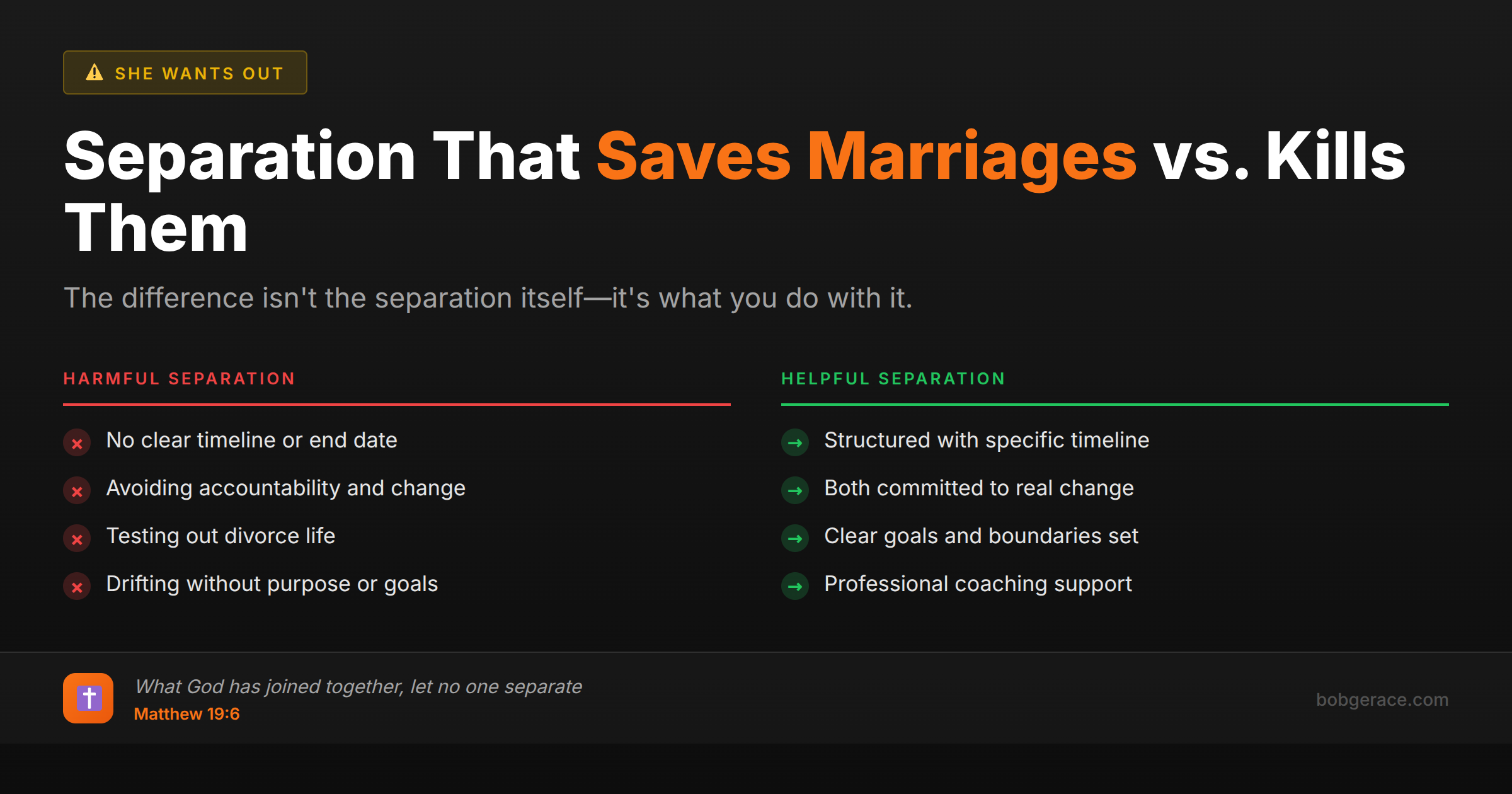
Separation becomes helpful when it's structured, time-limited, and focused on specific changes rather than an escape route. The key difference isn't the separation itself—it's what you do with it. Helpful separations have clear boundaries, defined goals, and both spouses committed to working toward reconciliation. They create space for real change, not just relief from conflict. Harmful separations happen when there's no structure, no timeline, and no commitment to change. When separation becomes a way to 'try out' divorce or avoid accountability, it usually accelerates the marriage's death. The research is clear: separations that drift without purpose almost always lead to divorce. But structured separations with coaching support can actually save marriages that seemed hopeless.
The Full Picture
The difference between helpful and harmful separation comes down to intention, structure, and commitment to change. Research shows that only 13% of separated couples reconcile without intervention, but that number jumps dramatically when specific factors are in place.
Helpful Separation Factors: • Clear time limits (typically 3-6 months maximum) • Defined goals for what each person will work on • Regular check-ins and progress reviews • Professional guidance from a coach or counselor • Maintained connection through scheduled contact • Commitment to the process from both spouses • Focus on personal growth, not blame or punishment
Harmful Separation Factors: • Open-ended timeline with no defined end • Vague or no goals for reconciliation • Complete no-contact that builds walls instead of bridges • Using separation to date others or 'test the waters' • Lack of accountability or professional support • Focus on relief rather than resolution • One spouse using it as a soft launch to divorce
The biggest mistake I see men make is agreeing to separation without structure. They think giving their wife 'space' will magically fix things. It won't. Space without purpose becomes distance. Distance becomes indifference. Indifference becomes divorce papers.
Successful separations require both spouses to lean into discomfort and do the hard work of change. If your wife wants separation to avoid working on the marriage, that's a red flag. If she wants separation to create space for both of you to become better people, that's potentially helpful—but only with the right framework.
What's Really Happening
From a therapeutic perspective, separation can serve as what we call a 'therapeutic interruption'—breaking destructive patterns that have become entrenched in the relationship system. However, the research on separation outcomes reveals critical factors that determine success.
Studies by Gottman and others show that structured separations with therapeutic support can be effective when couples are caught in high-conflict cycles. The key is that separation must interrupt negative patterns, not reinforce avoidance behaviors. When couples use separation as a way to avoid difficult conversations or personal accountability, it typically strengthens avoidant attachment styles and makes reconciliation less likely.
Neurologically, separation triggers the threat detection system in both partners' brains. Without structure and reassurance, this activates fight-or-flight responses that make rational problem-solving nearly impossible. This is why open-ended separations often fail—the brain interprets the ambiguity as danger and begins preparing for permanent loss.
Attachment theory helps us understand why some separations heal and others harm. Securely attached couples can use separation as a reset button, maintaining emotional connection while addressing specific issues. But for couples with anxious or avoidant attachment patterns, unstructured separation often reinforces their deepest fears and defensive strategies.
The most successful separations I've observed include weekly structured conversations where couples practice new communication skills, individual therapy to address personal contributions to the marital problems, and clear behavioral contracts outlining what changes each person will make. Without these elements, separation becomes what researchers call 'divorce rehearsal'—gradually acclimating both partners to life without each other.
What Scripture Says
Scripture doesn't explicitly address modern marital separation, but it provides clear principles about marriage, conflict resolution, and restoration that apply directly to this decision.
Matthew 19:6 reminds us: *'So they are no longer two, but one flesh. Therefore what God has joined together, let no one separate.'* This doesn't mean separation is always wrong, but it establishes that the goal should always be restoration of unity, not permanent division.
1 Corinthians 7:10-11 directly addresses separation: *'To the married I give this command (not I, but the Lord): A wife must not separate from her husband. But if she does, she must remain unmarried or else be reconciled to her husband.'* Paul acknowledges that separation sometimes happens while emphasizing that reconciliation remains the biblical goal.
Matthew 18:15-17 gives us the framework for addressing conflict: *'If your brother or sister sins, go and point out their fault, just between the two of you. If they listen to you, you have won them over.'* This suggests that separation should only come after direct communication attempts, not as a first response to marital problems.
Galatians 6:1 instructs: *'Brothers and sisters, if someone is caught in a sin, you who live by the Spirit should restore that person gently.'* The heart behind biblical separation should be restoration, not punishment. If separation becomes a way to inflict pain rather than promote healing, it contradicts this principle.
Ephesians 4:26-27 warns: *'In your anger do not sin: Do not let the sun go down while you are still angry, and do not give the devil a foothold.'* Unstructured separation can give bitterness and resentment time to take root. Biblical separation requires intentional work toward forgiveness and resolution, not just time apart.
What To Do Right Now
-
1
Assess whether separation is being proposed as avoidance or intervention—demand specific goals and timelines
-
2
Insist on professional guidance from a marriage coach or counselor who believes in restoration
-
3
Establish clear boundaries including communication schedule, financial arrangements, and child custody
-
4
Create written agreements about what each spouse will work on during separation
-
5
Schedule weekly check-ins to assess progress and maintain connection
-
6
Set a firm end date for evaluation—never agree to open-ended separation
Related Questions
- She wants separation — should I agree?
- What is 'structured separation' and does it work?
- What boundaries make separation therapeutic?
- What's the difference between space to heal and space to exit?
- Is trial separation ever a good idea?
- What does research say about trial separation outcomes?
- Should I give her space or fight for her?
- What boundaries should I set?
- What's the difference between boundary and ultimatum?
- How do I not pursue while also not abandoning?
Also find Bob on
Subscribe for weekly videos on Christian marriage.
Your separation needs a plan today
Structure matters more than time apart. A coach who knows your marriage can build the framework that keeps this from drifting into divorce.
Talk to Bob →