How do I hold both my responsibility and her agency?
6 min read
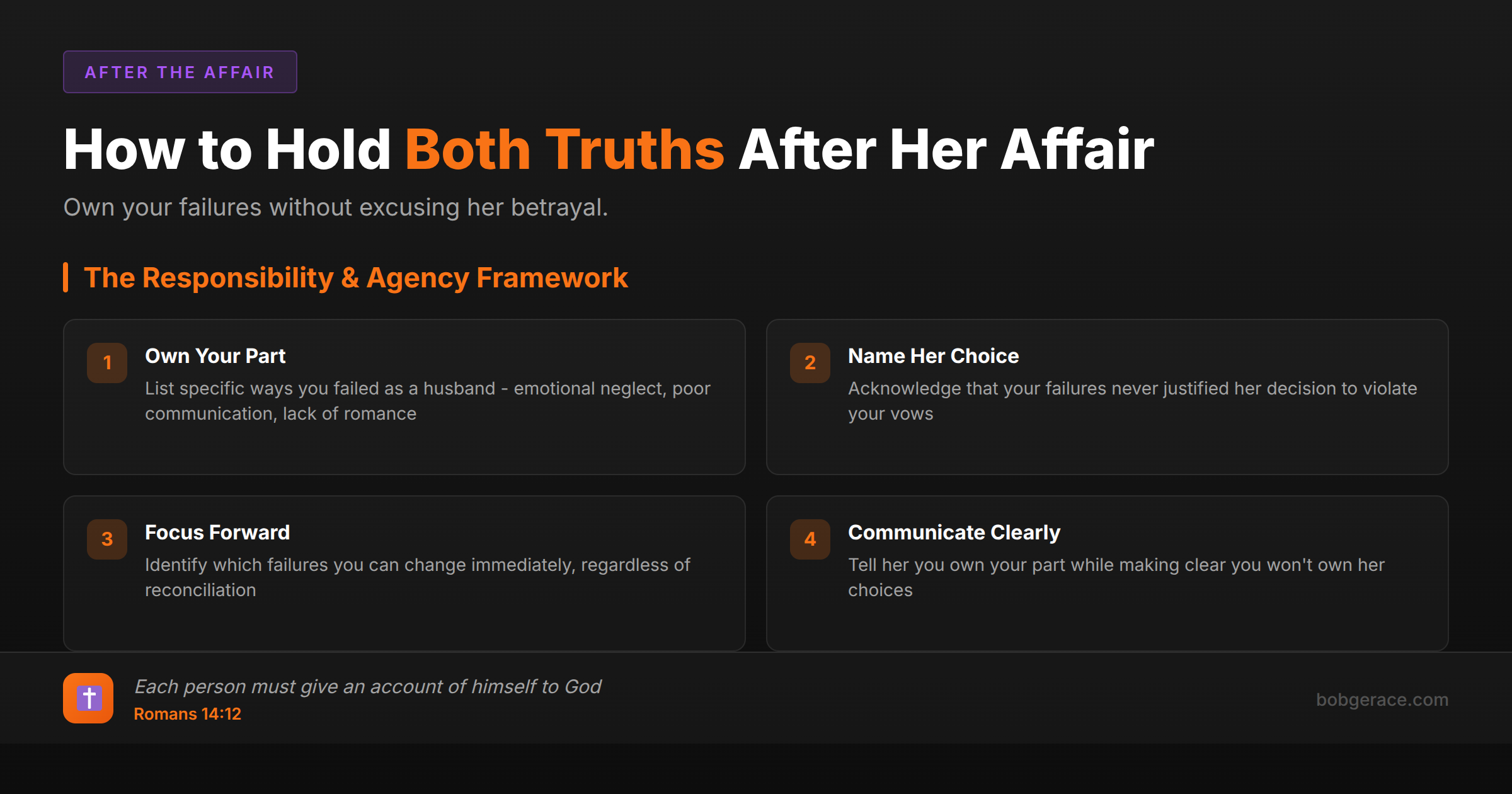
This tension between taking responsibility and respecting her agency is one of the hardest parts of affair recovery. You need to own your contributions to the marriage problems without taking responsibility for her choices. Your responsibility includes examining how you may have neglected the marriage, failed to meet emotional needs, or created distance. Her agency means she chose how to respond to those issues - and that choice was hers alone. The key is holding both truths simultaneously: you likely played a role in creating vulnerabilities in your marriage AND she made the choice to violate your vows. Taking responsibility for your part opens the door for real change and healing. Respecting her agency means not excusing her behavior while still working on yourself.
The Full Picture
When your wife has had an affair, you're caught in what feels like an impossible position. Take too much responsibility, and you're essentially excusing her betrayal. Take too little, and you miss the opportunity for real growth and change that could save your marriage.
Here's what I've learned after years of working with couples in crisis: both things can be true at the same time. You can have contributed to problems in your marriage AND she still chose to handle those problems in the worst possible way. These aren't mutually exclusive realities.
Most men I work with swing to one extreme or the other. Either they beat themselves up mercilessly, thinking "If only I had been a better husband, this never would have happened," or they go completely the other direction: "I wasn't perfect, but that doesn't justify what she did."
Both responses miss the mark. The first makes you a doormat who enables bad behavior. the second keeps you from the self-examination that could actually heal your marriage.
The mature response? Own your part completely while refusing to own hers. This means getting brutally honest about where you fell short as a husband - maybe you were emotionally distant, maybe you prioritized work over family, maybe you stopped pursuing her romantically. These things matter. They create vulnerabilities in a marriage.
But here's the crucial distinction: creating vulnerability isn't the same as forcing a choice. She had other options. She could have talked to you directly. She could have insisted on counseling. She could have even separated if things were that bad. Instead, she chose deception and betrayal.
Holding both realities requires emotional maturity most men haven't developed yet. But it's essential for real healing.
What's Really Happening
From a clinical perspective, this question reveals a sophisticated understanding of relationship dynamics that many couples never reach. What you're describing is the difference between contributory factors and causative factors.
Contributory factors are the conditions in your marriage that made an affair more likely - emotional distance, unmet needs, poor communication patterns, lack of intimacy. These are real, and they matter enormously for recovery. Research shows that marriages with certain vulnerabilities are statistically more prone to infidelity.
But contributory factors are not causative factors. The direct cause of the affair was a series of choices your wife made - to engage with another man, to cross boundaries, to maintain secrecy, to continue the relationship despite knowing it was wrong.
This distinction is psychologically crucial for several reasons. First, it prevents you from falling into toxic shame, which would actually hinder your ability to make positive changes. Second, it maintains appropriate boundaries around her accountability, which is essential for genuine reconciliation.
In my practice, I see men who can't hold this tension tend to get stuck. They either become paralyzed by guilt (which helps no one) or they become defensive and resistant to change (which kills any chance of reconciliation).
The healthiest response involves what we call 'differentiated accountability' - taking full ownership of your contributions while maintaining clear boundaries around her choices. This actually creates the best environment for both individual //blog.bobgerace.com/christian-marriage-investment-defense-protect-growth/:growth and potential reconciliation.
What Scripture Says
Scripture gives us a clear framework for holding both responsibility and agency. The principle is simple: we're accountable for our own actions, not others' responses to our actions.
"Each person must give an account of himself to God" (Romans 14:12). This verse cuts both ways - you'll answer for your failures as a husband, and she'll answer for her choices in response to those failures.
"Why do you look at the speck of sawdust in your brother's eye and pay no attention to the plank in your own eye?" (Matthew 7:3). Jesus calls us to ruthless self-examination first. Before you focus on her betrayal, deal with your own contributions to the marriage problems.
But Scripture also upholds personal responsibility for our choices: "The soul who sins is the one who will die" (Ezekiel 18:20). Each person bears the weight of their own moral decisions.
"Above all else, guard your heart, for everything you do flows from it" (Proverbs 4:23). This applies to both of you. You're responsible for guarding your heart and being the husband God calls you to be. She's responsible for guarding hers and choosing fidelity despite whatever problems existed.
The biblical pattern is clear: examine yourself thoroughly ("Search me, God, and know my heart" - Psalm 139:23), confess and change what needs changing, but don't take responsibility for someone else's sin. "Each one should carry their own load" (Galatians 6:5).
This biblical balance creates the foundation for both justice and mercy, accountability and forgiveness.
What To Do Right Now
-
1
Make a list of specific ways you failed as a husband - be brutally honest about emotional neglect, lack of romance, poor communication, etc.
-
2
Separately, acknowledge that none of these failures justified her choice to have an affair - write this down as a clear statement
-
3
Identify which of your failures you can start changing immediately, regardless of whether she chooses reconciliation
-
4
Communicate to her that you take full responsibility for your part while making clear you won't take responsibility for her choices
-
5
Begin making concrete changes in your behavior and character - don't just apologize, demonstrate real growth
-
6
Set boundaries that respect her agency while protecting your own dignity and requiring accountability for reconciliation
Related Questions
- Is she responsible even if I contributed to problems?
- What's the relationship between her sin and my sin?
- What role did our relationship problems play?
- What role did her individual issues play?
- Is it my fault she had an affair?
- What does biblical forgiveness require of me?
- What does 'taking responsibility' actually look like?
- What's the difference between explaining and defending?
- How do I honor her autonomy while fighting for us?
- What does repentance look like for accumulated sin?
Also find Bob on
Subscribe for weekly videos on Christian marriage.
Get a Coach Who Knows Your Marriage
This balance shifts depending on where you are and what she's actually doing. A coach who hears your specific situation can help you calibrate—so you're not guessing alone.
Talk to Bob →