What's the relationship between her sin and my sin?
6 min read
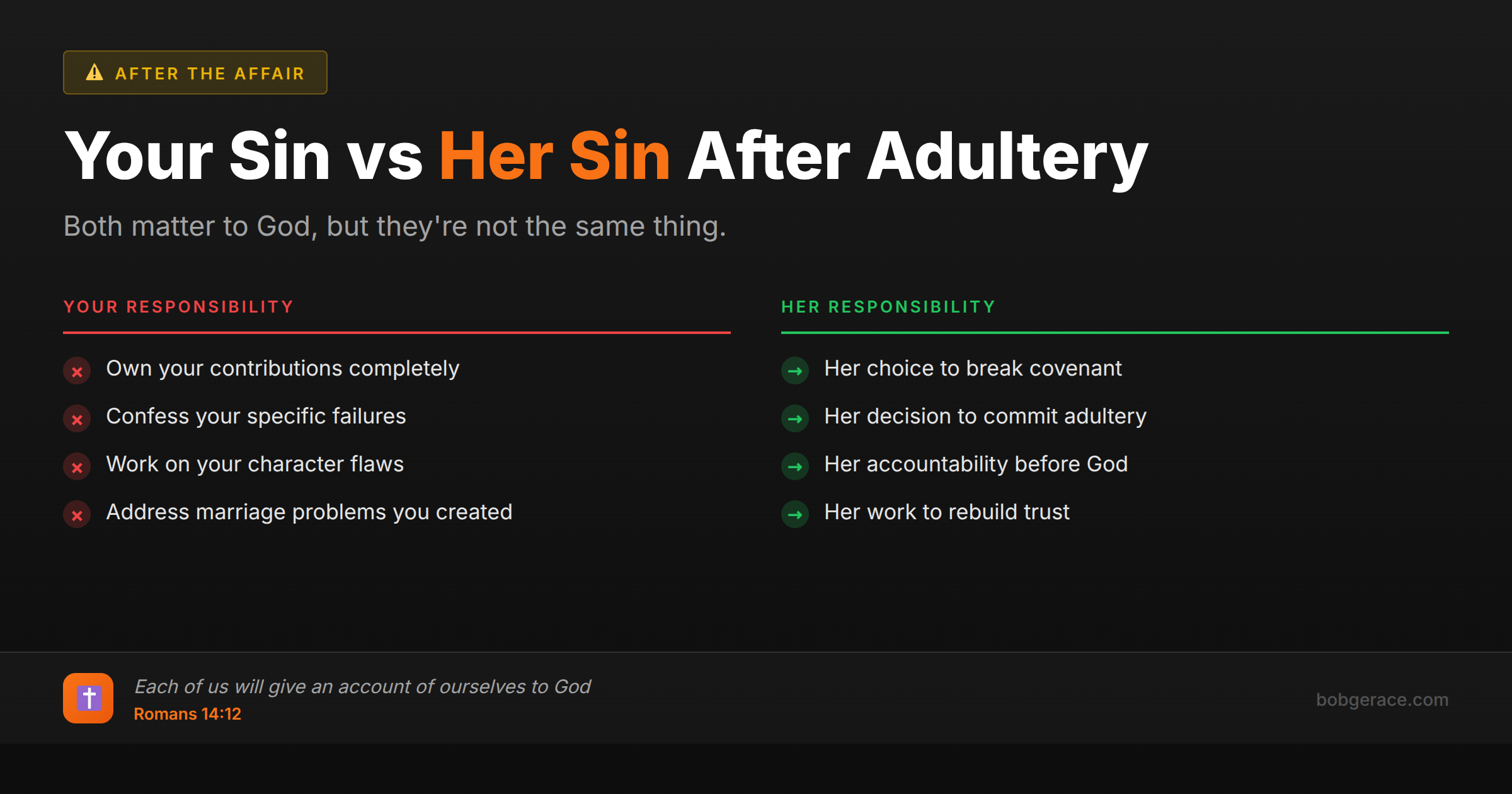
Your sin and her sin are separate moral choices before God, each requiring individual accountability. While marriage creates deep interconnection, adultery is her choice and responsibility - not caused by your failures or shortcomings. However, this doesn't mean your sin doesn't matter or shouldn't be addressed. The relationship between your sins is complex: both contribute to marriage problems, but adultery represents a fundamental covenant breaking that stands apart. Your job isn't to minimize your sin or take responsibility for hers, but to own what's yours completely while holding her accountable for what's hers. This distinction is crucial for healing, reconciliation, and preventing future destruction in your marriage.
The Full Picture
Here's what most men get wrong about sin in marriage after discovering infidelity: they either take responsibility for everything ("If I'd been a better husband, she wouldn't have cheated") or they minimize their own issues completely ("Her affair means I don't need to look at myself"). Both approaches are destructive and biblically wrong.
Your sin didn't cause her adultery. Let me be crystal clear about this. Adultery is a choice. It's a decision to break covenant, violate trust, and pursue selfish desire over commitment. No amount of your failures, neglect, or sin forced her to choose another man. She had dozens of other options: she could have talked to you, sought counseling, confronted you directly, or even separated if things were truly unbearable. She chose adultery instead.
But your sin still matters. The fact that she chose adultery doesn't erase your contributions to marriage problems. Maybe you've been emotionally distant, controlling, neglectful, or struggling with your own issues. These things damaged your marriage and need to be addressed - not because they caused her affair, but because they're sin against God and destructive to your covenant relationship.
Both sins work together to destroy marriages. Think of it like two people throwing rocks at a window. Her adultery might be the rock that finally shatters it, but your ongoing issues may have been creating cracks for years. The window's destruction required both, but each person is responsible only for the rocks they threw.
The goal isn't to weigh sins against each other or determine who's "worse." It's to own your part completely while refusing to own hers. This creates the foundation for real change, genuine repentance, and potential restoration.
What's Really Happening
From a therapeutic standpoint, the question of interconnected sin in marriage reveals deep psychological patterns that must be understood for healing to occur. What I observe consistently is a phenomenon I call "responsibility confusion" - where betrayed spouses either hyper-responsibility (taking blame for everything) or hypo-responsibility (refusing to examine their contribution to marital issues).
The trauma response complicates moral clarity. When men discover infidelity, their brains often enter survival mode. This can manifest as self-blame ("I must have driven her to this") or defensive blame-shifting ("She's the only problem here"). Neither response leads to healing because both distort the actual moral landscape of the marriage.
Codependency often underlies over-responsibility. Men who immediately assume their failures caused the affair usually struggle with codependent patterns. They've learned to manage others' emotions and choices, believing they're responsible for outcomes beyond their control. This isn't humility - it's actually a form of pride that assumes unrealistic power over another person's moral choices.
Individual moral agency remains intact in marriage. While spouses deeply influence each other, each person retains complete responsibility for their choices. Your wife's decision to commit //blog.bobgerace.com/spiritual-adultery-christian-marriage-counterfeits/:adultery was hers alone, made from her own heart condition, values, and character. Understanding this isn't about avoiding responsibility - it's about taking the RIGHT responsibility.
Healing requires separated accountability. Recovery happens when each spouse owns their contributions without taking ownership of their partner's choices. This creates space for genuine repentance, authentic change, and rebuilt trust based on reality rather than false guilt or misplaced responsibility.
What Scripture Says
Scripture is clear about individual moral responsibility while acknowledging the interconnected nature of marriage relationships. Understanding both truths is essential for biblical healing.
Individual accountability before God: *"Each of us will give an account of ourselves to God"* (Romans 14:12). Your wife will answer to God for her adultery, and you'll answer for your sin. These are separate conversations with separate accountability. *"The one who sins is the one who will die. The child will not share the guilt of the parent, nor will the parent share the guilt of the child"* (Ezekiel 18:20).
Sin doesn't excuse sin: *"All have sinned and fall short of the glory of God"* (Romans 3:23). Your sin matters and needs addressing, but it doesn't diminish or excuse her adultery. Two wrongs don't make a right, and her greater wrong doesn't make your wrongs disappear.
Marriage creates deep connection, not moral causation: *"They are no longer two, but one flesh"* (Matthew 19:6). Marriage creates profound spiritual and emotional connection, meaning your sins affect each other deeply. But connection isn't causation. Her response to your sin was still her choice.
Both need repentance: *"If we confess our sins, he is faithful and just and will forgive us our sins and purify us from all unrighteousness"* (1 John 1:9). Focus on confessing YOUR sins to God, not taking responsibility for hers.
Truth and grace work together: *"Instead, speaking the truth in love, we will grow to become in every respect the mature body of him who is the head, that is, Christ"* (Ephesians 4:15). Truth means acknowledging what's yours and what's not. Grace means extending forgiveness while maintaining appropriate boundaries.
What To Do Right Now
-
1
Make two lists: Write down your contributions to marriage problems and her contributions. Keep them separate. Own yours completely without minimizing or excusing them.
-
2
Confess your sin to God: Take your list before the Lord. Confess specifically, ask forgiveness, and commit to change. Don't confess her sin - that's not your job.
-
3
Stop explaining away her adultery: If you catch yourself saying "but if I had..." or "I drove her to this," stop immediately. You didn't cause her adultery.
-
4
Address your issues regardless: Work on your sin and character issues because they matter to God and your marriage, not because they caused her affair.
-
5
Hold her accountable: Don't minimize adultery because you have your own issues. Adultery is covenant-breaking sin that requires serious consequences and genuine repentance.
-
6
Seek wise counsel: Get help from a biblical counselor who understands both individual responsibility and marriage dynamics. Don't navigate this alone.
Related Questions
- Is she responsible even if I contributed to problems?
- How do I hold both my responsibility and her agency?
- What role did our relationship problems play?
- What role did her individual issues play?
- Is it my fault she had an affair?
- Does Scripture speak to 'why' she cheated?
- What did Jesus mean about removing the plank first?
- Is my anger a fruit problem or root problem?
- What role did my childhood play in my anger patterns?
- How do I hold boundaries without hardening my heart?
Also find Bob on
Subscribe for weekly videos on Christian marriage.
Your Marriage Isn't a Textbook Case
The line between your sin and hers matters—but where it lands in your specific situation requires someone who knows your story. Bob works with men navigating exactly this tension.
Talk to Bob →