How do I change when she's not even watching?
6 min read
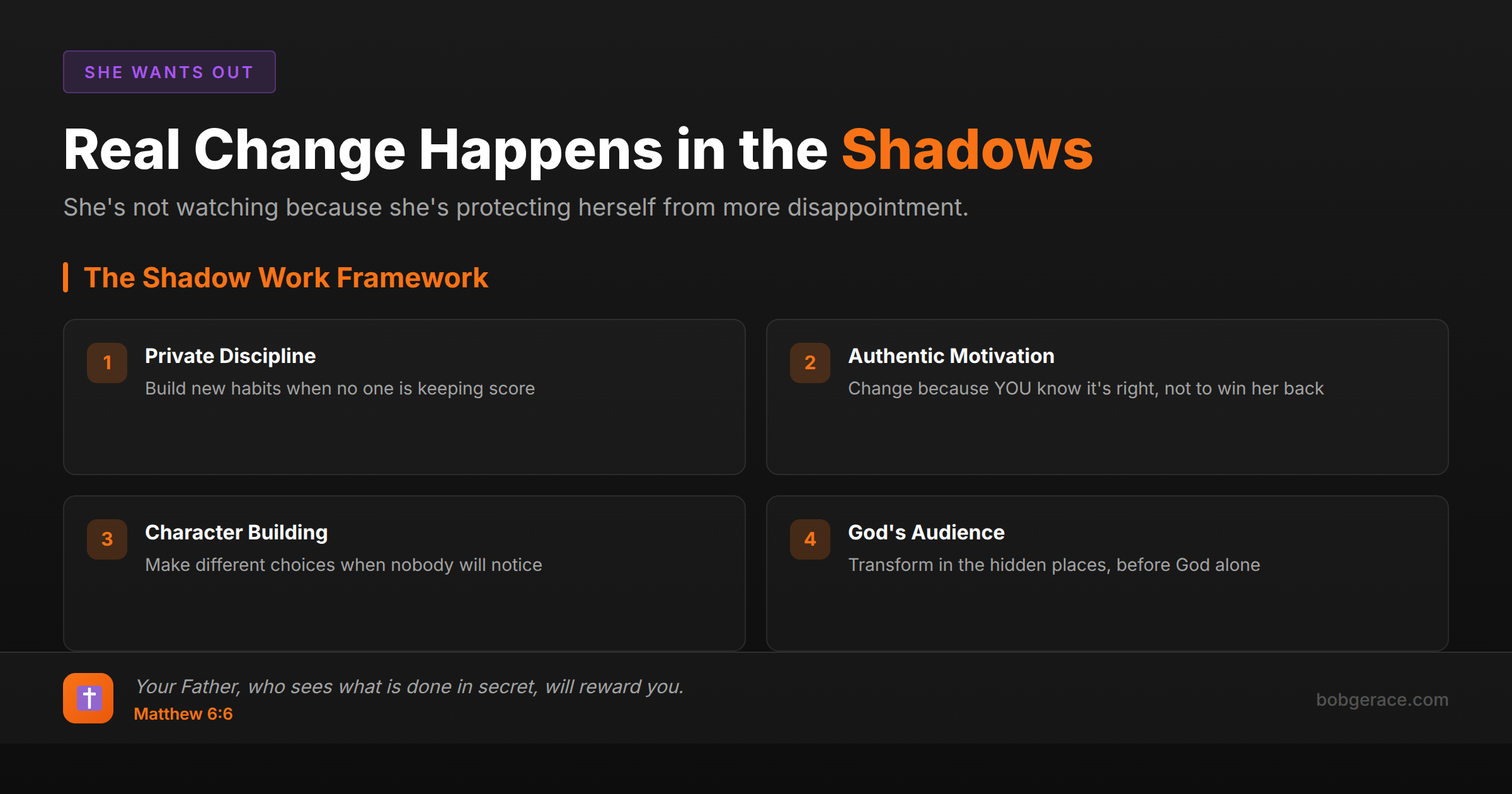
The deepest, most lasting change happens in the shadows—when no one's keeping score, when there's no immediate payoff, when it's just you and your commitment to becoming better. Your wife isn't watching because she's protecting herself from more disappointment. She's seen promises before. What she hasn't seen is a man who changes because he knows it's right, not because he's trying to win her back. This is actually the most powerful position you can be in. When you're changing for an audience of one—yourself—the transformation is authentic. When you're doing the work in private, building new habits in the dark, making different choices when nobody will notice, you're creating the foundation of real character. Your wife will eventually notice, but by then, the change won't be a performance. It'll be who you've become.
The Full Picture
Here's what's really happening: Your wife has emotionally detached because she's been hurt too many times by surface-level changes that didn't stick. She's not watching because watching hurts. Every time she's invested hope in your promises to change, only to see you revert to old patterns, it's created another wound.
This is actually your greatest opportunity. When someone stops watching, it means they've stopped trying to control the outcome. The pressure is off. You're free to change for the right reasons—because you know you need to, because you want to become the man God created you to be, because you're tired of being controlled by your weaknesses.
Most men make the mistake of trying to get their wife's attention during the change process. They announce their new commitments, ask for acknowledgment of their progress, or get frustrated when she doesn't notice their efforts. This is performance-based change, and it's fragile. The moment the audience stops applauding, the motivation dies.
Real change is different. It's:
• Consistent when no one's looking • Motivated by internal conviction, not external validation • Focused on character, not just behavior • Sustainable through setbacks and resistance • Evident in small, daily choices
When you're changing in private, you're building what I call authentic momentum. This is change that can't be shaken because it's not dependent on anyone else's response. You're developing new neural pathways, new habits, new ways of thinking and responding. This takes time—usually 90-180 days to see real transformation.
The paradox is this: The less you need her to notice, the more likely she is to eventually see the change. But by then, you won't be changing for her response. You'll be changing because you've discovered who you really are.
What's Really Happening
From a psychological perspective, what you're experiencing is the difference between extrinsic and intrinsic motivation. When your wife was watching and responding to your attempts at change, you were operating from extrinsic motivation—changing to get a reward or avoid punishment. Research shows this type of motivation is inherently unstable and tends to diminish over time.
Now that she's not watching, you have the opportunity to develop intrinsic motivation—changing because the behavior aligns with your values and sense of self. This is far more powerful and sustainable. Studies in behavioral psychology demonstrate that intrinsically motivated change creates lasting neural pathway alterations, while extrinsically motivated change often results in temporary behavioral shifts that revert under stress.
Your wife's emotional withdrawal is also a form of self-protection. In attachment theory, this is called deactivation—she's shutting down her attachment system to avoid further emotional injury. This isn't rejection; it's psychological survival. She's essentially saying, 'I can't keep hoping and being disappointed.'
This creates what we call a paradoxical healing space. Without the pressure of her attention and expectations, you can engage in authentic self-reflection and change. Neuroplasticity research shows that the brain changes more effectively when we're not in a state of performance anxiety or seeking external validation.
The key is understanding that sustainable change requires internal regulation. When you're changing to manage someone else's emotions or responses, you're still operating from a dependent, reactive position. True transformation happens when you develop the capacity to self-regulate, self-motivate, and self-direct—regardless of external circumstances.
This process typically takes 3-6 months of consistent internal work before external changes become naturally evident to others.
What Scripture Says
Scripture is clear that authentic transformation happens in the hidden places, before God alone. Matthew 6:6 says, *'But when you pray, go into your room, close the door and pray to your Father, who is unseen. Then your Father, who sees what is done in secret, will reward you.'* This principle applies to all areas of growth—God sees and honors what you do when no one else is watching.
1 Samuel 16:7 reminds us, *'The Lord does not look at the things people look at. People look at the outward appearance, but the Lord looks at the heart.'* Your wife can only see external behaviors, but God sees the heart change that's happening in private. This is where real transformation begins.
Galatians 6:4 instructs, *'Each one should test their own actions. Then they can take pride in themselves alone, without comparing themselves to someone else.'* You're not changing to measure up to your wife's expectations or to compete with who you used to be. You're changing because God is calling you to become who He created you to be.
Consider Daniel 6:10: *'Now when Daniel learned that the decree had been published, he went home to his upstairs room where the windows opened toward Jerusalem. Three times a day he got down on his knees and prayed, giving thanks to his God, just as he had done before.'* Daniel didn't change his private practices based on external pressure. His consistency in private made him unshakeable in public.
Psalm 139:23-24 should be your prayer: *'Search me, God, and know my heart; test me and know my anxious thoughts. See if there is any offensive way in me, and lead me in the way everlasting.'* This is about inviting God to do the deep work that only He can see.
Finally, 2 Corinthians 3:18 promises, *'And we all, who with unveiled faces contemplate the Lord's glory, are being transformed into his image with ever-increasing glory, which comes from the Lord, who is the Spirit.'* True transformation comes from focusing on Christ, not on who's watching or responding to your change.
What To Do Right Now
-
1
Create a private morning routine that includes prayer, reflection, and planning your day according to your values—not reactions
-
2
Identify three character qualities you want to develop and practice them daily in small, unnoticed ways
-
3
Start a private journal documenting your thoughts, struggles, and growth without sharing it with anyone
-
4
Choose one area where you've been inconsistent and commit to 30 days of private discipline in that area
-
5
Find an accountability partner outside your marriage—a mentor, pastor, or trusted friend who can observe your growth
-
6
Stop announcing your changes or asking for recognition—let your actions speak over time without commentary
Related Questions
- Should I focus on her or me right now?
- What if I change and she still leaves?
- Is changing for her manipulation?
- How do I show her I've changed without telling her?
- What changes actually matter to her?
- What is 'white-knuckling' vs. real transformation?
- What does real transformation look like?
- How do I change from the inside out?
- Can I actually become a different man?
- What does sustainable change require?
Also find Bob on
Subscribe for weekly videos on Christian marriage.
You Don't Have to Figure This Out Alone
Changing in the dark is hard. A coach who knows your specific marriage can see what you can't—and keep you accountable when no one else is watching.
Talk to Bob →