What is 'structured separation' and does it work?
5 min read
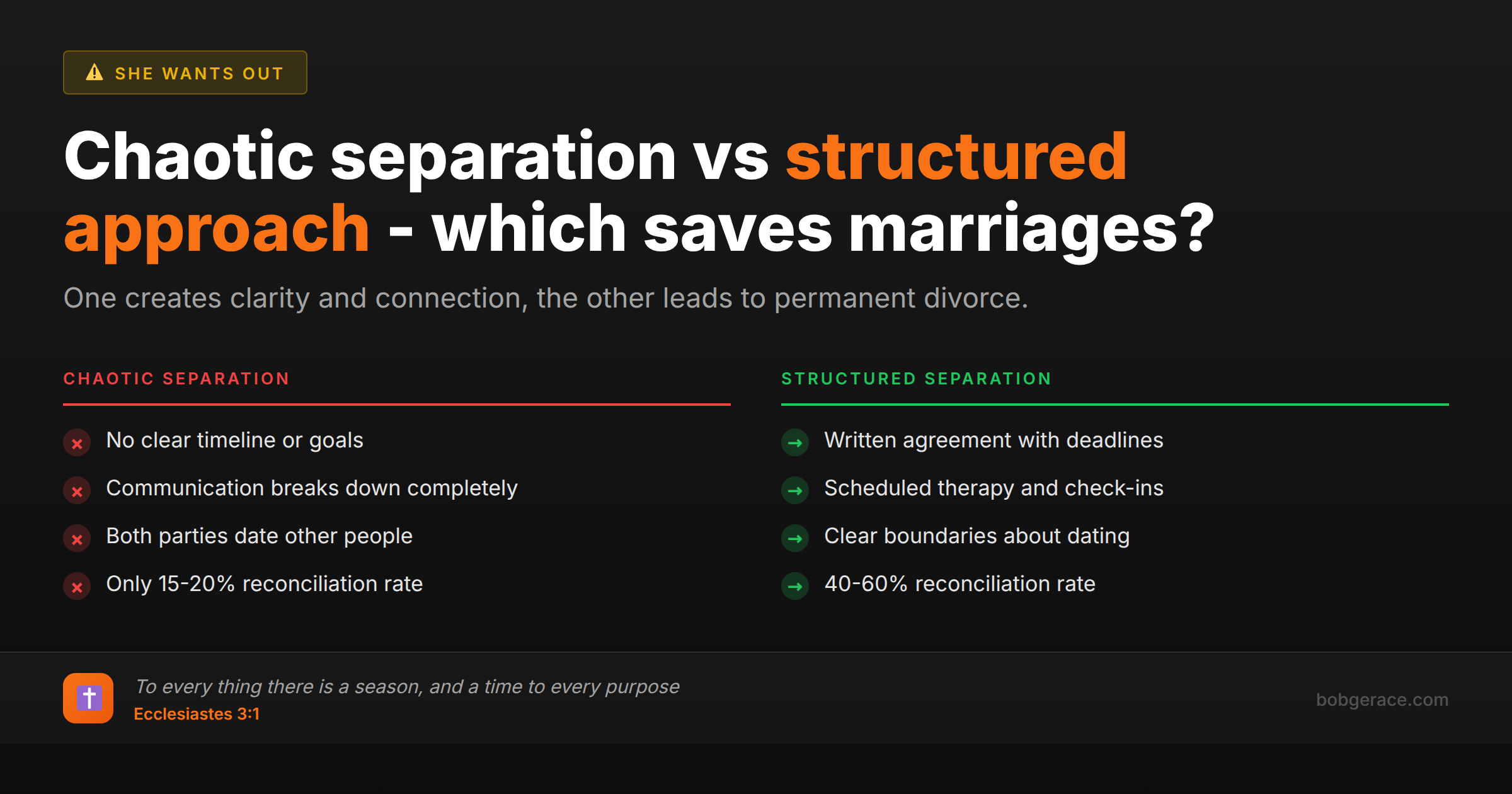
Structured separation is a formal time-apart arrangement where couples live separately while following specific guidelines, timelines, and goals - typically aimed at either reconciliation or conscious uncoupling. Unlike chaotic separations that often become permanent, structured separations include written agreements about communication, dating restrictions, therapy requirements, and decision deadlines. Research shows structured separations have a 40-60% reconciliation rate compared to just 15-20% for unstructured separations. The key difference? Clear boundaries and intentional work. When your wife says she needs space, a structured approach gives you both the breathing room to heal while maintaining connection and accountability. It's not a guarantee, but it's your best shot at creating clarity instead of chaos.
The Full Picture
Most separations happen in crisis mode - someone moves out in anger, communication breaks down, and what was meant to be temporary becomes permanent by default. Structured separation flips this script entirely.
Here's what makes it different:
• Written agreement covering living arrangements, finances, children, and communication rules • Specific timeframe (typically 3-6 months with review points) • Therapeutic requirements for one or both partners • Dating/relationship boundaries clearly defined • Regular check-ins to assess progress • Clear goals - reconciliation, conscious uncoupling, or gaining clarity
The most common mistake? Treating separation as punishment or abandonment. Structured separation reframes it as intentional healing space. Your wife isn't rejecting you - she's creating conditions where positive change becomes possible.
Successful structured separations require both partners to commit to the process, even if you have different hoped-for outcomes. You might be fighting for reconciliation while she's seeking clarity about divorce. That's okay - the structure serves both needs.
Warning signs it won't work: If she's already emotionally checked out, has an affair partner, or refuses to engage with any boundaries or timelines. Structured separation requires at least minimal good faith participation from both sides.
The real power is in the accountability and hope it creates. Instead of wondering "what's happening with us?" you both know exactly what you're working toward and when decisions will be made.
What's Really Happening
From a therapeutic standpoint, structured separation addresses the approach-avoidance conflict many distressed spouses experience. They want the marriage to improve but feel overwhelmed by its current state. Unstructured separation often increases anxiety and ambiguous loss - that psychological limbo that prevents healing.
Research from the Gottman Institute shows that couples in crisis need emotional safety before they can do repair work. Structured separation creates this safety through predictability and boundaries. The anxious partner (often the husband) knows exactly when contact will happen, and the avoidant partner (often the wife) knows her space will be respected.
Neurologically, separation impacts the attachment system powerfully. The pursuing partner experiences genuine grief and often enters protest behaviors - excessive texting, showing up unannounced, or making grand gestures. The distancing partner may feel relief initially, but often experiences her own grief once the immediate pressure is removed.
Structured separation works best when it includes individual therapy for both partners and couples therapy if possible. The time apart allows each person to work on their individual contributions to the marriage crisis without the daily triggers of cohabitation.
Clinical predictors of success include: maintained respect between partners, willingness to examine personal patterns, absence of active addiction or affairs, and at least one partner actively working on change. When these factors align with clear structure, couples report feeling more hopeful and less chaotic, even when the ultimate outcome remains uncertain.
What Scripture Says
Scripture doesn't specifically address structured separation, but it provides clear principles about marriage, restoration, and wise planning that apply directly.
Ecclesiastes 3:1 reminds us "To every thing there is a season, and a time to every purpose under heaven." Sometimes marriages need a season of separation for healing and reflection. This isn't abandoning your covenant - it's creating space for God to work.
Proverbs 27:14 warns that "He who blesses his friend with a loud voice, rising early in the morning, it will be counted a curse to him." When your wife feels overwhelmed, your attempts to fix things immediately might feel like harassment rather than love. Strategic withdrawal can be an act of love.
1 Corinthians 7:10-11 acknowledges that separation sometimes happens: "A wife must not separate from her husband. But if she does, she must remain unmarried or else be reconciled to her husband." Paul recognizes separation as a reality while maintaining hope for reconciliation.
Luke 14:28-30 emphasizes counting the cost: "For which of you, intending to build a tower, does not sit down first and count the cost, whether he has enough to finish it?" Structured separation is exactly this - intentional planning rather than reactive chaos.
Galatians 6:1 calls us to "restore such a person gently." Whether you're seeking to restore your marriage or help your wife find peace about her decision, gentleness and structure honor both your covenant and her humanity.
God can work powerfully in the space between - using time apart to bring healing, clarity, and sometimes miraculous reconciliation.
What To Do Right Now
-
1
Write down your specific goals for separation - reconciliation, clarity, or conscious uncoupling
-
2
Research therapists who specialize in couples work and structured separation agreements
-
3
Draft a preliminary separation agreement covering living arrangements, finances, and communication
-
4
Set a specific timeframe (3-6 months) with built-in review dates every 4-6 weeks
-
5
Establish clear boundaries about dating, social media, and contact with extended family
-
6
Schedule individual therapy for yourself immediately - don't wait for her to agree to couples work
Related Questions
- She wants separation — should I agree?
- Is trial separation ever a good idea?
- What are the rules of separation?
- Can we separate and still work on things?
- What boundaries make separation therapeutic?
- What's the difference between space to heal and space to exit?
- What boundaries should I set?
- What's the difference between boundary and ultimatum?
- How do I stay connected while enforcing boundaries?
- What does 'detach with love' actually mean?
Also find Bob on
Subscribe for weekly videos on Christian marriage.
Don't Wing Your Separation Agreement
A structured separation only works if the structure fits your actual marriage. Bob helps you build the boundaries, timelines, and communication rules that give your situation the best shot.
Talk to Bob →