How do I set boundaries without controlling?
6 min read
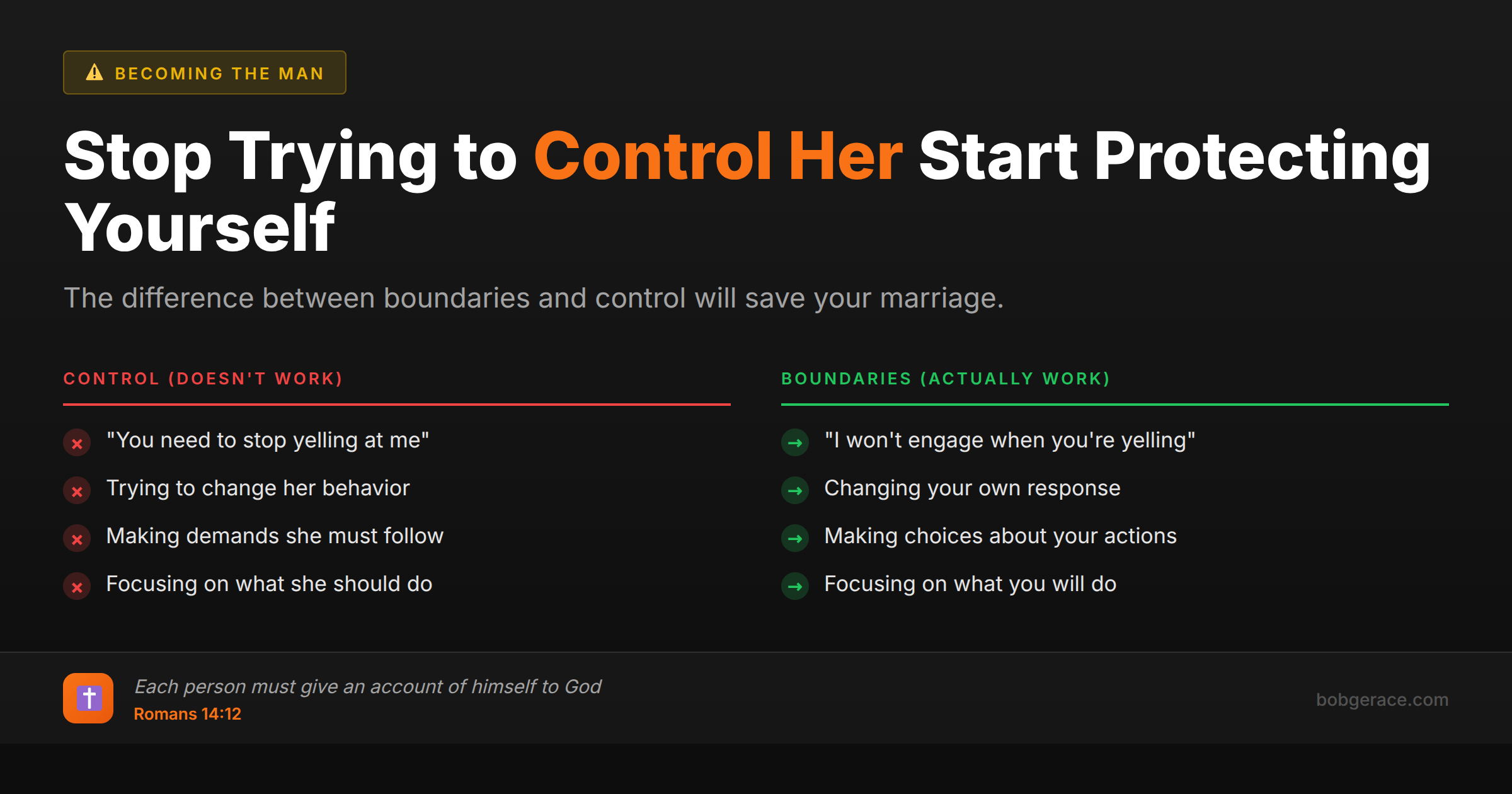
The key difference between boundaries and control lies in focus: boundaries protect you, while control attempts to change your spouse. Healthy boundaries define what you will and won't accept for yourself, then follow through with consequences that affect only you. For example, "I won't engage in conversations when you're yelling" followed by leaving the room, versus "You need to stop yelling at me" which attempts to control their behavior. True boundaries require you to change your own actions, not demand changes from your spouse. They're about self-protection, not spouse-modification. This means accepting that you cannot control your spouse's choices while maintaining clear limits on how those choices affect you.
The Full Picture
When there's another man in the picture, the line between healthy boundaries and controlling behavior becomes critically important. Many betrayed spouses swing between two extremes: either having no boundaries at all or attempting to control every aspect of their spouse's life out of fear and pain.
Understanding the fundamental difference is essential. Boundaries are about what *you* will do in response to certain behaviors. Control is about what you demand *they* do or stop doing. A boundary might sound like: "I won't stay in the house when you're texting other women, so I'll go to my sister's." Control sounds like: "You have to give me all your passwords and check in every hour."
The motivation matters too. Boundaries come from self-respect and self-protection. Control comes from fear, desperation, and the illusion that you can prevent betrayal by monitoring every move. While it's natural to want guarantees after betrayal, true healing requires accepting that you cannot control another person's choices.
Boundaries actually require courage because they involve risk. When you set a boundary, you're essentially saying, "I cannot control what you choose, but I can control how I respond." This means accepting that your spouse might choose poorly, but you're committed to protecting yourself regardless.
The paradox is powerful: The more you try to control your spouse, the more powerless you become. The clearer your boundaries, the more personal power you reclaim. Boundaries say, "I love myself enough to protect my wellbeing, and I respect you enough to let you make your own choices—even if they're wrong choices."
What's Really Happening
From a clinical perspective, the confusion between boundaries and control often stems from trauma responses following betrayal. When trust is shattered, the nervous system goes into hypervigilance mode, desperately seeking ways to prevent future harm. This biological response can hijack rational thinking, making controlling behaviors feel like necessary protection.
Trauma bonding complicates this further. The betrayed spouse becomes psychologically dependent on monitoring their partner's behavior for safety cues. This creates an addictive cycle where checking phones, demanding transparency, and surveillance provide temporary anxiety relief but ultimately increase dependency and erode self-worth.
Healthy boundaries activate different neural pathways. Instead of the anxious, hypervigilant state that drives controlling behaviors, boundaries engage the prefrontal cortex—the brain's executive function center. This allows for clear thinking, self-advocacy, and decisive action based on values rather than fear.
The clinical distinction is clear: Control attempts to manage external variables to feel safe internally. Boundaries manage internal responses regardless of external variables. One keeps you trapped in reactive patterns; the other builds genuine resilience and self-efficacy.
Recovery requires rewiring these responses. This means learning to tolerate the anxiety of not knowing or controlling while building confidence in your ability to handle whatever comes. It's uncomfortable initially, but it's the only path to authentic healing and restored personal power.
What Scripture Says
Scripture provides clear guidance on the balance between self-protection and loving others well, even in difficult circumstances.
Personal responsibility is fundamental: "Each person must give an account of himself to God" (Romans 14:12). This verse establishes that we're each responsible for our own choices and actions. You cannot give an account for your spouse's decisions, nor can they give an account for yours. This biblical truth forms the foundation of healthy boundaries.
Love includes protection: "Above all else, guard your heart, for everything you do flows from it" (Proverbs 4:23). God commands us to protect our hearts—not out of selfishness, but because our spiritual and emotional wellbeing affects everything else. Boundaries are actually an act of obedience to this command.
Wisdom requires discernment: "Be as shrewd as snakes and as innocent as doves" (Matthew 10:16). Jesus himself taught the importance of wisdom and discernment in relationships. This includes recognizing harmful patterns and protecting yourself while maintaining a pure heart toward others.
Truth and love work together: "Instead, speaking the truth in love, we will grow to become in every respect the mature body of him who is the head, that is, Christ" (Ephesians 4:15). Healthy boundaries speak truth in love—they're honest about what you will and won't accept while still honoring the other person's freedom to choose.
Trust is earned, not demanded: "The simple believe anything, but the prudent give thought to their steps" (Proverbs 14:15). Scripture doesn't command blind trust but rather wise evaluation of trustworthiness based on consistent actions over time.
What To Do Right Now
-
1
Write down three specific behaviors you won't tolerate, then identify what YOU will do (not what you'll make them do) when those behaviors occur
-
2
Practice the phrase 'I cannot control your choices, but I can control my response' until it becomes your default mindset
-
3
Create a safety plan that focuses on your actions (where you'll go, who you'll call, what you'll do) rather than trying to prevent their actions
-
4
Identify the difference between requests (which they can decline) and demands (which attempt to control) in your current communication patterns
-
5
Establish one small boundary today that you can follow through on consistently, building your confidence in boundary-setting
-
6
Seek support from a counselor or trusted friend who can help you distinguish between healthy self-protection and controlling behaviors
Related Questions
- What boundaries should I set?
- What's the difference between boundary and ultimatum?
- What makes boundaries effective vs. empty threats?
- What is a 'natural consequence' vs. 'punishment'?
- How do I stay connected while enforcing boundaries?
- How do I be warm without being a doormat?
- What is a boundary vs. an ultimatum?
- What makes boundaries healthy?
- Can I forgive and still have boundaries?
- How do I honor her autonomy while fighting for us?
Also find Bob on
Subscribe for weekly videos on Christian marriage.
Setting Boundaries in Your Marriage
Knowing the difference between boundaries and control is one thing. Applying it to your specific marriage—where emotions run high and old patterns pull hard—is another. A coach helps you see what's actually happening in your situation and build boundaries that hold.
Talk to Bob →