What's the difference between boundary and ultimatum?
6 min read
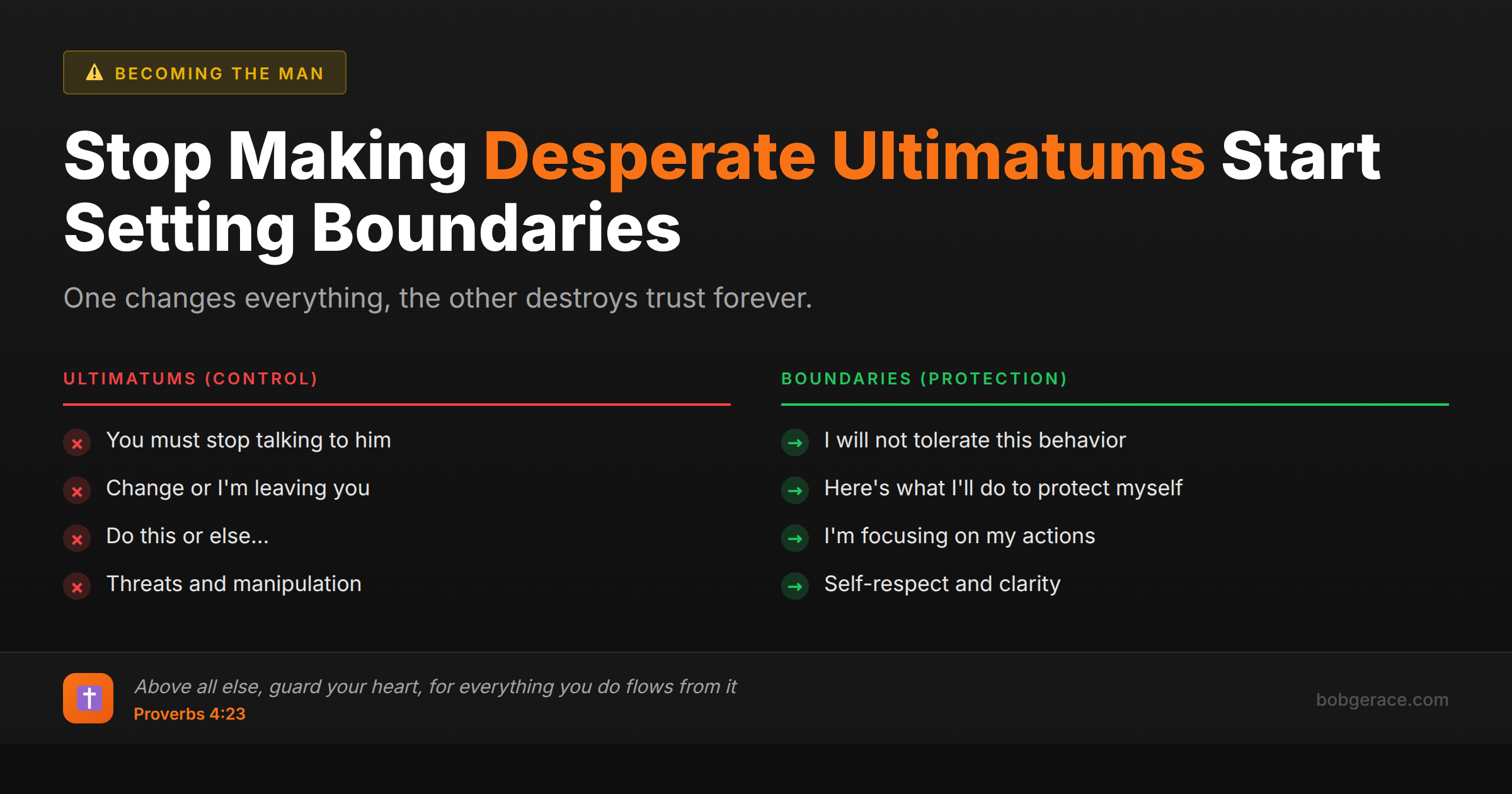
The difference between a boundary and an ultimatum is profound and game-changing for your marriage. A boundary is about protecting yourself and what you will or won't accept - it's self-focused and comes from a place of self-respect. An ultimatum is about controlling your spouse's behavior through threats - it's other-focused and comes from a place of desperation or manipulation. Boundaries say 'I will not tolerate this behavior and here's what I'll do to protect myself.' Ultimatums say 'You must change or else.' Boundaries are about your actions and choices. Ultimatums are about forcing someone else's actions and choices. When there's another man involved, this distinction becomes critical for your healing and your marriage's future.
The Full Picture
Here's what most people get wrong about boundaries versus ultimatums: they think it's just about the words you use. It's not. It's about the heart posture behind those words and who has control over the outcome.
Boundaries are self-protective. When you set a boundary, you're taking responsibility for your own well-being. You're not trying to control your spouse's choices - you're controlling your own response to their choices. A boundary might sound like: 'I will not remain in conversations where you compare me to him. If that happens, I will leave the room.' Notice how this focuses on what YOU will do.
Ultimatums are other-controlling. When you give an ultimatum, you're trying to force someone else's hand through threats or manipulation. An ultimatum sounds like: 'If you don't cut off all contact with him immediately, I'm filing for divorce.' The focus is entirely on what your spouse must do or else.
The difference becomes crucial when there's another man because your wife's heart and choices can't be threatened into changing. You can't ultimatum someone back into love or faithfulness. But you can absolutely boundary yourself into self-respect and emotional safety.
Boundaries invite respect. They show that you value yourself enough to protect your own well-being. Paradoxically, this often draws people toward you because it demonstrates strength and self-worth.
Ultimatums invite rebellion. They trigger our natural resistance to being controlled. Even if your spouse complies with an ultimatum, it's often grudgingly and temporarily.
The goal isn't to manipulate outcomes - it's to protect your own heart while creating space for genuine change and healing.
What's Really Happening
From a clinical perspective, the boundary-ultimatum distinction reveals fundamental differences in attachment patterns and emotional regulation. When clients issue ultimatums, they're typically operating from an anxious attachment state - desperate to control outcomes because they feel powerless and abandoned.
Boundaries, conversely, reflect secure attachment functioning. They demonstrate emotional regulation, self-awareness, and the ability to maintain personal integrity regardless of another person's choices. This is why boundaries are so much more effective therapeutically.
In cases involving emotional or physical affairs, I see husbands swing between two extremes: complete passivity (no boundaries at all) or aggressive ultimatums. Neither works. The passive husband enables continued boundary violations. The ultimatum-giving husband triggers defensive reactions and often pushes his wife further toward the other relationship.
Healthy boundaries require what we call 'differentiation' - the ability to maintain your sense of self while staying emotionally connected to your spouse. This is incredibly difficult when you're feeling betrayed and desperate, but it's exactly what creates the emotional safety needed for rebuilding trust.
Ultimatum-makers often see immediate compliance but miss the underlying resentment building. Boundary-setters might initially face more resistance, but they're building long-term respect and authentic change. The key is learning to tolerate your own anxiety while maintaining your standards - this is where most people struggle and where professional support becomes crucial.
What Scripture Says
Scripture gives us clear guidance on protecting ourselves while loving others well. The boundary-ultimatum distinction aligns perfectly with biblical principles of love, respect, and personal responsibility.
Boundaries reflect biblical wisdom. Proverbs 27:14 teaches us that 'whoever blesses his neighbor with a loud voice, rising early in the morning, will be counted as cursing him.' Sometimes our 'help' - including threats and ultimatums - actually harm our relationships.
We're called to self-protection. Proverbs 4:23 instructs us to 'guard your heart, for from it flow the springs of life.' This isn't selfishness - it's stewardship. You cannot love well from an unprotected, depleted heart.
Jesus modeled boundaries beautifully. In John 11:54, when people wanted to kill Him before His time, 'Jesus no longer walked openly among the Jews, but went from there to the region near the wilderness.' He didn't give ultimatums or try to force people to accept Him - He simply protected Himself.
Love doesn't mean enabling. Galatians 6:5 tells us that 'each will have to bear his own load.' You're not responsible for carrying the consequences of your spouse's choices, and trying to do so through ultimatums actually prevents their growth.
Ultimatums often reflect fear, not love. 1 John 4:18 reminds us that 'perfect love casts out fear.' When we operate from fear - fear of losing our spouse, fear of being alone - we tend toward control rather than trust.
The biblical model is clear: love deeply, protect wisely, trust God with outcomes you cannot control.
What To Do Right Now
-
1
Identify your current pattern - Write down recent conversations where you tried to influence your spouse's behavior. Were you setting boundaries (focusing on your actions) or giving ultimatums (trying to control theirs)?
-
2
Practice boundary language - Rewrite any ultimatums as boundaries. Instead of 'You must...' try 'I will not...' Focus entirely on what you can and will do to protect yourself.
-
3
Get clear on your non-negotiables - What behaviors genuinely threaten your safety, values, or well-being? These become your boundary lines, not manipulation tools.
-
4
Prepare for testing - Boundaries are almost always tested. Decide in advance how you'll respond when your spouse pushes against your newly established limits.
-
5
Remove timeline pressure - Ultimatums often include arbitrary deadlines that increase anxiety. Boundaries are ongoing commitments to self-protection, not time-limited threats.
-
6
Seek support for implementation - Most people struggle to maintain boundaries under pressure. Get coaching or counseling to help you stay strong when your resolve is tested.
Related Questions
- What boundaries should I set?
- What makes boundaries effective vs. empty threats?
- What is a 'natural consequence' vs. 'punishment'?
- How do I set boundaries without controlling?
- What does 'holding space' while 'holding boundary' look like?
- How do I stay connected while enforcing boundaries?
- Should I give her space or fight for her?
- What is a boundary vs. an ultimatum?
- What makes boundaries healthy?
- Can I forgive and still have boundaries?
Also find Bob on
Subscribe for weekly videos on Christian marriage.
Boundaries in Your Actual Marriage
Setting a boundary that holds — without blowing up your marriage or caving under pressure — requires someone who knows your story and can calibrate to what's actually happening in your house.
Talk to Bob →