What makes boundaries effective vs. empty threats?
6 min read
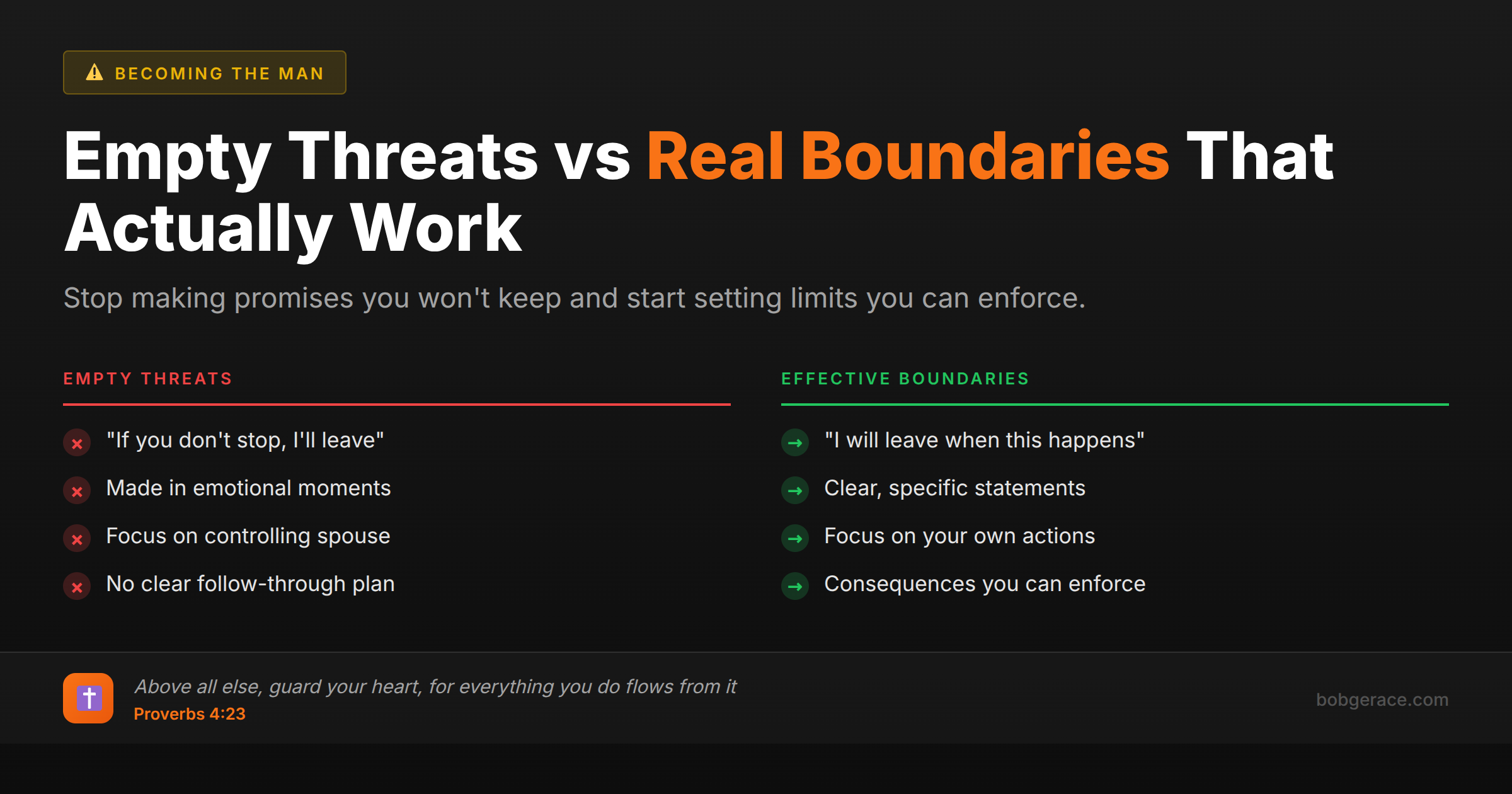
The difference between effective boundaries and empty threats comes down to three critical factors: specificity, consistency, and consequences you can actually enforce. Empty threats are vague ultimatums made in emotional moments without clear follow-through plans. They often sound like "If you don't stop, I'll leave" without any concrete action steps. Effective boundaries, however, are specific statements about what you will or won't accept, paired with clear consequences you're prepared to implement immediately. They focus on your own behavior rather than trying to control your spouse's actions. For example, instead of threatening "Stop talking to her or else," an effective boundary states "I will not remain in conversations where she's discussed. I will leave the room when this happens." The key is making boundaries about what you can control – your own responses and choices.
The Full Picture
When you're dealing with infidelity or emotional affairs, the temptation to make dramatic ultimatums is overwhelming. You're hurt, angry, and desperate for your spouse to understand the gravity of their actions. But here's what I've learned after years of marriage coaching: empty threats don't just fail to work – they actually make things worse.
Empty threats are emotional reactions disguised as boundaries. They usually emerge during heated arguments when you're at your breaking point. You hear yourself saying things like "I'm done with this marriage" or "Keep this up and I'm filing for divorce" – but deep down, you know you're not ready to follow through. Your spouse knows it too.
The problem with empty threats is that they erode your credibility and teach your spouse that your words don't carry weight. Each unfulfilled ultimatum weakens your position and makes future boundary-setting less effective. You become the spouse who "cries wolf," and your genuine concerns get dismissed.
Effective boundaries operate on completely different principles. They're not about controlling your spouse's behavior – they're about defining what you will and won't participate in. They're not punishment; they're protection. They're not made in anger; they're established thoughtfully when you're calm and clear-headed.
Real boundaries require three elements: clarity about what behavior is unacceptable, specific consequences you can implement immediately, and the inner resolve to follow through consistently. They sound different too: "I will not discuss our marriage issues while you're still in contact with her" rather than "You better cut contact or I'm leaving."
The shift from threats to boundaries represents a fundamental change in how you approach your marriage crisis. Instead of trying to force change through fear and ultimatums, you're taking responsibility for your own well-being and creating space for genuine healing to occur.
What's Really Happening
From a clinical perspective, the distinction between boundaries and threats reflects different psychological mechanisms at work. Empty threats typically emerge from a dysregulated emotional state – when the betrayed spouse is operating from their fight-or-flight system rather than their prefrontal cortex. In this state, the brain prioritizes immediate emotional relief over long-term strategic thinking.
Threats are externally focused attempts at control. They represent what we call "other-regulation" – trying to manage another person's behavior through fear or manipulation. This approach consistently fails because it violates a fundamental psychological principle: you cannot sustainably change another person's behavior through external pressure alone.
Effective boundaries, conversely, represent "self-regulation" in action. They emerge from what we call the "wise mind" – the integration of emotional awareness with rational thinking. When you set a boundary, you're making a values-based decision about your own behavior rather than trying to control your partner's choices.
Neurologically, consistent boundary enforcement actually rewrites neural pathways. Each time you follow through on a stated boundary, you strengthen the neural networks associated with self-advocacy and emotional regulation. This creates what we call "earned security" – a growing confidence in your ability to protect yourself emotionally.
The power dynamic in relationships also shifts dramatically. Threats often trigger defensive responses and can escalate conflict. Boundaries, when properly implemented, tend to de-escalate because they remove the element of control and coercion. Your spouse may not like your boundaries, but they're less likely to feel manipulated by them, which creates space for more authentic communication about the underlying issues in your marriage.
What Scripture Says
Scripture provides clear guidance on the difference between manipulation and healthy self-protection. The Bible never endorses using fear or threats to control others, but it strongly supports wise boundary-setting as an expression of stewardship over our own lives.
Proverbs 27:14 warns us about words spoken in anger: "Whoever blesses their neighbor with a loud voice in the morning will be counted as cursing." Empty threats made in emotional moments often carry this same destructive quality – they appear to address the problem but actually make it worse.
Matthew 5:37 calls us to integrity in our communication: "All you need to say is simply 'Yes' or 'No'; anything beyond this comes from the evil one." This verse speaks directly to the importance of saying only what we mean and meaning what we say. Empty threats violate this principle by using words we don't intend to back up with action.
The concept of boundaries finds strong biblical support in Galatians 6:5: "For each one should carry their own load." This verse establishes that we're responsible for our own choices and responses, not for controlling others. Effective boundaries honor this principle by focusing on what we can control – our own behavior.
Proverbs 25:28 provides a powerful image: "Like a city whose walls are broken through is a person who lacks self-control." Boundaries are like walls around a city – they define where we end and others begin. Without them, we become vulnerable to ongoing harm and manipulation.
1 Corinthians 13:7 reminds us that love "always protects." Sometimes the most loving thing we can do is establish clear boundaries that protect both ourselves and our marriage from further damage. This isn't punishment; it's creating the conditions necessary for genuine healing and restoration to occur in God's timing.
What To Do Right Now
-
1
Write down your current "threats" and identify which ones you're not actually prepared to enforce – be brutally honest about what you're really willing to do
-
2
Choose one specific behavior you will no longer participate in or enable – focus on something completely within your control to change
-
3
Craft a clear boundary statement using "I will" language instead of "You must" language – make it about your actions, not demands on your spouse
-
4
Identify the immediate consequence you'll implement when this boundary is crossed – ensure it's something you can do right away without your spouse's cooperation
-
5
Practice your boundary statement when you're calm – rehearse both the words and the follow-through action so you're prepared
-
6
Communicate your boundary once, clearly and calmly – then demonstrate it through your actions rather than repeating it multiple times
Related Questions
- What is a boundary vs. an ultimatum?
- How do I set boundaries without controlling?
- What does 'holding space' while 'holding boundary' look like?
- When does patience become enabling?
- What is a 'natural consequence' vs. 'punishment'?
- How do I enforce without controlling?
- What boundaries should I set?
- What's the difference between boundary and ultimatum?
- What boundaries are non-negotiable?
- What consequences are appropriate?
Also find Bob on
Subscribe for weekly videos on Christian marriage.
Setting boundaries in your actual marriage
You know the theory. The hard part is calibrating what works in your specific situation—what you can enforce, what timing makes sense, what your wife will actually respond to. A coach helps you build boundaries that fit your marriage, not a textbook.
Talk to Bob →