What does 'holding space' while 'holding boundary' look like?
6 min read
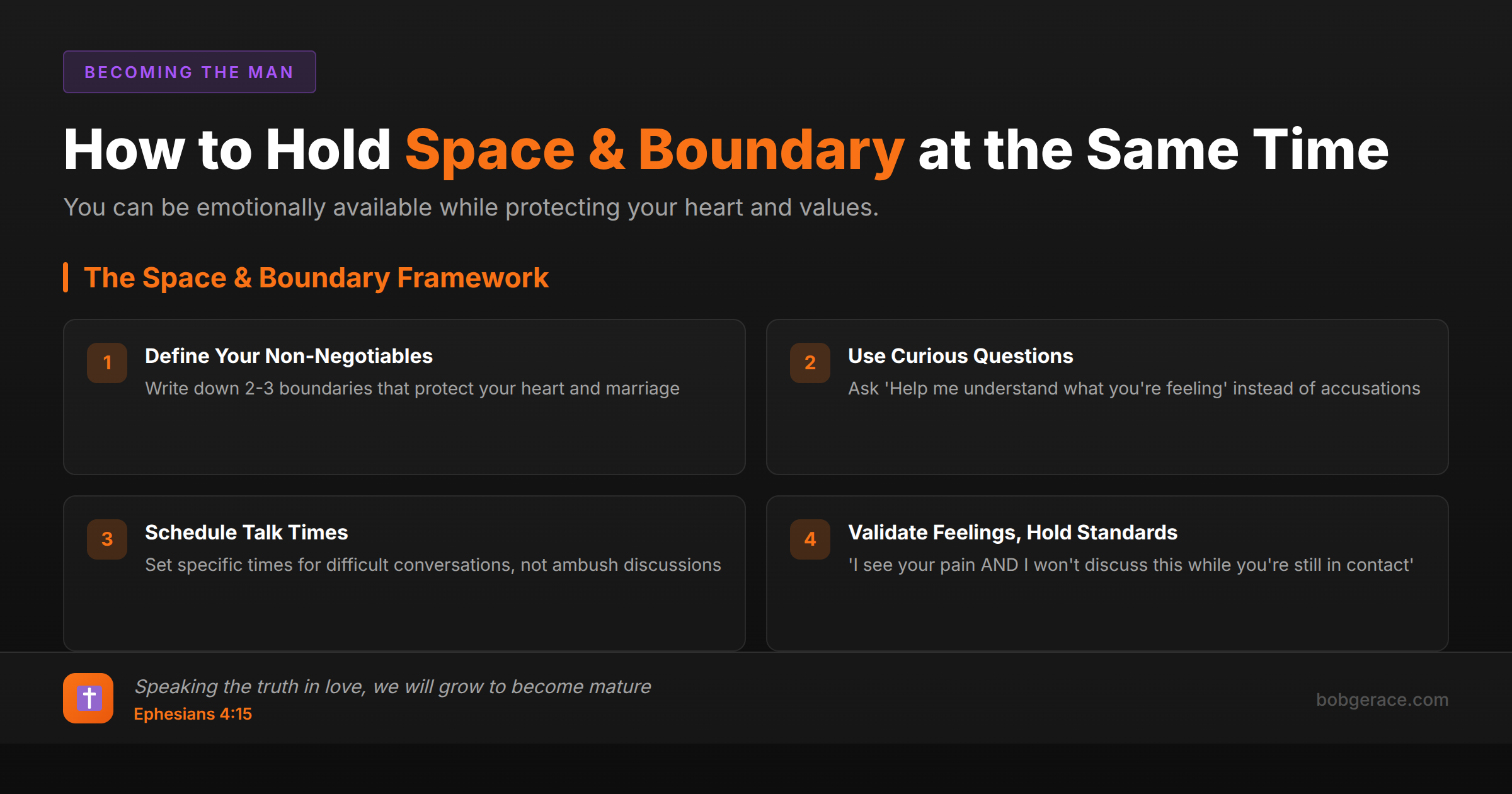
Holding space while holding boundary means creating emotional room for your spouse's pain and process while simultaneously protecting your own heart and values. It's standing firm on what you will and won't accept while remaining emotionally available for authentic conversation and growth. This looks like saying 'I can see you're hurting, and I want to understand, but I won't discuss this while you're still in contact with them' or 'I'm here to work on us, but only when you're fully committed to ending the affair.' You're not shutting down; you're creating a safe container for real healing to happen.
The Full Picture
When your marriage is in crisis because of another person, you face an impossible-seeming challenge: how do you stay open to your spouse while protecting yourself from further harm?
Holding space means creating emotional availability for your spouse's experience, feelings, and journey back to the marriage. It's choosing curiosity over judgment, listening over lecturing, and patience over pressure.
Holding boundary means maintaining clear, non-negotiable limits that protect your heart, your values, and the integrity of the healing process.
These aren't opposites - they're partners. Boundaries without space become walls. Space without boundaries becomes enabling.
## What This Actually Looks Like
- "I want to hear about your struggle, but only when you're committed to working on us" - Listening without rescuing - acknowledging their pain without fixing it - Staying curious about their journey while refusing to compromise your non-negotiables - Creating time for difficult conversations within the framework of your established boundaries - Showing up emotionally while maintaining physical and emotional safety
The goal isn't punishment or control. It's creating the healthiest possible environment for your marriage to heal. Sometimes the most loving thing you can do is refuse to enable destructive patterns while remaining open to genuine change.
What's Really Happening
From a therapeutic perspective, holding space while holding boundary creates what we call 'secure attachment under stress.' You're modeling emotional regulation while maintaining relational connection.
When someone has been unfaithful, they often experience shame, fear, and emotional dysregulation. If you respond with either complete shutdown or complete accommodation, you reinforce unhealthy patterns. But when you hold both space and boundary, you create what's called a 'corrective emotional experience.'
This approach activates several crucial healing mechanisms. First, it demonstrates that love and limits can coexist - something many people never learned in their family of origin. Second, it creates psychological safety for authentic confession and change. Third, it prevents the emotional flooding that shuts down the prefrontal cortex where real decision-making happens.
Neurologically, this balanced approach helps regulate both partners' nervous systems. The unfaithful spouse experiences being seen and accepted while also experiencing appropriate consequences. The betrayed spouse maintains agency and self-respect while remaining emotionally available.
This isn't about being 'nice' or 'understanding' in a way that enables. It's about creating the optimal conditions for genuine transformation and reconnection.
What Scripture Says
Scripture gives us a beautiful model of holding space and boundary simultaneously. Jesus consistently showed love while maintaining truth, grace while requiring change.
Ephesians 4:15 - *"Speaking the truth in love, we will grow to become in every respect the mature body of him who is the head, that is, Christ."* Truth and love aren't opposites; they work together for growth and healing.
Matthew 18:15-17 gives us the framework for confronting sin while remaining in relationship: *"If your brother or sister sins, go and point out their fault, just between the two of you. If they listen to you, you have won them over."*
Galatians 6:1 shows us how to approach someone caught in sin: *"Brothers and sisters, if someone is caught in a sin, you who live by the Spirit should restore that person gently. But watch yourselves, or you also may be tempted."*
Proverbs 27:5-6 reminds us that authentic love includes boundaries: *"Better is open rebuke than hidden love. Wounds from a friend can be trusted, but an enemy multiplies kisses."*
1 Corinthians 13:6 tells us that love *"does not delight in evil but rejoices with the truth."* Love doesn't enable sin; it creates space for truth and transformation.
God models this perfectly - showing incredible patience and grace while never compromising His holiness or enabling our destructive choices.
What To Do Right Now
-
1
Define your non-negotiables - Write down 2-3 boundaries that protect your heart and marriage (like 'no contact with the other person')
-
2
Practice curious questions - Instead of accusations, ask 'Help me understand what you're feeling right now'
-
3
Create designated talk times - Schedule specific times for difficult conversations rather than ambush discussions
-
4
Use 'I can hold both' language - 'I can hold space for your pain AND maintain my boundary about contact'
-
5
Validate feelings, not actions - 'I can see you're confused' without agreeing that confusion justifies betrayal
-
6
Get your own support - You can't hold healthy space without your own emotional tank being filled
Related Questions
- What boundaries should I set?
- What's the difference between boundary and ultimatum?
- What makes boundaries effective vs. empty threats?
- How do I set boundaries without controlling?
- How do I stay connected while enforcing boundaries?
- How do I be warm without being a doormat?
- What is a boundary vs. an ultimatum?
- What makes boundaries healthy?
- What does flexible but firm look like?
- How do I enforce without controlling?
Also find Bob on
Subscribe for weekly videos on Christian marriage.
This Balance Is Hard to Calibrate Alone
You're trying to hold two opposing truths at once — and getting it wrong costs you ground. A coach who knows your specific situation helps you find the line that actually works in your marriage.
Talk to Bob →