Why do I feel like I'm being attacked?
6 min read
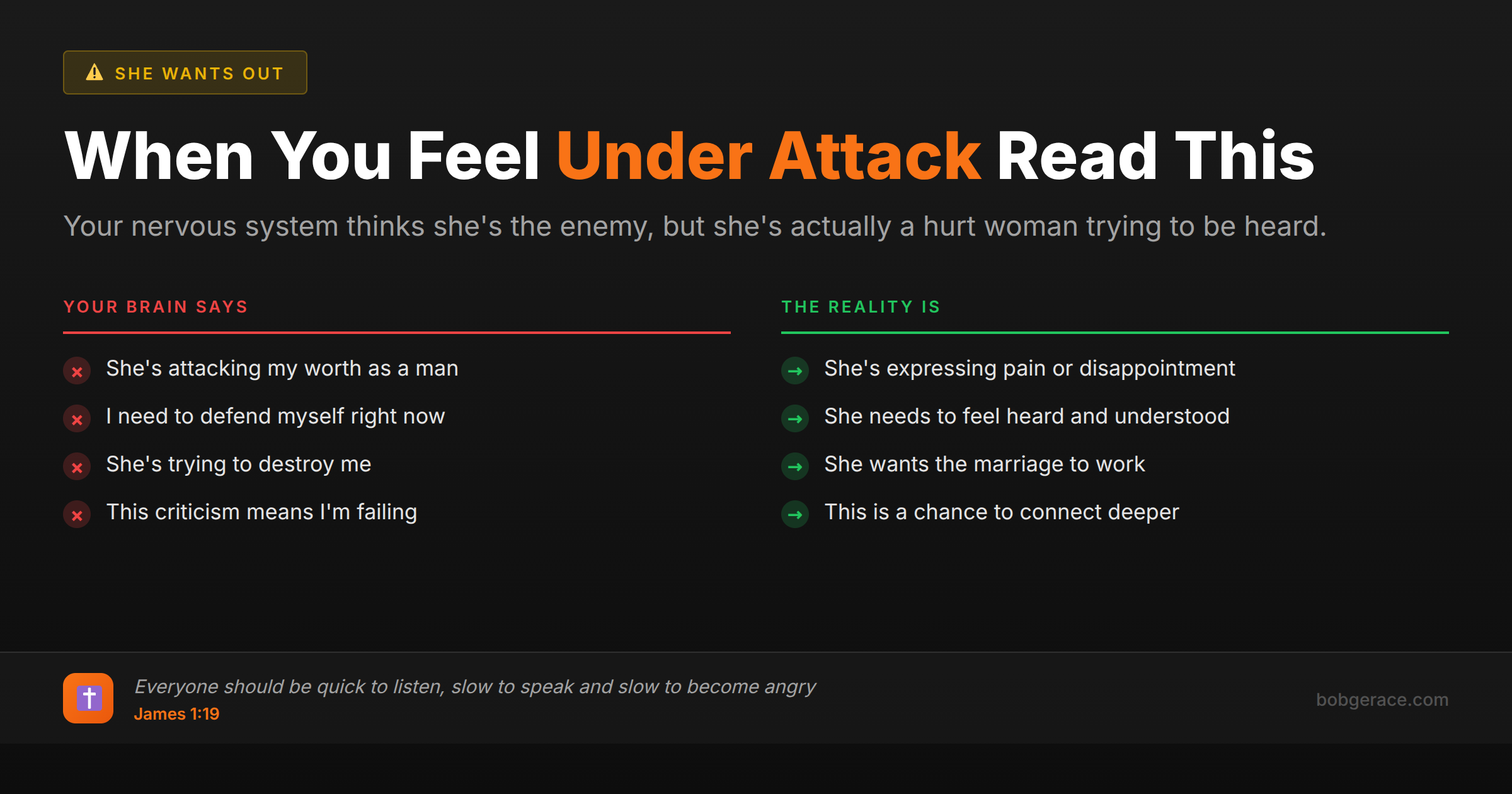
You feel attacked because your nervous system is responding to what it perceives as threats to your identity, your marriage, and your sense of worth. When she criticizes, withdraws, or expresses frustration, your brain interprets this as danger—even when she's simply expressing her pain or disappointment. This isn't weakness; it's biology. Your fight-or-flight response kicks in because the stakes feel existential. You're not just hearing complaints about dishes or communication—you're hearing that you've failed as a husband, provider, or man. But here's the crucial truth: feeling attacked and actually being attacked are two different things. Most of the time, she's not your enemy trying to destroy you. She's a hurt woman trying to be heard.
The Full Picture
When you're constantly feeling under attack in your marriage, you're caught in a destructive cycle that's bigger than any single conversation or conflict. Your wife says something critical, and immediately your body floods with stress hormones. Your jaw clenches, your shoulders tense, and your mind races to defend yourself.
This response makes perfect sense—but it's also killing your marriage.
Here's what's really happening: Your nervous system can't distinguish between a saber-toothed tiger and your wife's frustration about the garage door you promised to fix three weeks ago. Both trigger the same biological response. You feel your character being assassinated when she's actually trying to communicate a need.
Common triggers that feel like attacks: • Criticism about household responsibilities • Comments about your parenting or decision-making • Expressions of disappointment or frustration • Requests that feel like demands • Her emotional distance or withdrawal • Comparisons to other husbands or past versions of yourself
The problem isn't that you're sensitive—it's that you've learned to interpret her pain as a personal assault. When she says "You never help with bedtime," you hear "You're a terrible father." When she says "I feel disconnected from you," you hear "You're failing as a husband."
This defensive stance creates a vicious cycle. The more attacked you feel, the more you defend, justify, or counter-attack. The more you defend, the more frustrated she becomes. The more frustrated she becomes, the more attacked you feel. Meanwhile, the real issues—her needs, your relationship, the underlying problems—never get addressed because you're both stuck in combat mode.
Breaking this cycle requires understanding that her emotions aren't always about you, even when they involve you.
What's Really Happening
From a neurobiological perspective, what you're experiencing is called "emotional flooding"—when your amygdala (the brain's alarm system) hijacks your prefrontal cortex (your rational thinking center). This is particularly common in men who have high investment in being "good husbands" because any perceived criticism threatens their core identity.
Research in attachment theory shows that individuals with anxious attachment styles are hypervigilant to signs of rejection or criticism from their partners. If you grew up in an environment where approval was conditional or criticism was harsh, your nervous system learned to scan for threats to your worthiness. Now, even mild feedback from your wife can trigger the same neural pathways that were activated during childhood experiences of shame or rejection.
The Gottman Institute's research identifies "defensiveness" as one of the four predictors of divorce, precisely because it prevents couples from addressing underlying issues. When you feel attacked, your stress response system floods your body with cortisol and adrenaline, making it nearly impossible to listen, empathize, or problem-solve effectively.
Additionally, many men struggle with what psychologists call "rejection sensitivity"—an anxious expectation of rejection that leads to defensive reactions even when no attack is intended. This sensitivity often stems from early experiences but gets magnified in marriage because the stakes feel so high.
Understanding this physiological response is crucial because it helps normalize your experience while pointing toward solutions. Your feelings are valid, but they may not be accurate reflections of your wife's intentions. The goal isn't to stop feeling—it's to create enough space between stimulus and response so you can choose how to engage rather than just react.
What Scripture Says
Scripture addresses this dynamic with remarkable insight, starting with Proverbs 19:11: "A person's wisdom yields patience; it is to one's glory to overlook an offense." This doesn't mean becoming a doormat—it means having the wisdom to discern between actual attacks and expressions of pain or need.
James 1:19-20 provides a practical framework: "My dear brothers and sisters, take note of this: Everyone should be quick to listen, slow to speak and slow to become angry, because human anger does not produce the righteousness that God desires." When you feel attacked, your impulse is to be quick to speak and quick to become angry—the exact opposite of what leads to righteousness in relationships.
Peter addresses husbands specifically in 1 Peter 3:7: "Husbands, in the same way be considerate as you live with your wives, and treat them with respect as the weaker partner and as heirs with you of the gracious gift of life, so that nothing will hinder your prayers." The phrase "in the same way" refers back to Christ's example of not retaliating when attacked. Your defensive reactions may be hindering more than just your marriage.
Proverbs 15:1 offers tactical wisdom: "A gentle answer turns away wrath, but a harsh word stirs up anger." When you respond defensively to what feels like an attack, you're stirring up anger rather than de-escalating the situation. Your gentle response has the power to completely shift the dynamic.
Finally, Ephesians 4:26-27 acknowledges that anger itself isn't sin, but warns: "In your anger do not sin: Do not let the sun go down while you are still angry, and do not give the devil a foothold." Your defensive anger gives the enemy a foothold in your marriage by preventing reconciliation and understanding.
What To Do Right Now
-
1
Notice your physical response when you start feeling attacked—tense shoulders, clenched jaw, rapid heartbeat—and take three deep breaths before responding
-
2
Ask yourself 'Is she attacking me or expressing pain?' before you defend yourself against what she's saying
-
3
Practice saying 'Help me understand what you need' instead of explaining why she's wrong about you
-
4
Create a 20-minute cooling-off period for heated conversations—tell her you need time to process so you can respond better
-
5
Write down what you heard her say versus what you felt she meant about you—look for the gap between the two
-
6
Identify your three biggest triggers (criticism about work, parenting, household tasks, etc.) and prepare non-defensive responses in advance
Related Questions
- What is 'litigation stress' and how do I cope?
- How do I stay grounded when everything feels adversarial?
- How do I manage my nervous system through legal proceedings?
- How do I not let lawyers poison what's left?
- How do I show up as my best self when the system incentivizes my worst?
- What's happening in my nervous system right now?
- What is 'betrayal trauma' and do I have it?
- What is 'amygdala hijack' and how do I interrupt it?
- How do I function when my body won't calm down?
- What does nervous system regulation look like?
Also find Bob on
Subscribe for weekly videos on Christian marriage.
You Don't Have to Figure This Out Alone
A coach who knows your marriage can help you see what's actually happening in those moments—and what to do instead. Bring this to someone who's in your corner.
Talk to Bob →