How do I manage my nervous system through legal proceedings?
6 min read
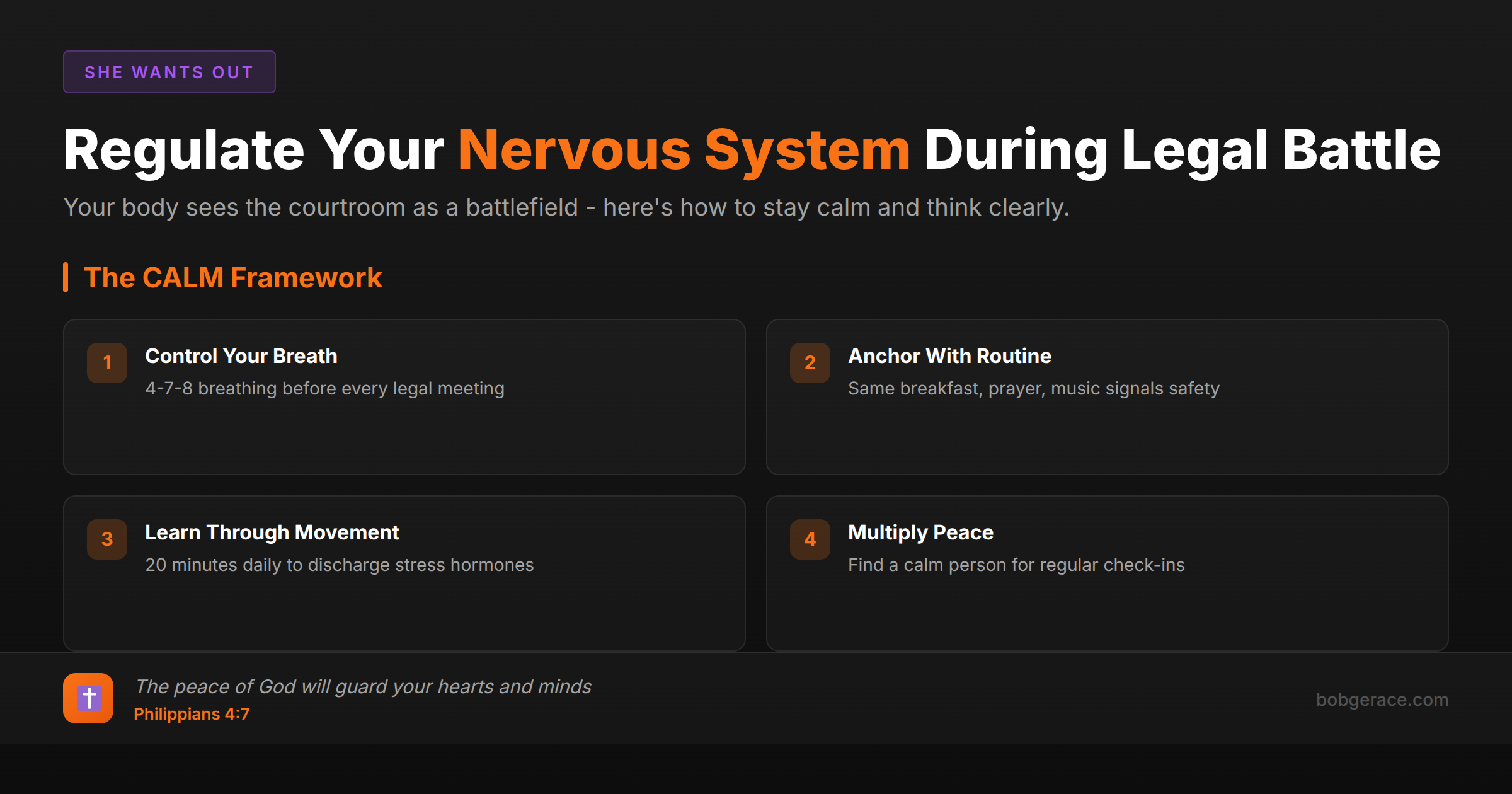
Legal proceedings trigger your nervous system like nothing else - your body perceives the courtroom as a battlefield because, frankly, it is one. Your fight-or-flight response kicks into overdrive, flooding you with cortisol and adrenaline that cloud your judgment exactly when you need clarity most. The key isn't eliminating stress - that's impossible. It's learning to regulate your nervous system so you can think clearly, respond wisely, and protect your interests. This means developing specific practices that calm your sympathetic nervous system and activate your parasympathetic response. You need breathing techniques, grounding exercises, and boundary strategies that work in real-time, not just meditation apps you'll forget to use when the pressure mounts.
The Full Picture
Legal proceedings create a perfect storm for nervous system dysregulation. You're dealing with financial uncertainty, custody battles, character assassination, and the complete rewriting of your future - all while sitting in a sterile room where strangers decide your fate.
Your nervous system doesn't distinguish between a saber-toothed tiger and a hostile attorney. Both trigger the same primal response: hypervigilance, shallow breathing, muscle tension, and cognitive fog. This is why smart men suddenly can't remember basic facts on the witness stand, or why you leave depositions feeling like you've run a marathon.
Common nervous system symptoms during legal proceedings: • Racing heart and shallow breathing • Inability to concentrate or remember details • Insomnia and exhaustion • Digestive issues and appetite changes • Emotional volatility - rage one moment, despair the next • Physical tension in jaw, shoulders, and back
The biggest mistake men make is trying to power through or numb out with alcohol, work, or other distractions. This actually dysregulates your nervous system further, making you more reactive and less effective.
Your nervous system needs three things: safety signals, predictable routines, and co-regulation (connection with safe people). Legal proceedings attack all three. The courtroom feels unsafe, your routine is constantly disrupted by meetings and paperwork, and you're often isolated from support systems.
Understand this: your nervous system's job is to keep you alive, not to make you look good in court. When it's dysregulated, it will choose survival over strategy every time. Learning regulation isn't self-care fluff - it's tactical preparation for the fight of your life.
What's Really Happening
From a clinical perspective, legal proceedings create what we call chronic stress activation - your nervous system gets stuck in a state of perceived threat that can last months or years. This isn't weakness; it's a normal response to an abnormal situation.
Polyvagal theory helps us understand what's happening. Your vagus nerve, which regulates your nervous system, has three responses: social engagement (calm and connected), sympathetic activation (fight or flight), and dorsal shutdown (freeze or collapse). Most men cycle between fight-or-flight during proceedings and collapse afterward.
Research shows that chronic stress activation: • Impairs memory consolidation and recall • Reduces prefrontal cortex function (executive decision-making) • Increases inflammatory markers linked to depression • Disrupts sleep architecture, preventing restorative rest • Weakens immune function, making you more susceptible to illness
The good news is that nervous system regulation is learnable. Techniques like box breathing, progressive muscle relaxation, and bilateral stimulation (like EMDR) can shift you from sympathetic activation to parasympathetic calm in real-time.
Co-regulation is crucial - your nervous system calms down in the presence of other regulated nervous systems. This is why having a steady therapist, coach, or support group isn't luxury - it's neurological necessity.
One key insight: your nervous system holds trauma in the body, not just the mind. This is why purely cognitive approaches (positive thinking, logic) often fail during high-stress legal situations. You need somatic interventions that work directly with your body's stress response system.
What Scripture Says
Scripture acknowledges that our bodies and spirits are interconnected, and God provides specific guidance for managing anxiety and fear during overwhelming circumstances.
Philippians 4:6-7 instructs us: *"Do not be anxious about anything, but in every situation, by prayer and petition, with thanksgiving, present your requests to God. And the peace of God, which transcends all understanding, will guard your hearts and your minds in Christ Jesus."* This isn't just spiritual advice - it's a nervous system regulation technique. Prayer shifts us from anxious rumination to surrender and gratitude.
Psalm 46:10 says *"Be still, and know that I am God."* The Hebrew word for "be still" is *raphah*, meaning to release, let go, or become slack. God is literally telling us to let our nervous systems settle, to stop the hypervigilance and trust His sovereignty over our circumstances.
Isaiah 26:3 promises: *"You will keep in perfect peace those whose minds are steadfast, because they trust in you."* Perfect peace (*shalom shalom* in Hebrew) suggests complete nervous system regulation - body, mind, and spirit aligned and at rest.
Matthew 11:28-30 offers Jesus' invitation: *"Come to me, all you who are weary and burdened, and I will give you rest. Take my yoke upon you and learn from me, for I am gentle and lowly in heart, and you will find rest for your souls. For my yoke is easy and my burden is light."* This is co-regulation with Christ - finding nervous system calm in His presence.
Practical application: Use scripture as bilateral stimulation - read a verse while walking, or repeat it while doing breathing exercises. Let God's word literally rewire your stress response. Your faith isn't separate from your physiology - God designed both to work together.
What To Do Right Now
-
1
Practice 4-7-8 breathing before every legal meeting: inhale for 4 counts, hold for 7, exhale for 8. Do this 4 times minimum.
-
2
Create a pre-court ritual that signals safety to your nervous system: same breakfast, same prayer, same calming music in the car.
-
3
Schedule 20 minutes of physical movement daily - walking, stretching, or strength training to discharge stress hormones.
-
4
Identify one person with a calm nervous system who can be your co-regulation partner through phone check-ins.
-
5
Use the 5-4-3-2-1 grounding technique when overwhelmed: name 5 things you see, 4 you hear, 3 you touch, 2 you smell, 1 you taste.
-
6
Set boundaries around legal discussions - designate specific times for case-related conversations, then protect your off-hours for nervous system recovery.
Related Questions
- Why do I feel like I'm being attacked?
- What is 'litigation stress' and how do I cope?
- How do I stay grounded when everything feels adversarial?
- How do I not let lawyers poison what's left?
- How do I show up as my best self when the system incentivizes my worst?
- How do I grieve while also fighting?
- What is 'betrayal trauma' and do I have it?
- What is 'window of tolerance' and how do I widen mine?
- How do I regulate my own system?
- What does self-care look like in this season?
Also find Bob on
Subscribe for weekly videos on Christian marriage.
Bring Your Case to a Coach
Legal proceedings hit different when someone who knows your marriage helps you regulate through the actual depositions, filings, and courtroom days. Bob works with men in the middle of divorce—not theory, your specific case.
Talk to Bob →