What does self-care look like in this season?
6 min read
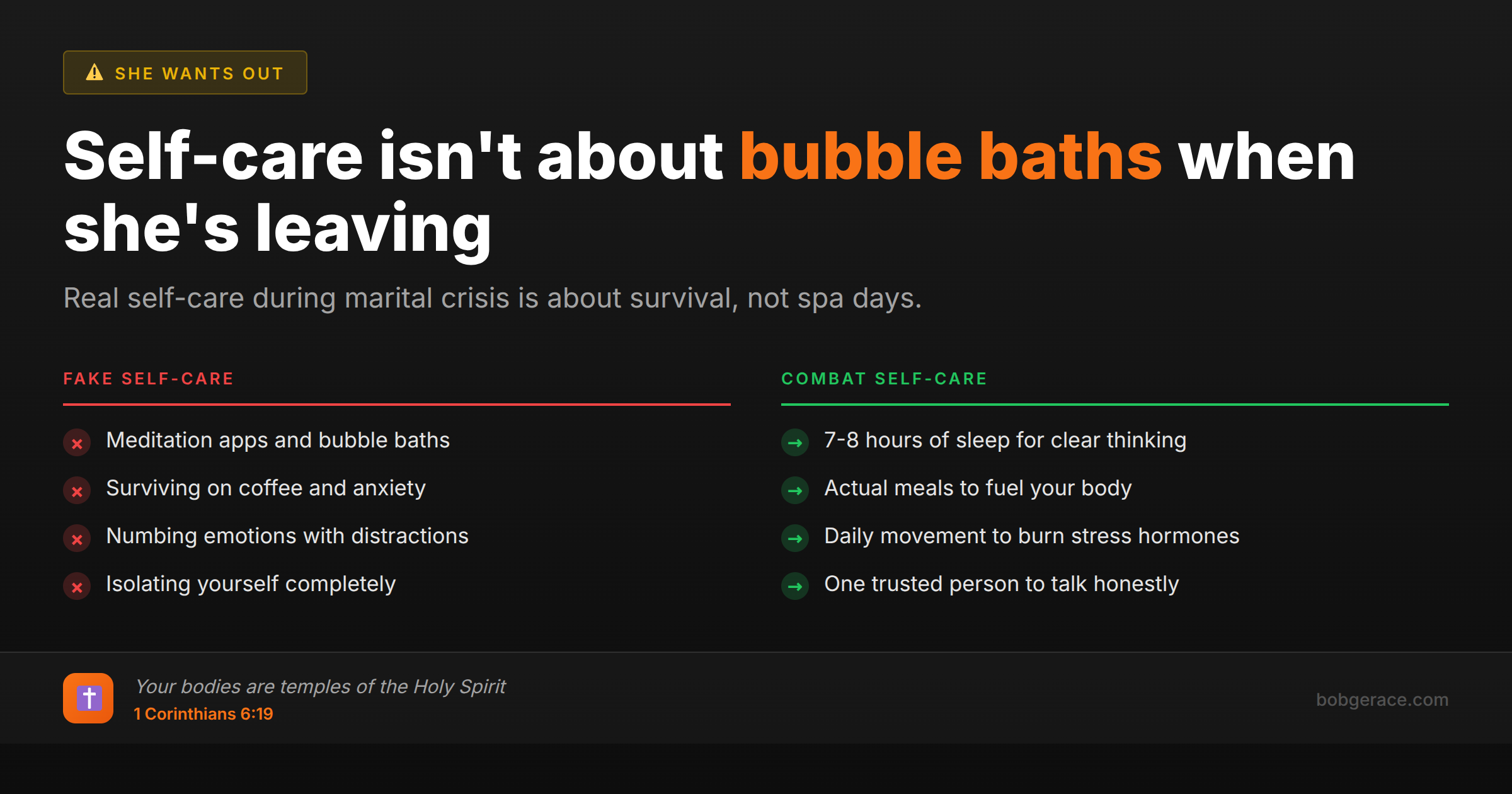
Self-care during marital crisis isn't about bubble baths and meditation apps—it's about survival. When your wife is already acting on her plan to leave, you're in emotional combat mode, and you need to treat yourself like the wounded soldier you are. Real self-care means getting enough sleep so you can think clearly, eating actual meals instead of surviving on coffee and anxiety, and moving your body to burn off the stress hormones flooding your system. It means having at least one person you can talk to honestly, setting boundaries with people who drain you, and doing the hard work of processing your emotions instead of numbing them. This isn't selfish—it's strategic. You can't save your marriage from a place of complete depletion.
The Full Picture
Most men think self-care is selfish when their marriage is falling apart. You're wrong. Self-care during crisis isn't about pampering yourself while your world burns—it's about maintaining the emotional, physical, and mental capacity to handle what's coming.
When your wife is already acting on her exit plan, your nervous system is in constant fight-or-flight mode. Your cortisol levels are through the roof, your sleep is garbage, and you're probably not eating regularly. This isn't just uncomfortable—it's impairing your judgment at the exact moment you need clarity most.
Physical self-care basics: • Force yourself to eat three meals a day, even if it's just protein bars • Get 6-7 hours of sleep minimum—take melatonin if you have to • Move your body daily to burn off stress hormones • Limit alcohol—it's a depressant that will make everything worse
Emotional self-care essentials: • Find one trusted friend or counselor to process with • Journal for 10 minutes daily to get thoughts out of your head • Set boundaries with people who offer unhelpful advice • Give yourself permission to feel angry, sad, and confused without judgment
Mental self-care strategies: • Limit social media and news consumption • Read or listen to something encouraging daily • Practice basic mindfulness to stay present • Avoid major life decisions while in crisis mode
The goal isn't to feel good—it's to maintain your capacity to think clearly, respond wisely, and show up as the man you want to be regardless of what your wife chooses to do.
What's Really Happening
From a clinical perspective, men experiencing marital crisis often display symptoms consistent with acute stress reaction and sometimes adjustment disorder. The chronic activation of your sympathetic nervous system creates a cascade of psychological and physiological effects that actually impair your ability to navigate the crisis effectively.
Research shows that chronic stress elevates cortisol levels, which directly impacts executive functioning—your ability to make decisions, regulate emotions, and think strategically. This is why men in marital crisis often report feeling "foggy" or making impulsive decisions they later regret.
Trauma-informed self-care recognizes that your nervous system needs specific interventions to return to baseline functioning. Progressive muscle relaxation, controlled breathing exercises, and bilateral stimulation activities (like walking or bilateral music) can help regulate your autonomic nervous system.
The concept of "emotional first aid" applies here. Just as you wouldn't ignore a physical wound, emotional wounds from betrayal, rejection, and loss require immediate and ongoing care. Men often struggle with this because they've been socialized to "push through" pain rather than tend to it.
Clinical research on resilience identifies several protective factors: social support, meaning-making, physical health maintenance, and emotional regulation skills. These aren't luxuries during crisis—they're necessities for psychological survival and eventual recovery.
Ignoring self-care during this season doesn't demonstrate strength or dedication to your marriage—it demonstrates poor crisis management that ultimately undermines your capacity to respond effectively to whatever comes next.
What Scripture Says
Scripture is clear that caring for yourself isn't selfish—it's stewardship. 1 Corinthians 6:19-20 reminds us: "Do you not know that your bodies are temples of the Holy Spirit, who is in you, whom you have received from God? You are not your own; you were bought at a price. Therefore honor God with your bodies."
This isn't just about avoiding sin—it's about actively caring for what God has entrusted to you, including your physical and emotional health.
Jesus modeled self-care throughout His ministry. Mark 1:35 tells us: "Very early in the morning, while it was still dark, Jesus got up, left the house and went off to a solitary place, where he prayed." Even the Son of God needed time alone to process and recharge.
Psalm 23:2-3 paints a picture of God's heart for our restoration: "He makes me lie down in green pastures, he leads me beside quiet waters, he refreshes my soul." God desires your restoration, not your depletion.
The principle of Sabbath rest shows us that rest is not laziness—it's obedience. Exodus 20:8 commands us to remember the Sabbath and keep it holy. This includes mental and emotional rest, not just physical inactivity.
1 Kings 19 shows us Elijah in deep depression after a major spiritual victory. God's response wasn't to rebuke him for weakness—God provided food, rest, and gentle care before addressing the spiritual issues. This is our model for crisis care.
Matthew 22:39 tells us to "love your neighbor as yourself"—which assumes appropriate self-love and self-care as the foundation for loving others well.
What To Do Right Now
-
1
Schedule three actual meals today and eat them, even if you don't feel hungry
-
2
Set a consistent bedtime and wake time, aiming for 7-8 hours of sleep nightly
-
3
Take a 20-minute walk outside daily, preferably in natural light
-
4
Identify one trusted friend or counselor and schedule a weekly check-in
-
5
Create a simple morning routine that includes prayer, reading, or journaling
-
6
Set boundaries with people who drain your energy or offer unhelpful advice
Related Questions
- How do I grieve while also fighting?
- How do I manage my nervous system through legal proceedings?
- How do I stay grounded when everything feels adversarial?
- How do I function at work after hearing this?
- What does healthy coping look like?
- How do I not let lawyers poison what's left?
- How do I not lose my mind right now?
- What does trauma recovery look like?
- What is self-care in crisis?
- How do I regulate my own system?
Also find Bob on
Subscribe for weekly videos on Christian marriage.
Self-Care Is Different When It's Your Marriage
What you actually need right now—sleep, boundaries, who to lean on—depends on where your wife is and what's happening this week. A coach who knows your situation can help you stay functional when it matters most.
Talk to Bob →