How do I notice feelings in my body?
6 min read
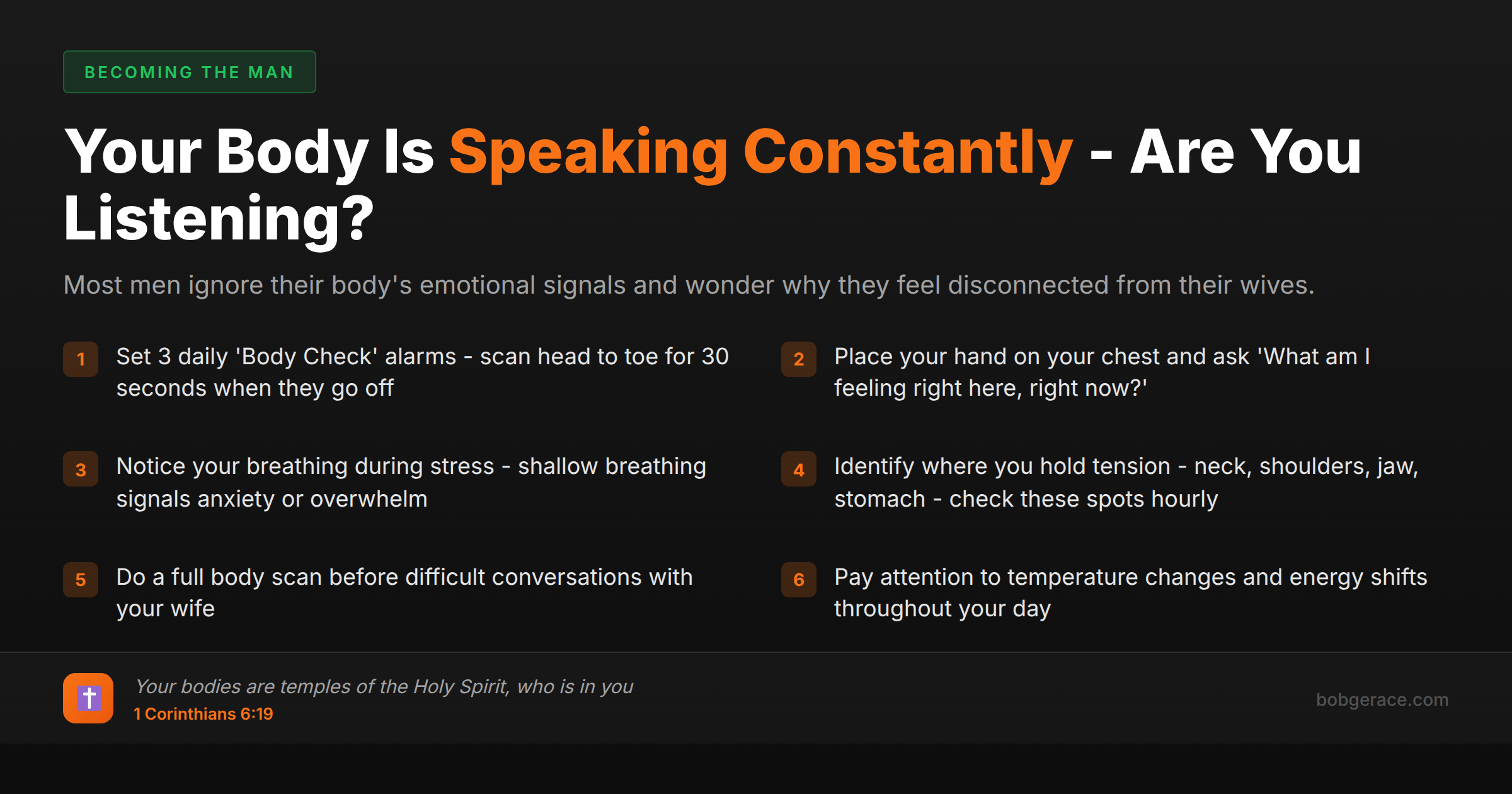
Learning to notice feelings in your body starts with slowing down and paying attention to physical sensations. Your body is constantly communicating emotional information through tension, temperature changes, breathing patterns, and energy levels. Most men have been conditioned to ignore these signals, but they're crucial for emotional intelligence. Start by doing regular body scans throughout your day. Notice where you hold tension when stressed, how your chest feels when anxious, or what happens in your stomach when angry. Practice placing your hand on different parts of your body and asking, 'What am I feeling here right now?' This simple awareness builds the foundation for understanding your emotional landscape and responding more thoughtfully in your marriage.
The Full Picture
Your body is like an early warning system for your emotions, but most guys never learned how to read the signals. We've been taught to push through, ignore discomfort, and 'man up' - which actually disconnects us from valuable emotional intelligence.
Here's what's really happening: Every emotion creates a physical response in your body. Anger might show up as tension in your jaw or heat in your chest. Anxiety often appears as a tight stomach or shallow breathing. Sadness can feel like heaviness in your chest or shoulders. Fear might create butterflies in your stomach or make your hands shake.
The problem is we're moving so fast and staying so busy that we miss these signals entirely. Then we wonder why we explode at our wives or shut down emotionally without warning.
Body awareness isn't soft or feminine - it's practical intelligence. Professional athletes use body awareness to perform at their peak. Military personnel are trained to notice physical stress responses. Business leaders who understand their physical stress signals make better decisions under pressure.
When you start tuning into your body's emotional signals, you gain lead time. Instead of going from zero to angry in two seconds, you notice the tension building in your shoulders first. Instead of shutting down without explanation, you recognize the heaviness in your chest that signals overwhelm.
This skill transforms your marriage because you can communicate what's happening before it becomes a problem. Your wife stops walking on eggshells because you're more predictable and self-aware. You stop apologizing for emotional reactions you didn't see coming.
What's Really Happening
From a neurobiological perspective, emotions always manifest as physical sensations before we consciously recognize them. The body's interoceptive system - our ability to sense internal signals - is fundamental to emotional regulation and relationship success.
Research shows that men often have lower interoceptive awareness than women, partly due to socialization and partly due to how male brains process emotions differently. The male brain tends to compartmentalize emotions, which can actually make body awareness more challenging but also more crucial.
When we ignore bodily sensations, we're essentially flying blind emotionally. The autonomic nervous system continues generating stress responses, but without conscious awareness, these build up until they explode or implode. This is why many men experience what seems like sudden anger or unexpected emotional shutdown.
Developing interoceptive skills literally rewires your brain. The insula, which processes body awareness, becomes more active and better connected to prefrontal regions responsible for emotional regulation. This creates what we call 'embodied emotional intelligence' - the ability to use physical sensations as emotional information.
Practically, this means teaching clients to identify their unique emotional-physical patterns. Some men carry stress in their neck and shoulders, others in their digestive system. Learning your personal patterns creates an early warning system that prevents emotional reactivity and improves relationship communication.
What Scripture Says
Scripture presents a unified view of human beings - body, soul, and spirit working together. God designed our physical bodies to be vessels of wisdom and discernment, not obstacles to overcome.
'Do you not know that your bodies are temples of the Holy Spirit, who is in you, whom you have received from God?' (1 Corinthians 6:19). Your body isn't just housing for your spirit - it's a sacred space where God dwells and communicates.
'Above all else, guard your heart, for everything you do flows from it' (Proverbs 4:23). The Hebrew word for heart includes both emotional and physical aspects. Guarding your heart means paying attention to what's happening in your body and emotions.
'Be still, and know that I am God' (Psalm 46:10). Stillness isn't just mental - it's physical. When we slow down enough to notice what's happening in our bodies, we create space for God's wisdom and peace.
'A heart at peace gives life to the body, but envy rots the bones' (Proverbs 14:30). This verse shows the clear connection between emotional health and physical well-being. When we ignore our emotional life, it affects our entire being.
'In your anger do not sin: Do not let the sun go down while you are still angry' (Ephesians 4:26). Notice Paul doesn't say don't get angry - he says don't sin in your anger. Part of healthy anger is recognizing it in your body before it becomes sinful action.
'The simple believe anything, but the prudent give thought to their steps' (Proverbs 14:15). Being prudent includes understanding your own emotional and physical patterns so you can respond wisely rather than reactively.
What To Do Right Now
-
1
Set three phone alarms throughout your day labeled 'Body Check' - when they go off, scan your body from head to toe for 30 seconds
-
2
Practice the 'Hand on Heart' technique - place your hand on your chest and ask 'What am I feeling right here, right now?'
-
3
Notice your breathing patterns during different activities - shallow breathing often signals stress or anxiety
-
4
Identify where you physically hold stress - neck, shoulders, jaw, stomach - and check these spots regularly
-
5
Before difficult conversations with your wife, do a 60-second body scan and name what you notice out loud
-
6
Create an emotion-body map by noting where you feel different emotions like anger, sadness, fear, and joy
Related Questions
- How do I identify what I'm feeling?
- What is 'alexithymia' and do I have it?
- How do I build emotional vocabulary?
- What is emotional granularity?
- What's the difference between thinking and feeling?
- How do I track emotional triggers?
- What is 'window of tolerance' and how do I widen mine?
- How do I regulate my own system?
- What does my body need right now?
- What's happening in my nervous system right now?
Also find Bob on
Subscribe for weekly videos on Christian marriage.
Ready to Apply This to Your Marriage?
Body awareness is a skill. Using it to change how you show up with your wife is different work. A coach helps you connect the dots in your specific situation.
Talk to Bob →