What are the components of EQ?
5 min read
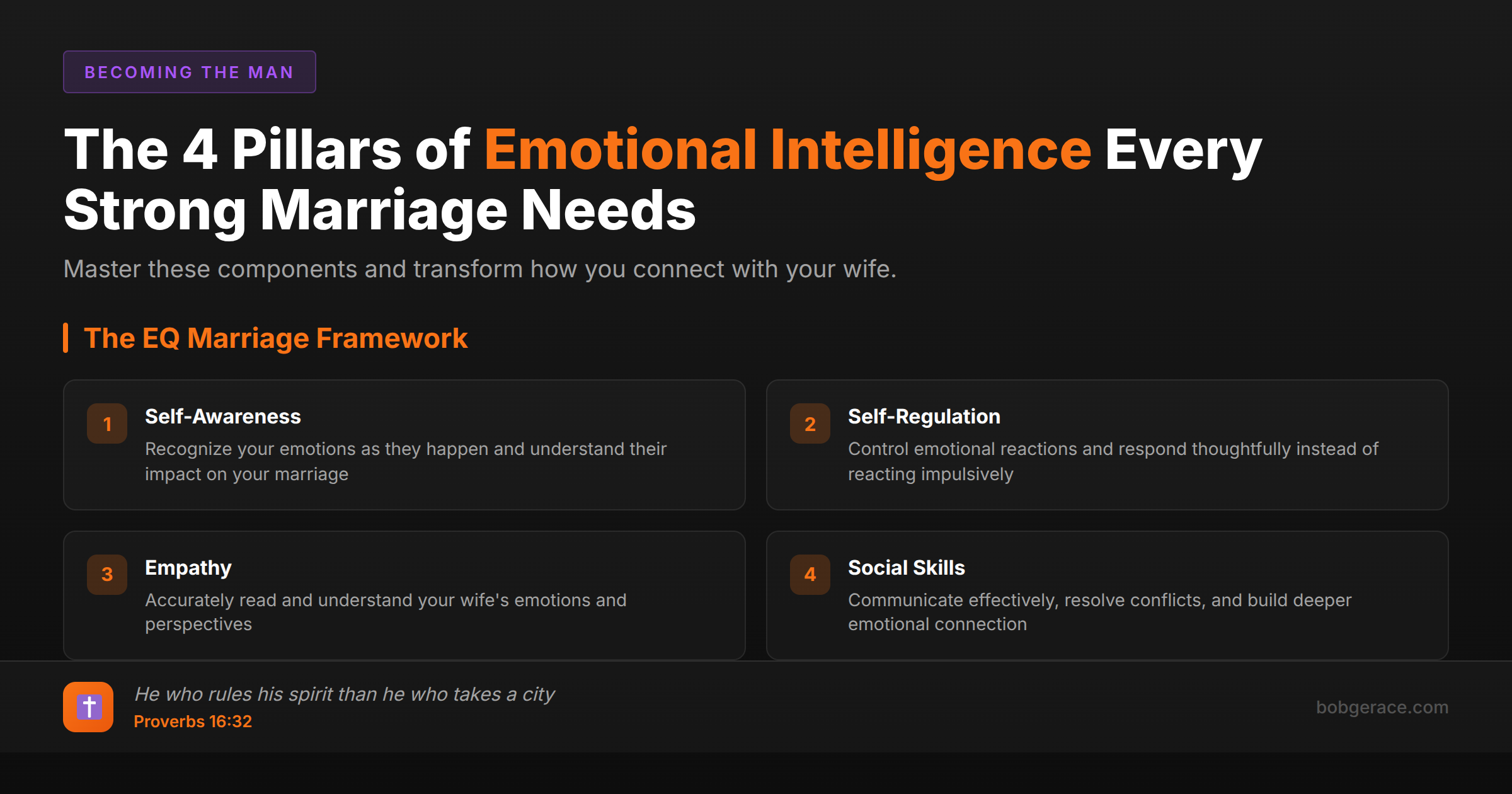
Emotional intelligence consists of four core components that determine how well you understand and manage emotions in your marriage. Self-awareness means recognizing your emotions as they happen and understanding their impact. Self-regulation is your ability to control emotional reactions and respond thoughtfully rather than react impulsively. Empathy involves accurately reading and understanding your wife's emotions and perspectives. Social skills encompass your ability to communicate effectively, resolve conflicts, and build deeper connection through emotional understanding. These four pillars work together to create the emotional foundation every strong marriage requires.
The Full Picture
Think of emotional intelligence as your marriage's operating system. Just like your phone needs iOS or Android to function, your relationship needs EQ to thrive. Without it, you're running on emotional dial-up while your marriage needs high-speed connection.
The four components aren't separate skills—they're interconnected systems that build on each other. Self-awareness is your foundation. You can't manage what you don't recognize. When you feel that familiar tension rising during a disagreement, self-awareness helps you identify: "I'm feeling defensive because I think she's criticizing my decision-making."
Self-regulation takes that awareness and gives you choice. Instead of snapping back or shutting down, you pause. You breathe. You choose your response based on what serves your marriage, not what feels good in the moment.
Empathy shifts your focus outward. It's not just hearing your wife's words—it's understanding the emotions behind them. When she says "You never help with dinner," empathy helps you hear "I feel overwhelmed and unsupported" instead of "I'm being attacked."
Social skills bring it all together. This is where you translate emotional understanding into connection. You validate her feelings, communicate your own clearly, and work together toward solutions.
Most men excel at one or two components but struggle with others. The guy who's great at self-regulation might lack empathy. The naturally empathetic husband might struggle with self-awareness. Growth happens when you develop all four systematically.
What's Really Happening
In my practice, I see how these EQ components interact daily. The husband who storms out during arguments lacks self-regulation. The man who can't understand why his wife is upset about something that seems trivial to him struggles with empathy. The guy who knows he's angry but can't articulate why lacks self-awareness.
Neurologically, these components represent different brain functions. Self-awareness involves the prefrontal cortex recognizing limbic system activity. Self-regulation requires the prefrontal cortex to modulate that limbic response. Empathy activates mirror neurons and theory of mind networks. Social skills integrate all these systems with language and behavioral planning centers.
What's fascinating is how these components create feedback loops. Poor self-awareness leads to emotional reactivity, which damages social connection, which reduces motivation for empathy, which further impairs self-awareness. It's a downward spiral I see repeatedly.
But the reverse is also true. As men develop one component, others naturally improve. Building self-awareness through mindfulness practices enhances self-regulation. Improved self-regulation creates space for empathy. Greater empathy motivates better social skills. It's an upward spiral that transforms not just the man, but his entire relational world.
The key insight: EQ isn't fixed. These are learnable skills that physically change your brain through neuroplasticity. Every time you pause instead of react, every moment you truly listen to understand rather than defend, you're literally rewiring your neural pathways for better relationships.
What Scripture Says
Scripture beautifully illustrates each EQ component through both teaching and example. Self-awareness is reflected in David's psalms: *"Search me, God, and know my heart; test me and know my anxious thoughts"* (Psalm 139:23). David regularly examined his inner world, inviting God into his emotional reality.
Self-regulation is captured in Proverbs: *"Whoever is slow to anger is better than the mighty, and he who rules his spirit than he who takes a city"* (Proverbs 16:32). The ability to govern your emotional responses is presented as greater than military conquest. James echoes this: *"Be quick to listen, slow to speak, slow to anger"* (James 1:19).
Empathy is Jesus's defining characteristic. *"When he saw the crowds, he had compassion for them, because they were harassed and helpless, like sheep without a shepherd"* (Matthew 9:36). Christ didn't just observe people's circumstances—He felt their emotional reality. Paul commands this same empathy: *"Rejoice with those who rejoice, weep with those who weep"* (Romans 12:15).
Social skills are outlined in Ephesians: *"Let no corrupting talk come out of your mouths, but only such as is good for building up, as fits the occasion, that it may give grace to those who hear"* (Ephesians 4:29). Every word should serve connection and edification.
Perhaps most powerfully, 1 Corinthians 13 describes love through EQ components: patient (self-regulation), kind (social skills), not self-seeking (empathy), keeping no record of wrongs (self-awareness of forgiveness). Biblical love is emotional intelligence in action, making EQ development not just practical but deeply spiritual.
What To Do Right Now
-
1
Start an emotion journal - Write down what you're feeling three times daily for one week to build self-awareness
-
2
Practice the pause - When you feel triggered, count to ten and take three deep breaths before responding
-
3
Ask empathy questions - When your wife shares something, ask 'How did that make you feel?' and really listen
-
4
Use 'I' statements - Replace 'You always...' with 'I feel...' in your conversations this week
-
5
Schedule daily check-ins - Spend 10 minutes each evening asking about each other's emotional experiences
-
6
Study one biblical example - Choose David, Jesus, or Paul and note how they demonstrated emotional intelligence in one specific story
Related Questions
Ready to Master All Four EQ Components?
Get personalized coaching to develop the emotional intelligence that transforms marriages from the inside out.
Start Coaching →