What is emotional intelligence and why does it matter?
5 min read
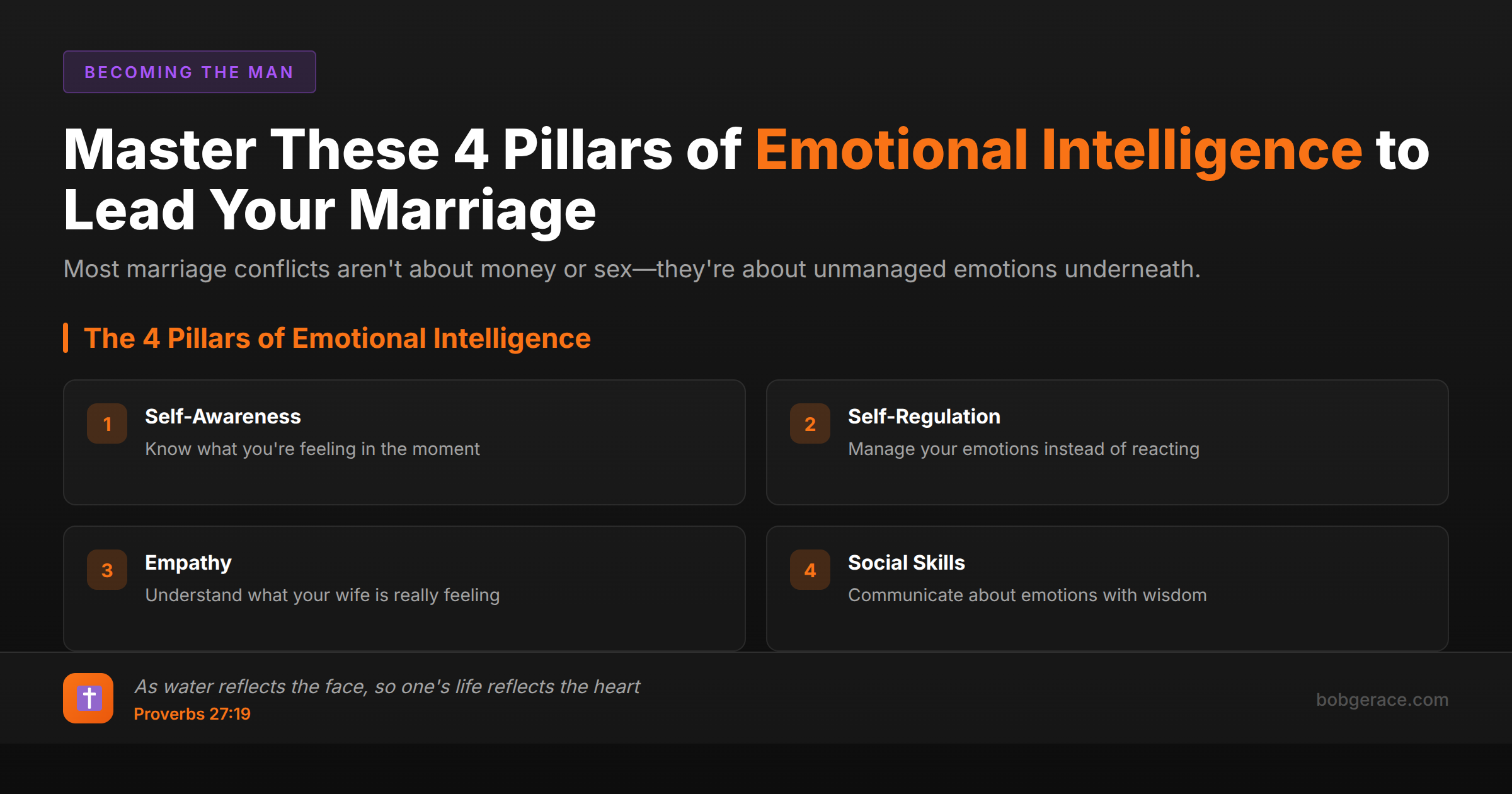
Emotional intelligence is your ability to recognize, understand, and manage both your own emotions and those of others - especially your wife. It's built on four pillars: self-awareness (knowing what you're feeling), self-regulation (managing those feelings), empathy (understanding her emotions), and social skills (communicating effectively about emotions). This matters because most marriage conflicts aren't really about money, sex, or kids - they're about unmanaged emotions underneath those topics. When you develop emotional intelligence, you stop reacting defensively and start responding with wisdom. You become the kind of husband who can stay calm in conflict, truly hear your wife's heart, and lead your marriage through difficult seasons with strength and grace.
The Full Picture
Here's what most men don't realize: your marriage isn't struggling because of external circumstances - it's struggling because of unmanaged internal emotions.
Emotional intelligence (EQ) consists of four critical components that every husband must master:
Self-Awareness - This is knowing what you're actually feeling in real-time. Most men live emotionally numb until they explode. High EQ means you notice the tension building in your shoulders during a difficult conversation, recognize the frustration before it becomes anger, and identify the hurt underneath your defensiveness.
Self-Regulation - This is managing your emotional responses. It's not about suppressing feelings - it's about choosing your response instead of being controlled by your impulses. When your wife brings up a sensitive topic, self-regulation lets you stay present instead of shutting down or getting defensive.
Empathy - This is accurately reading and understanding your wife's emotional experience. Most husbands try to fix, dismiss, or debate their wife's emotions. Empathy means you can feel what she's feeling without losing yourself in it, and respond to her heart, not just her words.
Social Skills - This is communicating about emotions effectively. It's knowing how to have the hard conversations, how to validate feelings without agreeing with everything, and how to lead through conflict toward resolution.
Here's the game-changer: marriages don't fail because of incompatibility - they fail because of emotional incompetence. The couples who thrive aren't the ones who never have problems; they're the ones who can navigate emotions skillfully when problems arise.
What's Really Happening
From a clinical perspective, emotional intelligence is the strongest predictor of marriage satisfaction and longevity. Research consistently shows that couples with higher emotional intelligence have better conflict resolution, deeper intimacy, and greater relationship stability.
What I observe in my practice is that most husbands operate with what I call 'emotional tunnel vision.' They can identify basic emotions like anger or happiness, but they miss the complex emotional landscape that drives most marital dynamics. They don't recognize that their wife's 'nagging' about the dishes might actually be her feeling unseen and undervalued. They don't realize that their tendency to withdraw isn't just personality - it's often fear of conflict or inadequacy.
Neurologically, when we're emotionally triggered, our amygdala hijacks our prefrontal cortex - the rational thinking part of our brain. This is why smart, capable men can become reactive, defensive, or shut down during marital conflict. Emotional intelligence literally rewires these patterns by strengthening the neural pathways between emotional awareness and rational response.
The husbands who develop emotional intelligence create what researchers call 'secure attachment' in their marriages. Their wives feel emotionally safe, understood, and valued. This isn't just feel-good psychology - it's measurable. These couples report higher satisfaction, better physical intimacy, and significantly lower divorce rates. Emotional intelligence isn't soft skills - it's the foundation of strong marriages.
What Scripture Says
Scripture calls us to emotional wisdom and maturity that goes far beyond worldly understanding. God designed us as emotional beings, and developing emotional intelligence is part of becoming the man He's called us to be.
Proverbs 27:19 reminds us: *"As water reflects the face, so one's life reflects the heart."* Self-awareness starts with honest examination of our hearts before God. We can't lead others emotionally if we don't understand our own inner world.
Proverbs 16:32 teaches us about self-regulation: *"Better a patient person than a warrior, one with self-control than one who takes a city."* True strength isn't in emotional reactivity - it's in emotional mastery under God's authority.
Empathy is modeled perfectly in Romans 12:15: *"Rejoice with those who rejoice; mourn with those who mourn."* This isn't just being nice - it's entering into another person's emotional experience with understanding and compassion.
Ephesians 4:15 shows us godly social skills: *"Speaking the truth in love, we will grow to become in every respect the mature body of him who is the head, that is, Christ."* We're called to communicate with both truth and love - addressing real issues while honoring the person.
1 Peter 3:7 directly commands husbands: *"Live with your wives in an understanding way."* The Greek word for understanding means 'to know thoroughly' - including her emotional world.
James 1:19 gives us the perfect framework: *"Be quick to listen, slow to speak and slow to become angry."* This is emotional intelligence in action - awareness, regulation, empathy, and wise communication all working together.
What To Do Right Now
-
1
Start an emotion journal - write down what you're feeling twice daily for one week, using specific emotion words beyond 'good,' 'bad,' 'fine,' or 'frustrated.'
-
2
Practice the pause - when you feel triggered in conversation, take three deep breaths and ask yourself 'What am I really feeling right now?' before responding.
-
3
Ask your wife this question: 'Help me understand what you're feeling right now' - then listen without trying to fix, defend, or problem-solve.
-
4
Identify your emotional triggers - the specific topics, tones, or situations that cause you to shut down or react defensively, and share these with your wife.
-
5
Practice validation - when your wife shares emotions, respond with 'That makes sense that you'd feel that way' before trying to discuss solutions.
-
6
End each day by asking your wife: 'How did I do today at understanding and responding to your heart?' and genuinely listen to her feedback.
Related Questions
- How do I become emotionally intelligent?
- What are the components of EQ?
- How do I identify what I'm feeling?
- What is 'alexithymia' and do I have it?
- How do I build emotional vocabulary?
- What does emotional attunement look like?
- Why do I get defensive every time?
- She says I'm emotionally unavailable
- How do I stop the mental movies?
- What does 'holding space' actually mean?
Also find Bob on
Subscribe for weekly videos on Christian marriage.
Ready to Apply This to Your Marriage?
Understanding emotional intelligence is one thing. Practicing it in your specific marriage—with your wife's patterns, your triggers, your history—is another. A coach helps you see what you can't see alone.
Talk to Bob →