How do I build emotional vocabulary?
6 min read
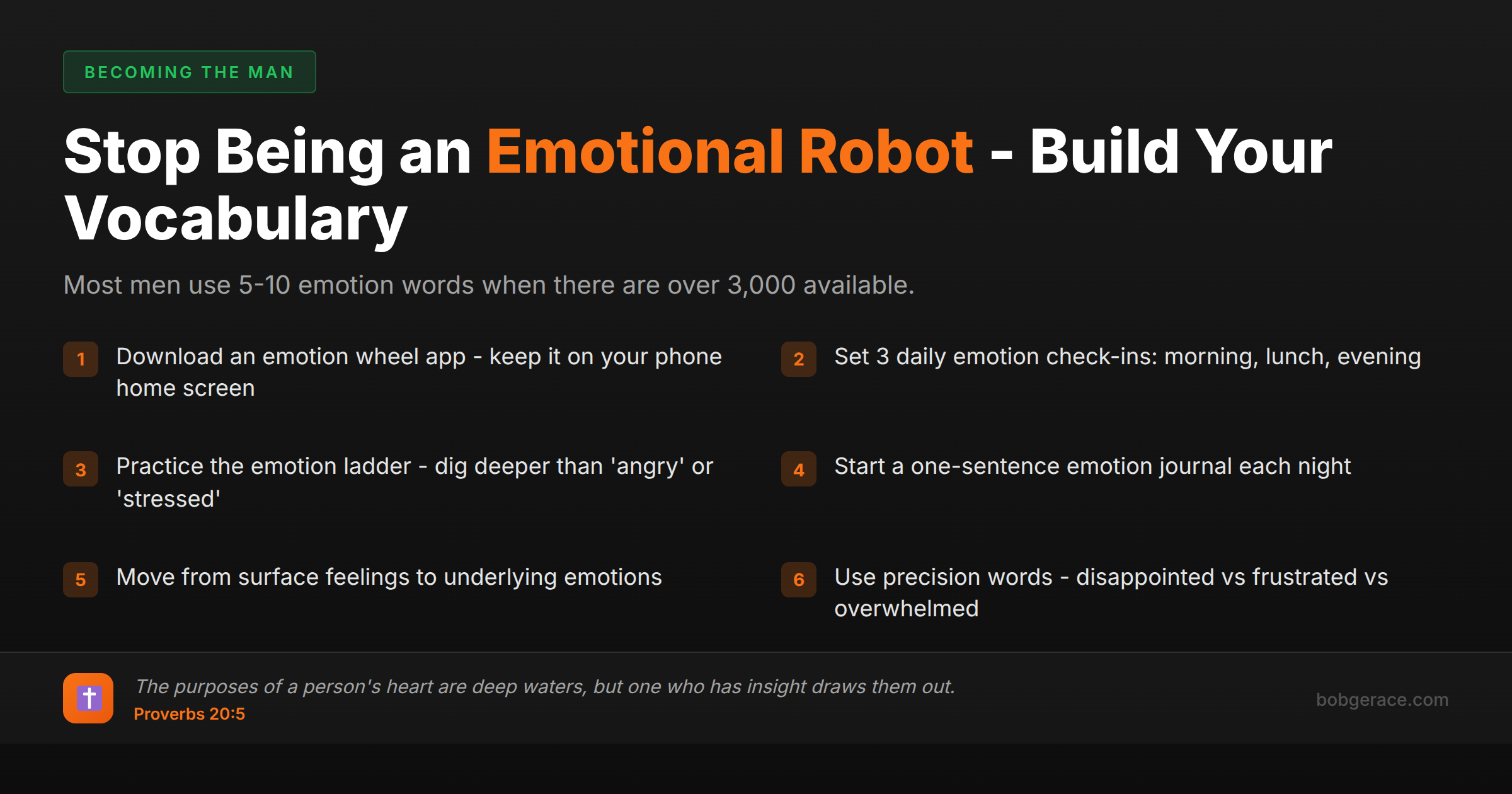
Building emotional vocabulary starts with intentional practice in naming what you're actually feeling beyond 'good,' 'bad,' or 'fine.' Most men operate with about 5-10 emotional words when there are over 3,000 emotion-related terms in English. Start by keeping an emotion wheel or feelings chart handy and referring to it three times daily. The key is moving from surface-level emotions to the underlying feelings. When you say you're 'angry,' dig deeper - are you actually disappointed, frustrated, overwhelmed, or hurt? This precision helps your wife understand you better and creates the emotional intimacy she craves. Remember, emotional vocabulary isn't touchy-feely nonsense - it's a practical communication tool that strengthens your marriage.
The Full Picture
Here's what most men don't realize: your wife isn't asking you to become emotional - she's asking you to become emotionally articulate. There's a massive difference.
Think about it this way - if you only knew five words to describe your car problems ('broken,' 'loud,' 'slow,' 'hot,' 'dead'), you'd struggle to communicate with a mechanic. Emotions work the same way. When you can only say 'fine,' 'stressed,' or 'angry,' your wife feels locked out of your inner world.
The problem compounds because women typically have larger emotional vocabularies than men. She might say she's feeling 'overlooked and undervalued,' while you respond with 'whatever.' This isn't because you don't have those feelings - it's because you haven't developed the language to express them.
Building emotional vocabulary serves three purposes: First, it helps you understand yourself better. When you can name that you're feeling 'overwhelmed' rather than just 'stressed,' you can address the root cause. Second, it dramatically improves communication with your wife. Third, it models emotional intelligence for your children.
The resistance is normal. Many men worry that developing emotional vocabulary will make them 'soft' or less masculine. The opposite is true. A man who can clearly articulate his feelings demonstrates strength, self-awareness, and leadership. Your wife doesn't want you to cry at commercials - she wants to know what's happening in your heart and mind.
What's Really Happening
From a clinical perspective, limited emotional vocabulary - called alexithymia when severe - is incredibly common among men and stems from both biological and social factors. The male brain tends to process emotions differently, often moving quickly to problem-solving mode rather than emotional processing.
Neurologically, men often experience emotions in their bodies before recognizing them cognitively. You might feel tension in your shoulders (stress), tightness in your chest (anxiety), or restlessness (frustration) before you can name the emotion. This body-first experience is why many men say they 'don't know' what they're feeling - they're experiencing it physically without the cognitive framework to label it.
The social conditioning compounds this. Most men were taught that emotions are private, weakness-inducing, or simply unimportant compared to actions and achievements. This creates what I call 'emotional illiteracy' - you have the feelings but lack the language to express them effectively.
In marriage therapy, I see this pattern constantly: wives expressing detailed emotional experiences while husbands respond with basic, surface-level acknowledgments. This isn't emotional deficiency - it's skill deficiency. The good news is that emotional vocabulary, like any language, can be learned and expanded through intentional practice. Research shows that men who develop broader emotional vocabularies report higher marital satisfaction and better conflict resolution skills.
What Scripture Says
Scripture is rich with emotional vocabulary and calls men to emotional wisdom and expression. Proverbs 20:5 tells us, *"The purposes of a person's heart are deep waters, but one who has insight draws them out."* God designed you with complex emotions and expects you to develop the insight to understand and express them.
Jesus Himself demonstrated remarkable emotional vocabulary. He expressed being *"deeply moved"* (John 11:33), *"sorrowful to the point of death"* (Matthew 26:38), and felt *"compassion"* for the crowds (Matthew 9:36). Christ didn't simply say He felt 'bad' - He articulated the specific nature of His emotional experiences.
Proverbs 27:19 states, *"As water reflects the face, so one's life reflects the heart."* Your emotional vocabulary reflects the condition and complexity of your heart. A limited vocabulary suggests an unexamined heart, while rich emotional language demonstrates the self-awareness God calls you to develop.
The principle of edification applies directly here. Ephesians 4:29 commands: *"Do not let any unwholesome talk come out of your mouths, but only what is helpful for building others up according to their needs, that it may benefit those who listen."* Vague emotional responses like 'fine' or 'whatever' don't build up your wife - precise, honest emotional communication does.
Consider David's emotional vocabulary in the Psalms - he expressed feeling abandoned, joyful, fearful, confident, sorrowful, and hopeful, often in the same psalm. Psalm 139:23-24 shows his commitment to emotional self-examination: *"Search me, God, and know my heart; test me and know my anxious thoughts."*
What To Do Right Now
-
1
Download an emotion wheel app or print an emotions chart - keep it visible on your desk, bathroom mirror, or phone home screen
-
2
Set three daily emotion check-ins (morning, lunch, evening) where you identify and name your current emotional state using specific words
-
3
Start an emotion journal - write one sentence each night describing your strongest emotion of the day and what triggered it
-
4
Practice the 'emotion ladder' technique - when you feel 'angry' or 'stressed,' ask yourself what three more specific emotions might be underneath
-
5
Read one Psalm per day focusing specifically on David's emotional vocabulary - write down emotion words you don't typically use
-
6
Share your daily emotion check-in with your wife for one week, using the new vocabulary you're learning
Related Questions
- What is emotional intelligence and why does it matter?
- What is 'alexithymia' and do I have it?
- How do I identify what I'm feeling?
- What is emotional granularity?
- How do I notice feelings in my body?
- What's the difference between thinking and feeling?
- How do I express emotion without dumping?
- What's underneath my anger?
- What is 'window of tolerance' and how do I widen mine?
- How do I stop the mental movies?
Also find Bob on
Subscribe for weekly videos on Christian marriage.
Your Marriage Needs More Than a Chart
An emotion wheel helps. A coach who knows your specific dynamic and hears how you actually talk to your wife — that's what moves the needle.
Talk to Bob →