How do I stay grounded when everything feels adversarial?
5 min read
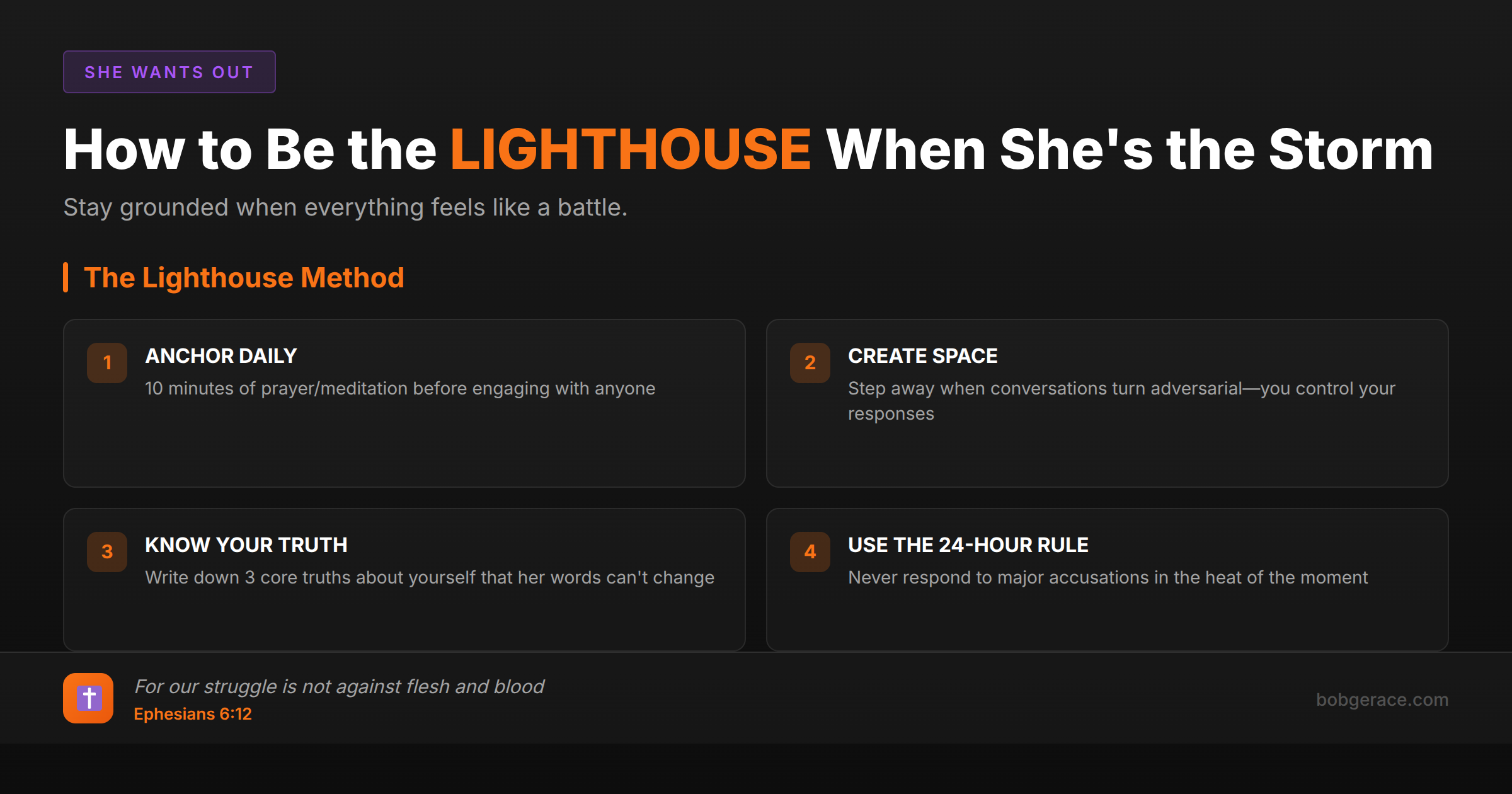
When your marriage feels like a war zone, staying grounded isn't about winning battles—it's about maintaining your center so you can respond rather than react. The key is creating internal stability when external chaos threatens to pull you under. This means establishing non-negotiable daily practices that anchor you, setting clear boundaries around what you will and won't engage with, and remembering that her adversarial behavior often reflects her own pain and fear, not necessarily the truth about you or your worth. You can't control the storm, but you can learn to be the lighthouse—steady, clear-eyed, and offering guidance even in the darkest moments.
The Full Picture
Living in an adversarial marriage is like being trapped in a psychological minefield. Every conversation feels loaded, every interaction carries potential for explosion, and you find yourself walking on eggshells while simultaneously feeling under constant attack. This isn't just uncomfortable—it's genuinely traumatic and can fundamentally alter your nervous system's baseline.
The adversarial dynamic creates several destructive patterns:
• Hypervigilance: You're constantly scanning for threats, which exhausts your mental resources • Emotional dysregulation: Your fight-or-flight response stays chronically activated • Decision paralysis: When everything feels like a trap, you freeze up instead of taking action • Identity erosion: Constant criticism makes you question your own reality and worth
Many men make the mistake of either escalating (fighting fire with fire) or completely withdrawing (emotional shutdown). Both responses actually fuel the adversarial cycle. She escalates because she's not feeling heard or seen, and your escalation or withdrawal confirms her fears that you don't care or can't handle her emotions.
The real challenge isn't surviving the attacks—it's maintaining your authentic self while not getting pulled into her emotional chaos. This requires developing what I call "compassionate detachment"—you care deeply about her and the relationship, but you don't absorb her emotional state as your own reality.
Grounded men understand that adversarial behavior is often a distress signal, not a character assassination. When she's attacking, she's usually drowning in her own pain and fear. This doesn't make the behavior acceptable, but it gives you a framework for responding with strength rather than defensiveness.
What's Really Happening
From a clinical perspective, adversarial dynamics in marriage often indicate that both partners are operating from activated attachment systems. When the relationship feels unsafe, our primitive brain takes over, prioritizing survival over connection. This creates what we call a "negative cycle" where each partner's protective behaviors trigger the other's fears.
Research from Emotionally Focused Therapy shows that adversarial behavior typically masks underlying attachment fears—fear of abandonment, fear of engulfment, or fear of inadequacy. When a wife appears chronically adversarial, she may be experiencing what we call "protest behavior"—an unconscious attempt to get her attachment needs met when she perceives the relationship as threatened.
The neurobiological impact on the male partner is significant. Chronic exposure to adversarial interactions can dysregulate the hypothalamic-pituitary-adrenal axis, leading to elevated cortisol levels, disrupted sleep patterns, and compromised immune function. This physiological stress response can impair cognitive function, making it even harder to respond skillfully to conflict.
Staying grounded requires intentional nervous system regulation. This involves practices that activate the parasympathetic nervous system—deep breathing, progressive muscle relaxation, mindfulness meditation, and physical exercise. The goal is to create enough internal stability that you can observe the dynamic without being consumed by it.
Clinically, I often see that men who successfully navigate adversarial periods are those who can hold two truths simultaneously: they validate their partner's underlying pain while maintaining clear boundaries around unacceptable behavior. This requires emotional differentiation—the ability to be close to someone without losing yourself in their emotional experience.
What Scripture Says
Scripture provides profound wisdom for navigating adversarial relationships with both strength and grace. Ephesians 6:12 reminds us, "For our struggle is not against flesh and blood, but against the rulers, against the authorities, against the powers of this dark world." Your wife isn't your enemy—the real battle is against forces that seek to destroy your marriage.
Proverbs 27:14 warns, "Whoever blesses their neighbor with a loud voice early in the morning will have it counted as a curse." This speaks to the importance of timing and approach. Even good intentions can become adversarial if delivered with poor timing or insensitive methods.
1 Peter 3:7 instructs husbands to "live with your wives in an understanding way, showing honor to the woman as the weaker vessel, since they are heirs with you of the grace of life." This doesn't mean weakness in character, but recognizing that women often experience emotional vulnerability differently than men. Understanding this helps you respond with strength rather than defensiveness.
Proverbs 15:1 offers practical wisdom: "A gentle answer turns away wrath, but a harsh word stirs up anger." When everything feels adversarial, your gentle strength can actually de-escalate rather than inflame.
James 1:19-20 provides a framework for emotional regulation: "Be quick to listen, slow to speak and slow to become angry, because human anger does not produce the righteousness that God desires." This isn't about suppressing your emotions, but about responding thoughtfully rather than reactively.
Finally, Galatians 6:1 calls us to "restore gently" when someone is caught in transgression. Even in adversarial moments, your goal is restoration, not retaliation. This biblical perspective helps you stay grounded in love rather than getting lost in the battle.
What To Do Right Now
-
1
Establish a daily grounding practice—10 minutes of prayer, meditation, or deep breathing every morning before engaging with anyone
-
2
Create physical space when conversations become adversarial—say 'I need a few minutes to process this' and step away
-
3
Write down three core truths about yourself that remain constant regardless of her words or behavior
-
4
Practice the 24-hour rule—don't respond to major accusations or decisions in the heat of the moment
-
5
Identify one person outside the marriage you can talk to honestly without being judged or given quick fixes
-
6
Set one clear boundary about what behavior you will and won't engage with, then communicate it calmly and enforce it consistently
Related Questions
- How do I manage my nervous system through legal proceedings?
- What is 'litigation stress' and how do I cope?
- How do I not let lawyers poison what's left?
- How do I show up as my best self when the system incentivizes my worst?
- What does self-care look like in this season?
- How do I grieve while also fighting?
- How do I function when my body won't calm down?
- What is 'window of tolerance' and how do I widen mine?
- How do I regulate my own system?
Also find Bob on
Subscribe for weekly videos on Christian marriage.
Your Marriage Isn't a Template Case
A coach who knows your specific story can see what you can't see from inside the storm. You don't have to keep guessing what steady looks like in your situation.
Talk to Bob →