How do I not let lawyers poison what's left?
6 min read
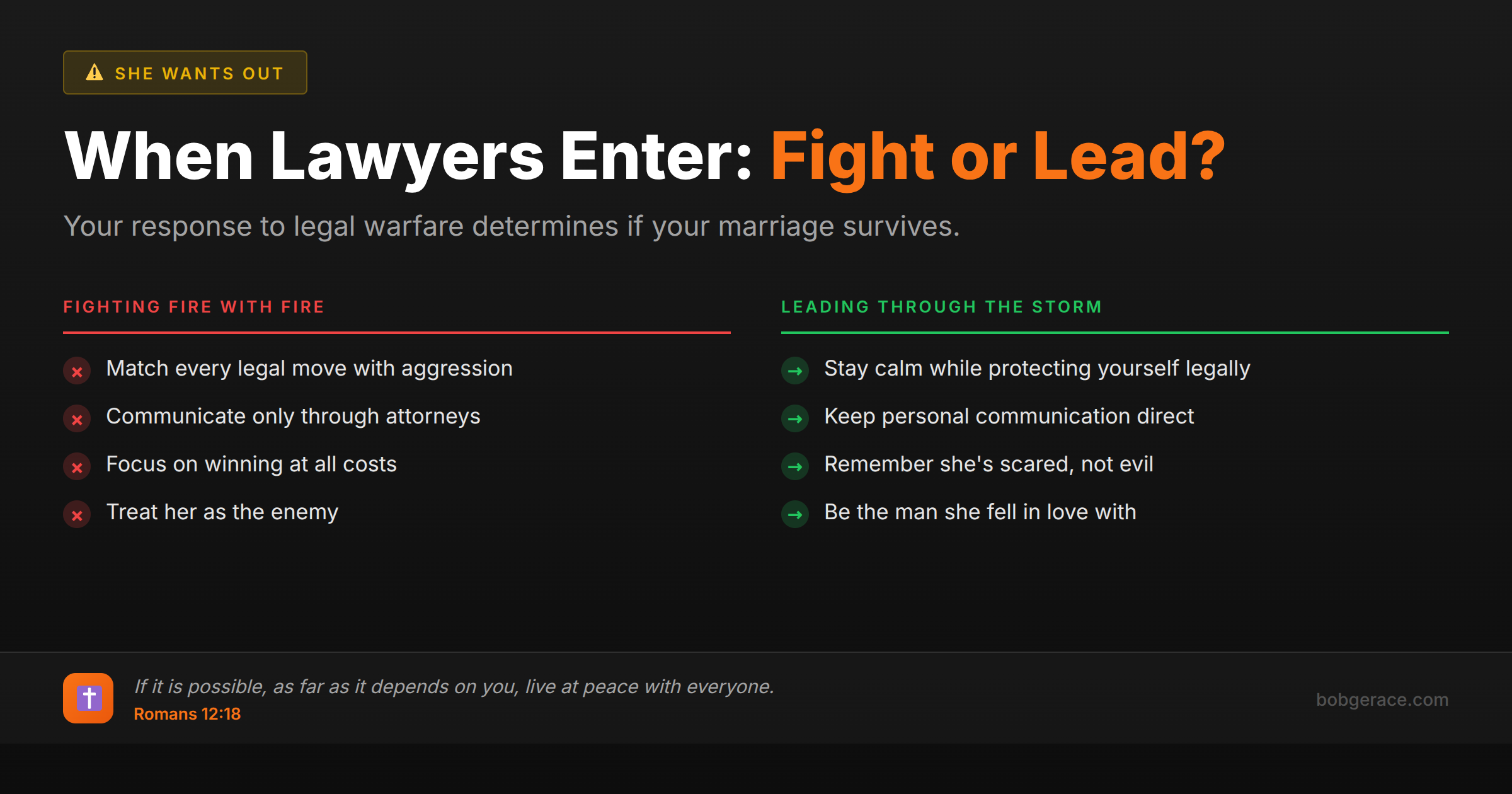
The moment lawyers enter the picture, everything changes. Suddenly, your wife isn't your wife anymore - she's "the opposing party." The lawyers don't get paid to save your marriage; they get paid to protect their client's interests, which often means treating you like the enemy. But here's what I've learned from hundreds of men in your shoes: you can't control what her lawyer says, but you can absolutely control how you respond. The key is remembering that behind all those legal maneuvers is still the woman you married, who's probably as scared and confused as you are. Your job isn't to fight fire with fire - it's to stay the man she fell in love with, even when everyone else is pushing for war.
The Full Picture
When lawyers get involved, they bring their own agenda that has nothing to do with your marriage. Their job is to win, not to heal. They're trained to see conflict, leverage points, and potential problems - not reconciliation opportunities.
Here's what typically happens:
• Her lawyer tells her to document everything - suddenly she's looking for evidence of your failures • Your lawyer tells you to protect yourself - now you're both in defensive mode • Both lawyers advise against direct communication - cutting off the very thing that could save your marriage • Every conversation becomes strategic - authenticity dies when everything is calculated
The most dangerous part isn't the legal process itself - it's how the adversarial mindset seeps into every interaction. You start seeing her moves through a legal lens instead of an emotional one. When she asks for space, you hear "she's building a case." When she's cold, you think "her lawyer told her to document my reaction."
But here's the reality most men miss: even when she has a lawyer, she's still processing this emotionally, not just legally. Yes, she's getting legal advice, but she's also lying in bed at night wondering if this is really what she wants. The lawyer can't make those deeper decisions for her.
The men who navigate this successfully understand that the legal process and the emotional process are separate tracks. You can't ignore the legal reality, but you can't let it completely override the relational opportunity that might still exist.
What's Really Happening
From a psychological perspective, involving attorneys creates what we call "systemic triangulation" - a third party that fundamentally alters the couple's dynamic. Research shows that when couples move into adversarial legal processes, they experience increased cortisol levels and decreased capacity for empathy and creative problem-solving.
The brain's threat detection system becomes hyperactive when lawyers enter the picture. Both spouses begin operating from their amygdala - the fight-or-flight center - rather than their prefrontal cortex where higher-level reasoning occurs. This neurological shift makes reconciliation exponentially more difficult because both parties are literally less capable of seeing nuanced solutions.
What's particularly challenging is that lawyers are trained in positional bargaining, which is the opposite of the collaborative communication that saves marriages. They focus on "getting the best deal" rather than "finding mutual understanding." This creates what attachment theory calls "protest behaviors" - both spouses begin acting in ways designed to protect themselves rather than connect with each other.
However, it's crucial to understand that hiring a lawyer doesn't necessarily mean she's emotionally committed to divorce. Many women seek legal counsel as a way to feel more secure and in control during a chaotic time. The legal action may be more about self-protection than relationship termination. Studies indicate that up to 30% of people who file for divorce experience ambivalence throughout the process, suggesting that emotional doors may remain open even when legal doors appear to be closing.
What Scripture Says
Scripture gives us clear guidance on how to respond when others treat us as adversaries, even when we're facing legal challenges.
Matthew 5:39 reminds us, "But I tell you, do not resist an evil person. If anyone slaps you on the right cheek, turn to them the other cheek also." This doesn't mean becoming a doormat legally, but it means not matching aggression with aggression.
Romans 12:18 instructs us: "If it is possible, as far as it depends on you, live at peace with everyone." Notice it says "as far as it depends on you." You can't control her lawyer's advice or her responses, but you can control whether you contribute to the escalation.
Proverbs 15:1 tells us that "A gentle answer turns away wrath, but a harsh word stirs up anger." Every interaction with her, even through lawyers, is an opportunity to demonstrate the character that originally drew her to you.
1 Peter 3:9 challenges us: "Do not repay evil with evil or insult with insult. On the contrary, repay evil with blessing, because to this you were called so that you may inherit a blessing." This is incredibly difficult when you feel attacked legally, but it's often the very thing that breaks through her defenses.
Ephesians 4:26-27 warns us: "In your anger do not sin: Do not let the sun go down while you are still angry, and do not give the devil a foothold." Bitterness toward her lawyer or the legal process will poison your heart and make you less attractive to your wife, not more.
The biblical approach isn't passive - it's strategically loving, which often proves more powerful than legal maneuvering.
What To Do Right Now
-
1
Separate legal protection from relational connection - get your own attorney for legal matters but don't let legal strategy drive your emotional responses
-
2
Refuse to communicate about your marriage through lawyers - insist on direct communication for personal matters while using legal counsel only for legal issues
-
3
Document her positive behaviors and expressions of ambivalence - lawyers focus on problems, but you should notice signs of connection and uncertainty
-
4
Stay consistent with who you were before lawyers arrived - don't let the legal process change your character or how you treat her
-
5
Pray specifically for her lawyer and legal team - this will keep bitterness from poisoning your heart and may soften the legal approach
-
6
Set clear boundaries about legal discussions - don't let every conversation become about legal strategy or court dates
Related Questions
- She's already talked to a lawyer — what now?
- Should I contest or cooperate?
- How do I protect assets without being aggressive?
- When does legal strategy serve reconciliation vs. destroy it?
- How do I manage my nervous system through legal proceedings?
- How do I show up as my best self when the system incentivizes my worst?
- What boundaries should I set?
- How do I stay connected while enforcing boundaries?
- How do I handle righteous anger without sin?
- What does humility in conflict look like?
Also find Bob on
Subscribe for weekly videos on Christian marriage.
You Don't Have to Figure This Out Alone
When lawyers are in the picture, the stakes are real and the margin for error is thin. A coach who knows your specific situation can help you stay grounded when everyone else is pushing you toward war.
Talk to Bob →