How do I separate behavior criticism from identity attack?
6 min read
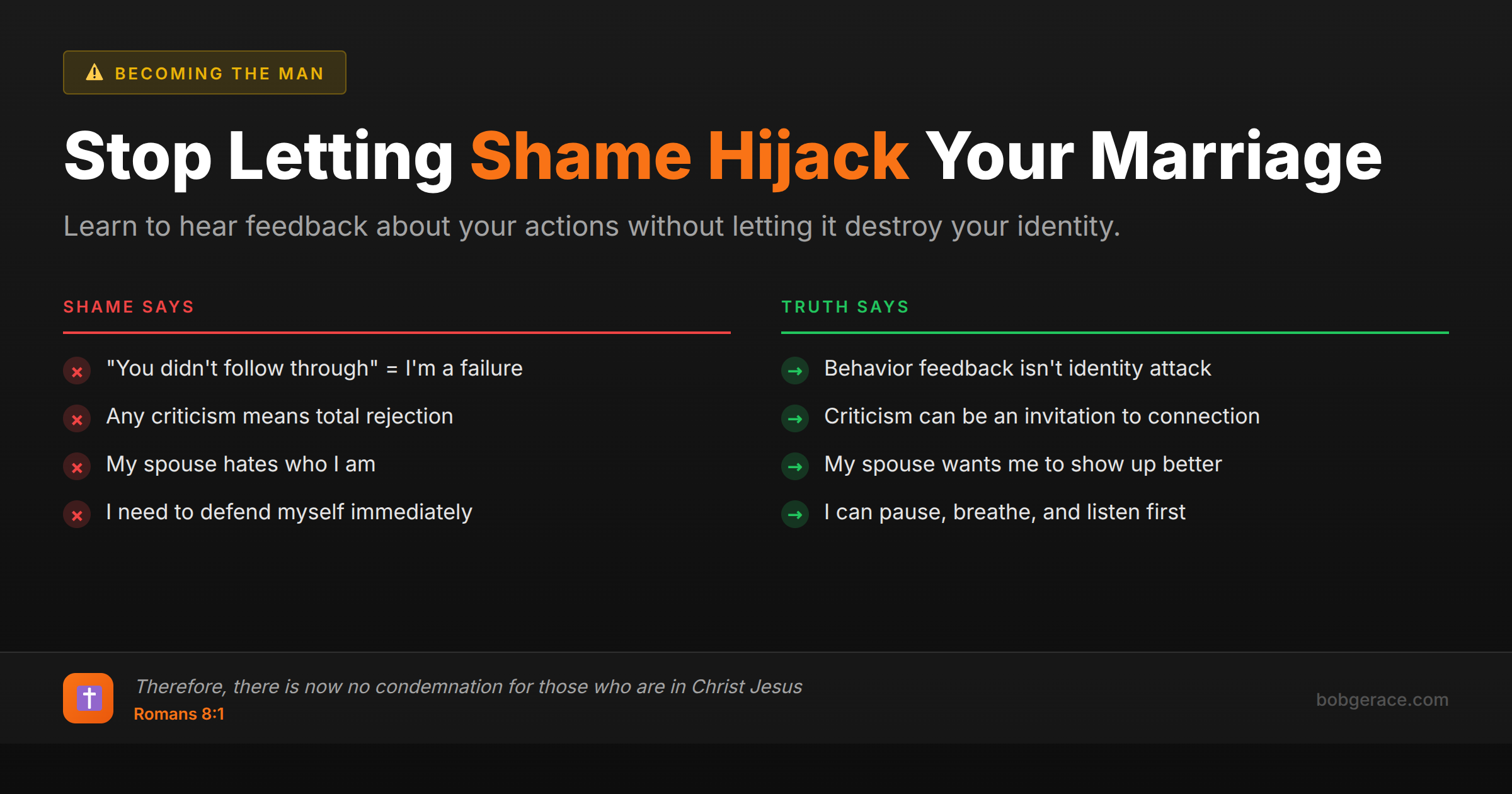
The key is recognizing that criticism of your actions isn't condemnation of your soul. When your spouse says "You didn't follow through on what you promised," they're addressing a behavior, not declaring you worthless. Your shame-wired brain immediately translates this into "I'm a failure as a person," but that's not what's happening. Start by taking a breath and asking yourself: "Is my spouse attacking who I am, or are they frustrated with what I did?" Most of the time, it's the latter. Your defensive response comes from old wounds that convinced you that any criticism means total rejection. But in a healthy marriage, feedback about behavior is actually an invitation to connection - your spouse is saying "I need you to show up differently so we can be close."
The Full Picture
Here's what's really happening when you can't separate behavior feedback from identity attacks: your attachment system is hijacked by shame. Every time your spouse points out something you did or didn't do, your brain immediately goes to "I'm fundamentally flawed and about to be abandoned."
This isn't your fault - it's how shame works. Shame tells you that you ARE the problem, not that you HAVE a problem. So when your wife says "You forgot to pick up groceries again," shame translates that into "You're a worthless husband who can't be trusted with anything."
But here's the critical distinction: behavior is changeable, identity is not. Your actions can be adjusted, improved, and redirected. Your fundamental worth as a person created in God's image cannot be diminished by forgetting groceries or making mistakes.
The problem is that many of us learned early in life that love was conditional on performance. Maybe your parents' approval depended on your grades, your behavior, or your achievements. So now, any feedback feels like a threat to your very survival in the relationship.
Your spouse isn't your parent, and your marriage isn't your childhood. When your wife gives you feedback, she's not looking for reasons to reject you - she's trying to build something better with you. She's saying "I believe in us enough to ask for what I need."
The goal isn't to never receive criticism or feedback. The goal is to develop the emotional capacity to hear feedback without your shame spiraling into defensive panic. This means learning to pause, breathe, and ask yourself: "What is my spouse actually asking for here?"
What's Really Happening
From a clinical perspective, the inability to separate behavior feedback from identity attacks stems from what we call "shame-based attachment wounds." When criticism activates your attachment system, your brain perceives it as a threat to the relationship bond itself, not just feedback about a specific action.
This creates what we call "global self-attribution" - you take specific feedback and make it about your entire character. Your nervous system can't distinguish between "You left dishes in the sink" and "You are a terrible person." Both trigger the same fight-flight-freeze response.
Neurologically, shame activates the same brain regions as physical pain. So when your spouse gives behavioral feedback, your brain literally experiences it as injury. No wonder you get defensive - you're protecting yourself from what feels like attack.
The therapeutic work involves developing what we call "differentiation" - the ability to maintain your sense of self while staying emotionally connected to your spouse. This means you can hear their feedback without your identity collapsing into shame.
Practically, this involves learning to activate your prefrontal cortex (your thinking brain) before your limbic system (your emotional brain) takes over. The pause between stimulus and response is where healing happens. In that space, you can ask: "Is this about what I did, or who I am?"
Recovery involves building new neural pathways that can hold both truths: "I made a mistake AND I am loved." This isn't about positive self-talk - it's about rewiring your attachment system to receive feedback as information, not condemnation.
What Scripture Says
Scripture makes a clear distinction between our identity in Christ and our behavior that needs correction. Romans 8:1 declares: "Therefore, there is now no condemnation for those who are in Christ Jesus." Your identity is secure in God's love, regardless of your mistakes.
Hebrews 12:6 tells us: "The Lord disciplines the one he loves, and chastises every son whom he receives." Notice that discipline comes FROM love, not instead of love. God corrects our behavior precisely because our identity as His children is secure.
Galatians 2:20 gives us the foundation: "I have been crucified with Christ and I no longer live, but Christ lives in me." Your true identity isn't based on your performance - it's based on Christ's finished work. Behavioral feedback can't touch that.
Proverbs 27:6 says: "Wounds from a friend can be trusted, but an enemy multiplies kisses." Sometimes the most loving thing your spouse can do is give you honest feedback about your behavior. This is friendship, not attack.
1 Corinthians 13:7 reminds us that love "always protects, always trusts, always hopes, always perseveres." When your spouse gives you feedback, they're hoping for something better in your marriage - that's love in action.
Ephesians 4:15 calls us to "speak the truth in love." Your spouse's feedback, when given in love, is an opportunity for growth and deeper intimacy. The enemy wants you to hear condemnation where God intends transformation.
What To Do Right Now
-
1
Pause and breathe - When you receive feedback, take three deep breaths before responding. Ask yourself: 'Is this about my actions or my identity?'
-
2
Separate the message from the messenger - Focus on the specific behavior being addressed, not your interpretation of what it means about you
-
3
Ask clarifying questions - 'Are you saying I'm a bad person, or that you need me to handle this differently?' Most of the time, it's the latter
-
4
Acknowledge the behavior without defending your character - 'You're right, I didn't follow through. How can I do better next time?'
-
5
Remind yourself of your true identity - 'I am loved by God and my spouse, even when my behavior needs adjustment'
-
6
Thank your spouse for caring enough to give feedback - Recognize that indifference, not criticism, is the real threat to your marriage
Related Questions
- Is my defensiveness shame protection?
- What is 'shame-based defensiveness'?
- Why does criticism feel like annihilation?
- What does 'core shame' have to do with my reactions?
- How do I build tolerance for being wrong?
- What would it take to be curious instead of defensive?
- What does 'taking responsibility' actually look like?
- What are markers of genuine remorse vs. guilt?
- She doesn't believe I understand what I did
- What is 'felt understanding' and how do I give it?
Also find Bob on
Subscribe for weekly videos on Christian marriage.
Your Marriage Isn't Generic. Neither Is the Work.
A tool can't hear your specific story or see what's actually happening in your arguments. A coach can. If you're tired of guessing whether you're doing this right, talk to Bob.
Talk to Bob →