What is 'normative male alexithymia'?
6 min read
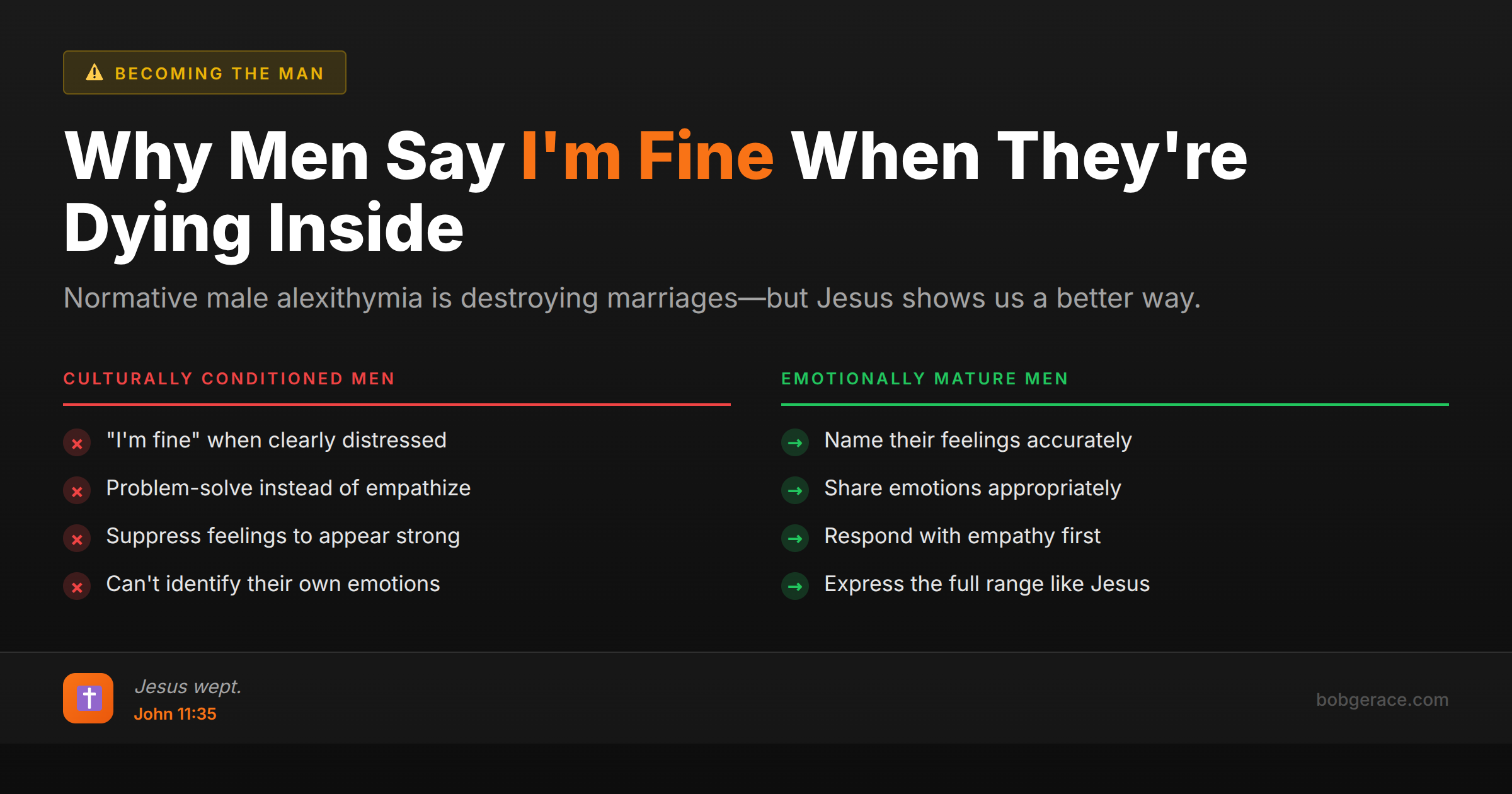
Normative male alexithymia is the culturally conditioned inability many men have to identify, understand, and express their emotions effectively. Unlike clinical alexithymia (a neurological condition), this 'normative' version develops through social conditioning that teaches boys to suppress emotional expression and prioritize logic over feelings. This learned emotional limitation affects millions of men and their marriages. Men with normative male alexithymia often struggle to recognize their own emotional states, communicate feelings to their wives, and respond appropriately to their partner's emotional needs. They might say 'I'm fine' when clearly distressed, or respond to their wife's emotions with problem-solving rather than empathy. The good news? Because it's learned, it can be unlearned through intentional practice and biblical emotional development.
The Full Picture
Normative male alexithymia isn't a character flaw or weakness—it's a predictable result of how our culture raises boys. From early childhood, boys receive constant messages: 'Big boys don't cry,' 'Man up,' 'Don't be so sensitive.' These messages create neural pathways that literally rewire how men process and express emotions.
The symptoms show up everywhere in marriage. Your wife shares something emotional, and you immediately jump to solutions instead of listening. She asks how you're feeling, and you genuinely don't know beyond 'good' or 'bad.' You feel overwhelmed but can't identify whether you're angry, sad, frustrated, or afraid. During conflict, you shut down or get defensive because the emotional intensity feels unmanageable.
This isn't just a communication issue—it's a disconnection issue. When you can't access your own emotions, you can't truly connect with your wife's. When you can't identify what you're feeling, you can't communicate your needs effectively. When emotions feel foreign or dangerous, intimacy becomes impossible.
The impact on marriage is devastating but fixable. Your wife may feel lonely, unheard, or like she's married to an emotional stranger. You might feel constantly criticized or like nothing you do is right. These aren't relationship problems—they're emotional development problems that have relationship consequences.
Here's what gives me hope: emotional intelligence is learnable. Your brain retains neuroplasticity throughout life. You can develop new neural pathways for emotional awareness and expression. Men who commit to this work transform not just their marriages, but their entire experience of life.
What's Really Happening
From a clinical perspective, normative male alexithymia represents a profound disruption in emotional development that occurs during critical childhood years. The male brain, already naturally less connected between emotional and verbal processing centers, becomes further impaired through cultural conditioning.
Research shows that boys and girls start life with equal emotional expressiveness. By age five, significant gender differences emerge—not due to biology alone, but through systematic emotional suppression in boys. Parents unconsciously respond more positively to boys' anger than to their sadness or fear, creating neural patterns that persist into adulthood.
The neurological impact is measurable. Brain imaging studies show that men with alexithymic traits have reduced activity in the anterior cingulate cortex and insula—regions crucial for emotional awareness and empathy. However, these same studies demonstrate that targeted emotional training can literally rewire these neural networks.
In couples therapy, I see how this manifests as emotional labor imbalance. The female partner becomes the relationship's emotional processor, carrying the burden of both partners' emotional needs. This creates resentment, exhaustion, and disconnection.
The intervention is straightforward but requires commitment: emotional vocabulary development, mindfulness practices, and graduated emotional expression exercises. Men who engage this work show measurable improvements in relationship satisfaction within 8-12 weeks. The key is understanding that emotional development isn't about becoming 'soft'—it's about becoming complete.
What Scripture Says
God designed men to be emotionally whole and expressive. Scripture reveals a God who models the full range of human emotions, and calls men to emotional maturity and connection.
Jesus demonstrates perfect masculine emotional intelligence. He wept at Lazarus's tomb (John 11:35), felt deep compassion for crowds (Matthew 9:36), experienced righteous anger in the temple (Matthew 21:12), and agonized in Gethsemane (Luke 22:44). Christ never suppressed emotions—He expressed them appropriately and powerfully.
David, the man after God's own heart, was deeply emotional. The Psalms overflow with his fears, joys, anger, and sorrow: 'My tears have been my food day and night' (Psalm 42:3). David's emotional authenticity didn't diminish his warrior spirit—it enhanced his leadership and intimacy with God.
Paul calls for emotional maturity, not emotional suppression. 'When I became a man, I gave up childish ways' (1 Corinthians 13:11). Emotional suppression is childish—emotional maturity means feeling deeply while responding wisely.
Scripture commands emotional connection in marriage. 'Rejoice with those who rejoice; mourn with those who mourn' (Romans 12:15). You cannot obey this with your wife if you can't access your own emotions first.
God calls men to emotional leadership, not emotional absence. 'Husbands, love your wives as Christ loved the church' (Ephesians 5:25). Christ's love was emotionally engaged, sacrificial, and deeply connected. Normative male alexithymia prevents you from loving as Christ loved—making emotional development a spiritual imperative, not just a relationship improvement.
What To Do Right Now
-
1
Start daily emotion check-ins: Set three phone alarms and ask yourself 'What am I feeling right now?' Use an emotion wheel to expand beyond 'fine' or 'stressed.'
-
2
Practice the 'Name it to claim it' principle: When you notice physical tension, stop and identify the emotion causing it before taking any action.
-
3
Share one feeling with your wife daily: Start small with 'I felt proud when...' or 'I was disappointed that...' Build the neural pathway gradually.
-
4
Read Psalms for emotional vocabulary: Notice how David expresses complex emotions and borrow his language for your own emotional expression.
-
5
Institute a 24-hour rule: When your wife shares emotions, resist problem-solving for 24 hours. Just listen, validate, and connect first.
-
6
Join a men's group focused on emotional growth: Find other men committed to breaking free from normative male alexithymia and supporting each other's development.
Related Questions
Ready to Break Free from Emotional Limitations?
Don't let cultural conditioning rob you of deep connection with your wife. I help men develop the emotional intelligence God designed them to have.
Start Growing →