Why do men struggle with emotions?
6 min read
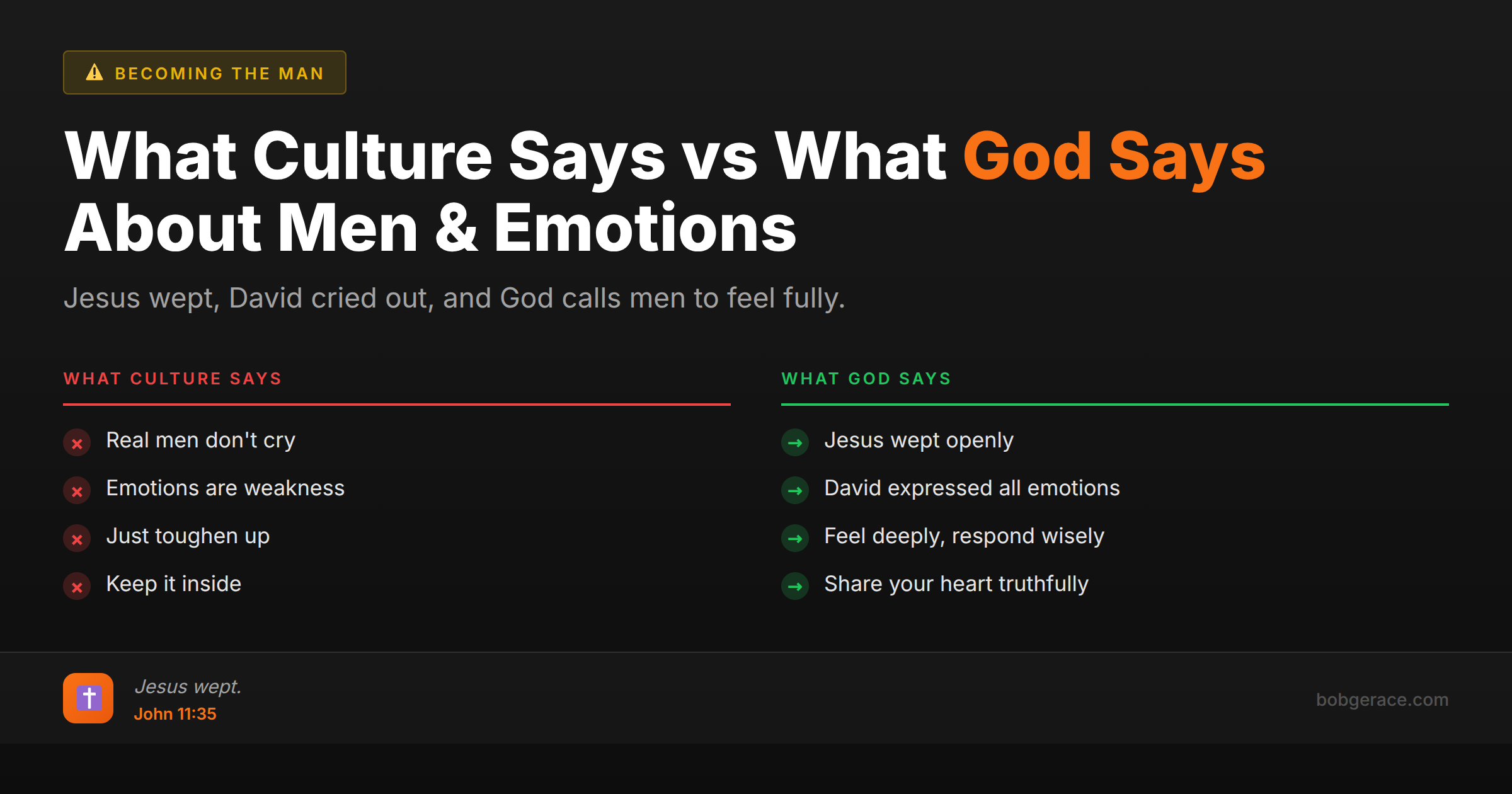
Men struggle with emotions primarily because of cultural conditioning, biological differences, and lack of emotional education. From childhood, most men are taught that emotions are weakness, leading to suppression rather than healthy expression. This creates a cycle where emotional muscles never develop properly. The result? Men often feel overwhelmed by emotions they can't name or navigate. In marriage, this shows up as withdrawal, anger outbursts, or emotional numbness. The good news is that emotional intelligence is learnable. Men can develop these skills at any age with the right approach and commitment to growth.
The Full Picture
The emotional struggle most men face isn't a character flaw—it's a predictable result of how we've been shaped. From the moment boys can walk, they hear messages like "big boys don't cry," "toughen up," and "stop being so sensitive." These aren't just phrases; they're emotional programming that creates adults who literally don't know how to process feelings.
The Cultural Factor runs deep. Traditional masculinity equated emotional expression with weakness, and many men still carry this burden. Add competitive environments—sports, work, social groups—where vulnerability is seen as liability, and you get men who've learned to survive by shutting down emotionally.
Biology plays a role too. Research shows men's brains process emotions differently, often taking longer to identify and articulate feelings. The male brain tends to compartmentalize, which can be helpful in crisis but problematic in relationships that require emotional connection.
The Marriage Impact is significant. When a husband can't access or express emotions, his wife often feels disconnected, lonely, or like she's married to a stranger. She may interpret his emotional unavailability as rejection or lack of care, even when he's simply operating from the only emotional toolkit he knows.
The Skills Gap is real but fixable. Most men never learned emotional vocabulary, recognition techniques, or healthy expression methods. It's like expecting someone to play piano without lessons—the potential is there, but the skills need development.
What's Really Happening
From a clinical perspective, male emotional struggles stem from what I call 'emotional atrophy'—the natural result of years of suppression and avoidance. When we consistently ignore or minimize emotions, we lose the neural pathways that help us recognize and process them effectively.
Neurologically, men's brains show less connectivity between emotional centers and verbal processing areas. This means feelings often remain unnamed and unprocessed, leading to what appears as emotional unavailability but is actually emotional illiteracy.
In therapy, I see three primary patterns: Emotional Flooding (overwhelming feelings that lead to shutdown), Emotional Numbing (complete disconnection from feelings), and Emotional Mislabeling (calling everything anger when it might be hurt, fear, or disappointment).
The attachment impact is profound. Men with emotional struggles often had fathers who modeled similar patterns, creating intergenerational cycles of emotional distance. Their nervous systems learned that emotions equal danger, so they develop sophisticated avoidance mechanisms.
Recovery requires rewiring these patterns through practice, patience, and often professional support. The brain's neuroplasticity means change is possible at any age, but it requires consistent effort and safe spaces to practice new emotional skills.
What Scripture Says
God never intended men to be emotionally stunted. Scripture reveals a rich emotional landscape for godly masculinity that contradicts cultural stereotypes.
Jesus modeled full emotional expression. He wept at Lazarus's tomb (John 11:35), showed righteous anger in the temple (John 2:15-17), and expressed deep sorrow in Gethsemane (Matthew 26:38). The Son of God didn't suppress emotions—He felt them fully and expressed them appropriately.
David's psalms overflow with emotion. This warrior king wrote, "I am worn out from my groaning; all night long I flood my bed with weeping" (Psalm 6:6). His emotional honesty before God shows that vulnerability and strength coexist beautifully.
Paul modeled emotional transparency: "I wrote you out of great distress and anguish of heart and with many tears" (2 Corinthians 2:4). The apostle who planted churches and faced persecution wasn't ashamed to express his emotional struggles.
Scripture commands emotional connection: "Rejoice with those who rejoice; mourn with those who mourn" (Romans 12:15). This requires emotional awareness and expression—we can't connect emotionally while being emotionally numb.
God calls men to emotional growth: "Be completely humble and gentle; be patient, bearing with one another in love" (Ephesians 4:2). These qualities require emotional intelligence and maturity.
Biblical manhood includes the full spectrum of human emotion, expressed in healthy, God-honoring ways.
What To Do Right Now
-
1
Start an emotion journal - Write down one feeling you experienced each day and what triggered it
-
2
Learn emotion vocabulary - Study a feelings wheel and practice naming emotions beyond 'fine,' 'good,' or 'angry'
-
3
Practice the pause - When emotions rise, take three deep breaths before reacting or shutting down
-
4
Schedule emotion check-ins - Ask yourself 'How am I feeling?' three times daily and actually answer honestly
-
5
Share one feeling daily - Tell your wife one genuine emotion you experienced, even if it feels awkward
-
6
Seek professional help - Work with a counselor who specializes in men's emotional development and couples therapy
Related Questions
- What is emotional intelligence and why does it matter?
- What is 'alexithymia' and do I have it?
- What is 'normative male alexithymia'?
- How were boys socialized away from feeling?
- What is the 'man box' and how do I get out?
- What did I learn about emotions from my father?
- She says I'm emotionally unavailable
- Why does she seem numb/flat/dead inside?
- What does emotional attunement look like?
- How do I become a safe emotional presence?
Also find Bob on
Subscribe for weekly videos on Christian marriage.
You Don't Have to Figure This Out Alone
Coaching means a human who knows your marriage, not just the theory. When you're stuck in patterns you can't see, Bob helps you map what's actually happening in your specific relationship.
Talk to Bob →