What is the 'man box' and how do I get out?
6 min read
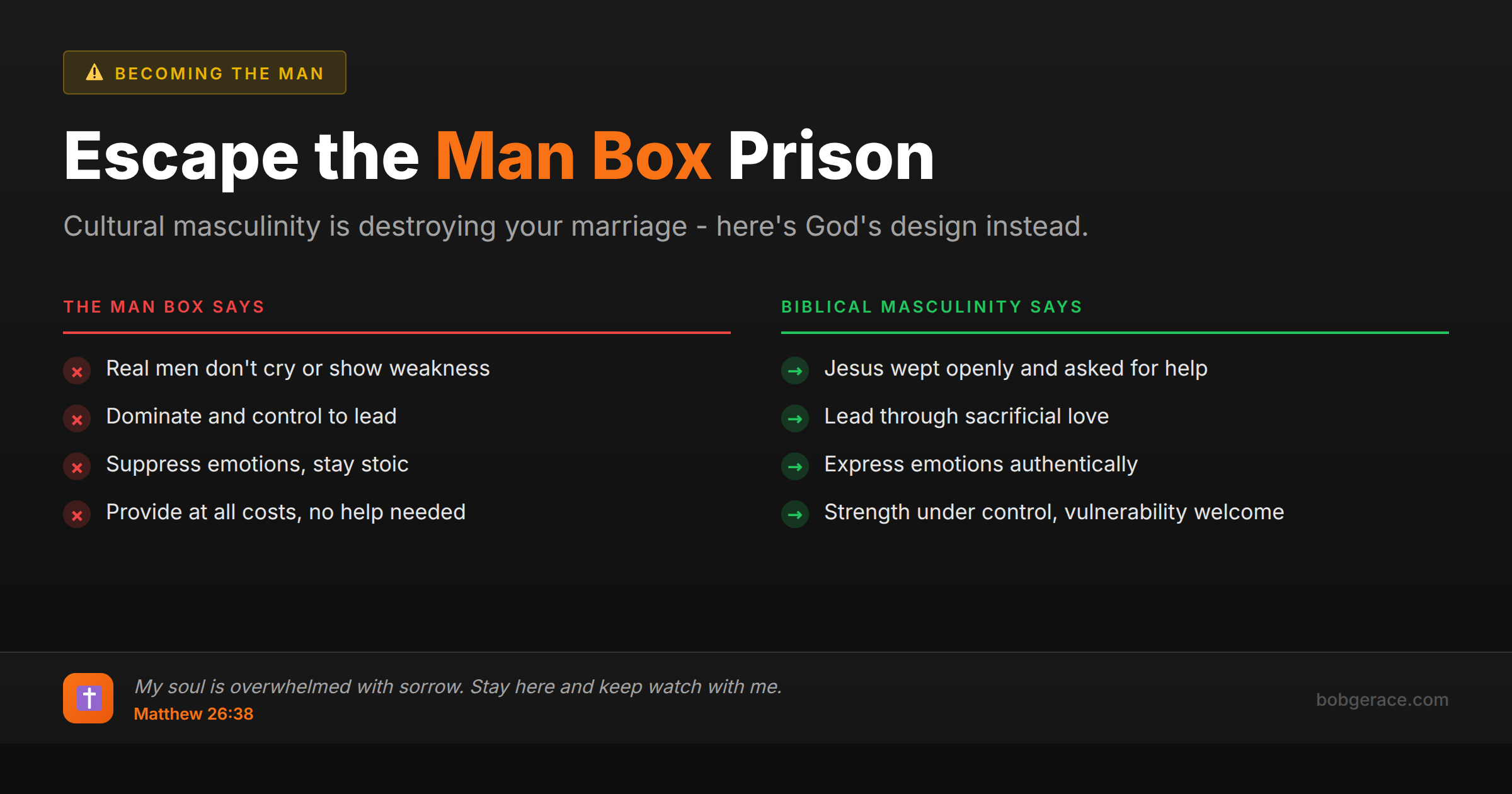
The 'man box' is an invisible prison of cultural expectations that tells men they must be stoic, aggressive, emotionally disconnected, and dominant to be 'real men.' It's the voice that says 'real men don't cry,' 'show no weakness,' and 'provide at all costs.' This toxic masculinity destroys marriages because it prevents authentic connection and emotional intimacy. Getting out requires intentional work: acknowledge the box exists, identify which rules you've internalized, practice emotional expression in safe spaces, and redefine masculinity through God's design rather than culture's demands. True biblical manhood isn't about suppressing emotions or dominating others—it's about strength under control, sacrificial love, and authentic leadership.
The Full Picture
The 'man box' is one of the most destructive forces in modern marriages, and most men don't even realize they're trapped inside it. This invisible cage of cultural expectations has been built around men from childhood, telling them exactly how to think, feel, and behave to be considered 'masculine.'
The rules of the man box are brutal: - Never show vulnerability or ask for help - Anger is the only acceptable emotion - Your worth equals your ability to provide and perform - Real men dominate and control - Emotional needs are weakness - Pain should be endured in silence
Here's what's tragic: these rules are marriage killers. When you operate from inside the man box, you can't create the emotional intimacy your wife craves. You can't be fully present because you're too busy maintaining an image. You can't receive love because you're afraid it makes you weak.
I've worked with hundreds of men who were suffocating inside this box, wondering why their marriages felt distant despite their best efforts to be 'good providers.' The answer is simple: you can't build intimate connection while hiding behind a mask.
The man box isn't biblical masculinity—it's a counterfeit. God designed men to be emotionally whole, relationally connected, and authentically strong. The box tries to replace God's design with society's broken expectations, leaving men isolated and marriages struggling.
Breaking free isn't about becoming 'soft' or losing your masculine edge. It's about becoming the man God created you to be—one who leads with love, serves with strength, and connects with authenticity.
What's Really Happening
From a psychological perspective, the 'man box' represents learned gender role strain that begins in early childhood. Boys receive consistent messages from family, peers, and media about what constitutes 'acceptable' masculine behavior, creating rigid cognitive schemas that persist into adulthood.
This conditioning activates what we call 'hypervigilance around masculinity threat'—men become constantly alert to situations that might challenge their masculine identity, leading to defensive behaviors that damage relationships. The stress hormone cortisol elevates when men perceive threats to their masculine image, triggering fight-or-flight responses in situations that require emotional vulnerability.
The neurological impact is significant. Chronic suppression of emotions actually rewires the brain, reducing activity in areas responsible for emotional processing and empathy. This creates a biological barrier to the intimate connection essential for marital satisfaction.
Research shows men trapped in rigid masculine roles experience higher rates of depression, anxiety, and relationship dissatisfaction. Their wives report feeling emotionally disconnected and unsupported, creating a cycle where both partners' needs go unmet.
The path out requires neuroplasticity—literally rewiring the brain through new experiences. This happens through practicing emotional expression, challenging rigid thoughts about masculinity, and creating new neural pathways through vulnerable connection. It's not just about changing behavior; it's about changing the underlying brain patterns that drive those behaviors.
The good news? Adult brains are remarkably adaptable. With consistent practice, men can develop new emotional skills and break free from limiting patterns.
What Scripture Says
God's design for masculinity looks nothing like the man box. Scripture shows us men who were emotionally expressive, relationally connected, and authentically vulnerable:
Jesus wept openly (John 11:35) and expressed deep emotion without shame. He asked for help in His greatest moment of need: "My soul is overwhelmed with sorrow to the point of death. Stay here and keep watch with me" (Matthew 26:38). This is authentic masculinity—strength that embraces vulnerability.
David, the warrior king, poured out his heart in the Psalms: "Be merciful to me, Lord, for I am faint; heal me, Lord, for my bones are in agony" (Psalm 6:2). Real men acknowledge their struggles and seek God's help.
Paul showed emotional openness with fellow believers: "I have great sorrow and unceasing anguish in my heart" (Romans 9:2). He wasn't afraid to express pain or need.
Husbands are called to love sacrificially: "Love your wives, just as Christ loved the church and gave himself up for her" (Ephesians 5:25). This requires emotional connection, not domination.
We're commanded to "bear one another's burdens" (Galatians 6:2), which is impossible when trapped in the man box's demand for self-sufficiency.
True strength comes from dependence on God: "My grace is sufficient for you, for my power is made perfect in weakness" (2 Corinthians 12:9).
Biblical masculinity embraces the full range of human emotion, seeks community over isolation, and leads through service rather than domination. The man box is a lie that keeps you from becoming the man God created you to be.
What To Do Right Now
-
1
Identify your man box rules - Write down the unspoken rules you've lived by ("real men don't..." "I have to..." "I can't show...")
-
2
Practice naming emotions daily - Use an emotion wheel to identify what you're actually feeling beyond 'fine,' 'good,' or 'angry'
-
3
Share one vulnerable thing with your wife this week - Start small: a fear, insecurity, or struggle you've kept hidden
-
4
Challenge the voice - When you hear man box messages in your head, consciously ask 'Is this God's truth or cultural lie?'
-
5
Find a safe male community - Join a men's group where authentic sharing is encouraged and modeled
-
6
Redefine strength - Practice seeing vulnerability, emotional expression, and asking for help as signs of courage, not weakness
Related Questions
- What is 'normative male alexithymia'?
- How were boys socialized away from feeling?
- What emotions are 'allowed' for men?
- What is the cost of emotional suppression?
- What is 'healthy masculinity'?
- What is 'boy psychology' vs. 'man psychology'?
- Why do I get defensive every time?
- How do I identify what I'm feeling?
- What role did my childhood play in my anger patterns?
- What did I learn about emotions from my father?
Also find Bob on
Subscribe for weekly videos on Christian marriage.
You Don't Have to Figure This Out Alone
The rules you've internalized are specific to your story. A coach who knows your marriage can help you see which ones are still running you—and what to do instead.
Talk to Bob →