What did I learn about emotions from my father?
6 min read
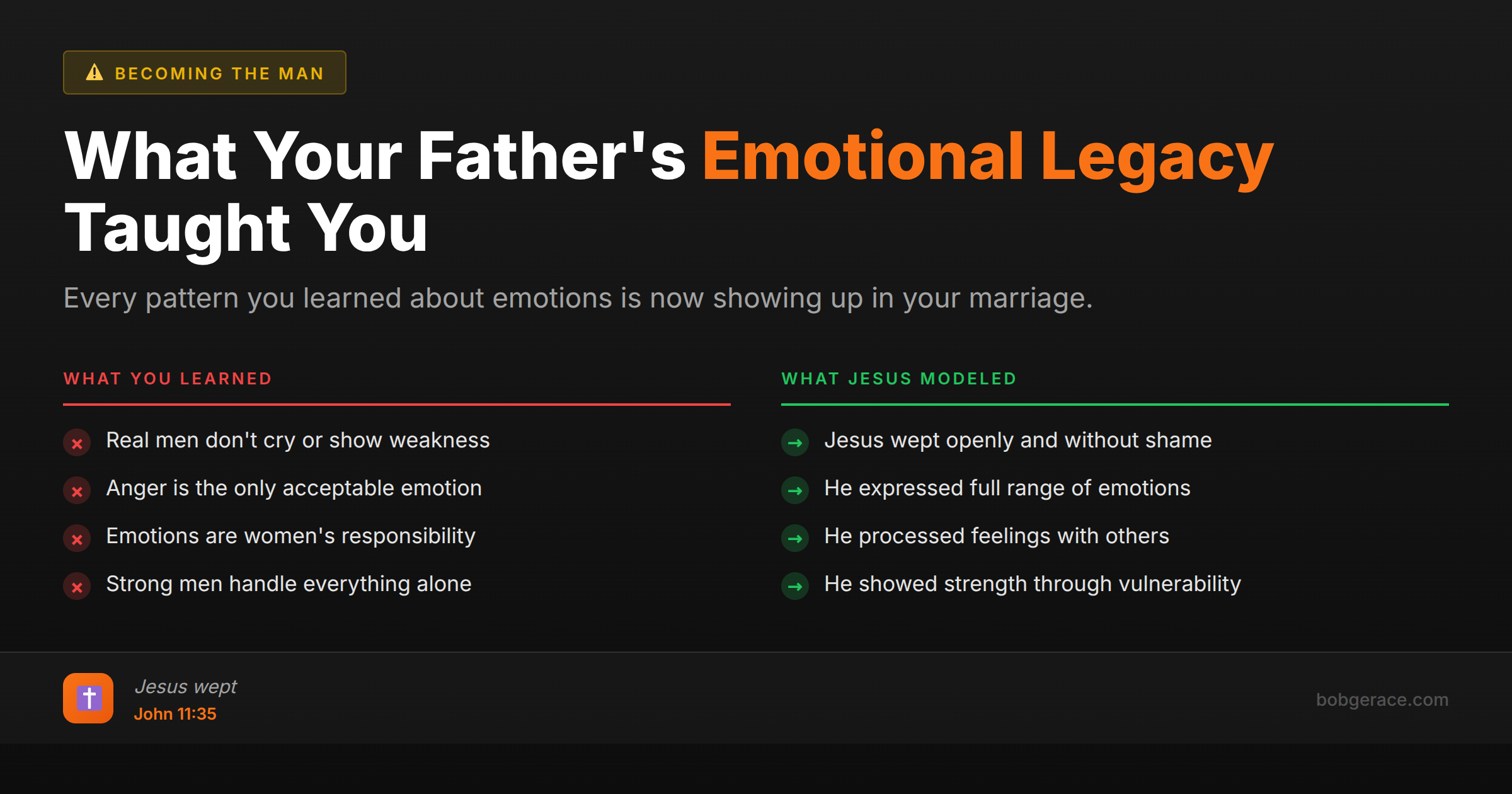
Your father was your first model of masculine emotion, whether he was present or absent. Most men learned that emotions are either dangerous, shameful, or something women handle. Maybe your dad was the strong silent type, the explosive angry type, or maybe he wasn't there at all - each taught you something about how men 'should' handle feelings. Here's the truth: whatever you learned about emotions from your father is now showing up in your marriage. If he stuffed his feelings, you probably do too. If he exploded, you might swing between numbness and rage. If he was absent, you might not even know what healthy emotional expression looks like. The good news? You can learn new patterns that will transform your marriage and break the cycle for your kids.
The Full Picture
Your father didn't just teach you how to throw a ball or fix a car - he taught you how to be a man through every interaction, every response to stress, every moment of joy or disappointment. Most of this teaching happened without words.
If your father was emotionally shut down, you learned that real men don't feel - they endure. If he was quick to anger, you learned that anger is the only acceptable male emotion. If he was absent, you learned that men disappear when things get hard. If he was emotionally volatile, you learned that emotions are dangerous and unpredictable.
Maybe your dad was loving but never talked about his inner world. Maybe he provided well but never showed vulnerability. Maybe he was a good man who simply didn't know how to process his own emotional life, so he couldn't teach you.
Here's what's happening in your marriage right now: You're unconsciously repeating these patterns. When your wife wants to talk about feelings, you shut down like dad did. When conflict arises, you either explode or disappear - just like you saw growing up. When she's emotional, you try to fix it quickly because emotions feel uncomfortable and foreign.
The generational cycle continues until someone decides to break it. Your father's emotional limitations don't have to become yours. You can honor what he gave you while choosing to grow beyond his emotional vocabulary. Your marriage can be the place where this healing begins, where you learn to feel without fear and love without reservation.
What's Really Happening
From a clinical perspective, your father's emotional modeling created neural pathways that still influence your stress responses today. This isn't about blame - it's about understanding how early attachment patterns shape adult relationships.
Men who had emotionally distant fathers often struggle with emotional attunement in marriage. They've learned to override their emotional signals, which makes it difficult to connect with their wives emotionally. Conversely, men who experienced explosive or unpredictable emotions from their fathers may have learned to associate strong feelings with danger or loss of control.
The research shows that men's emotional development is significantly impacted by their father's emotional availability during childhood. Sons of emotionally engaged fathers develop better emotional regulation, stronger marriages, and healthier relationships with their own children.
What's crucial to understand is that these patterns are learned, which means they can be unlearned. Neuroplasticity research demonstrates that adult brains can form new pathways for emotional processing. Through intentional practice and often therapeutic support, men can develop the emotional intelligence their fathers may not have modeled. This work isn't just personal healing - it's generational transformation that impacts your marriage, your children, and beyond.
What Scripture Says
Scripture presents a beautifully complex picture of godly manhood that includes the full range of human emotion. Jesus himself shows us that emotional expression is part of spiritual maturity.
*"Jesus wept"* (John 11:35) - The shortest verse in the Bible reveals volumes about masculine emotion. Jesus didn't apologize for his tears or try to hide them. He felt deeply and expressed it openly.
*"Be angry and do not sin; do not let the sun go down on your anger"* (Ephesians 4:26) - God doesn't condemn anger; He gives us instructions for handling it righteously. This assumes we'll feel anger and need wisdom for expressing it.
*"Rejoice with those who rejoice, weep with those who weep"* (Romans 12:15) - Paul commands emotional engagement, not emotional numbness. We're called to feel with others, which requires feeling in ourselves.
*"Above all else, guard your heart, for everything you do flows from it"* (Proverbs 4:23) - You can't guard what you can't feel. Emotional awareness is spiritual responsibility.
Your heavenly Father models perfect emotional health - He feels joy, anger, love, and even grief. The Father-heart of God includes the full spectrum of emotion expressed in perfect wisdom and love. Whatever your earthly father modeled or failed to model, you have access to the perfect Father who can teach you to feel, express, and connect in ways that honor Him and bless your marriage.
What To Do Right Now
-
1
Write down three specific emotional patterns you observed in your father - both positive and negative
-
2
Identify which of these patterns you see showing up in your marriage today
-
3
Have an honest conversation with your wife about what you're discovering about your emotional inheritance
-
4
Choose one emotional skill your father didn't model and commit to learning it (like expressing sadness without anger)
-
5
Find a mentor or counselor who can help you develop healthy emotional patterns you didn't learn growing up
-
6
Begin practicing emotional check-ins with yourself three times daily - 'What am I feeling right now and why?'
Related Questions
- What is 'normative male alexithymia'?
- How were boys socialized away from feeling?
- What is the 'man box' and how do I get out?
- What emotions are 'allowed' for men?
- What is the cost of emotional suppression?
- What role did my childhood play in my anger patterns?
- What is 'family of origin' work?
- What patterns did I inherit vs. choose?
- What unmet needs from childhood am I still seeking?
- What does 'sins of the fathers' mean?
Also find Bob on
Subscribe for weekly videos on Christian marriage.
Your marriage isn't your father's marriage
A coach who knows your specific story can help you build emotional patterns that actually work for you and your wife—not just react to what you inherited.
Talk to Bob →