How were boys socialized away from feeling?
6 min read
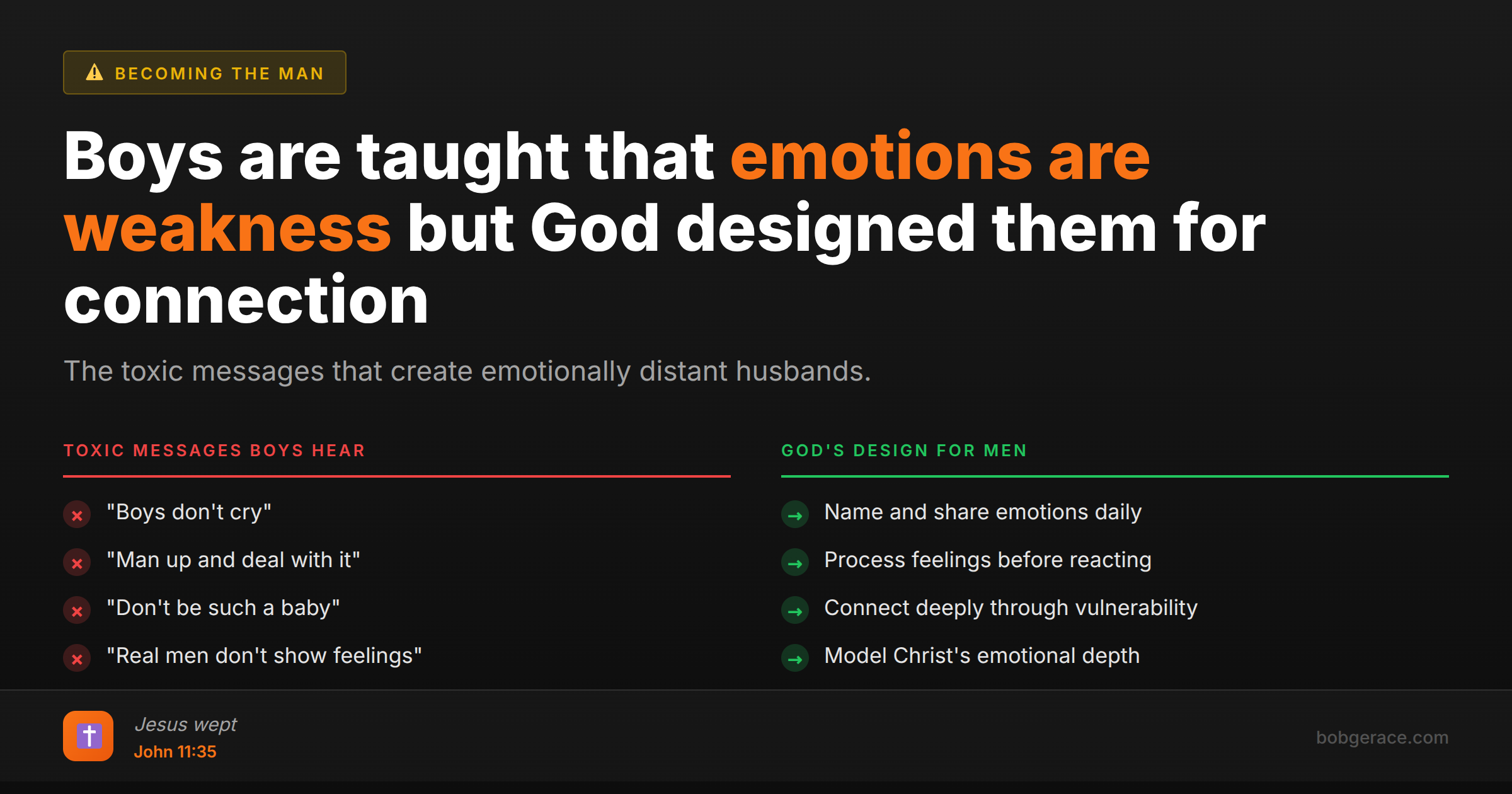
From childhood, boys receive consistent messages that emotions make them weak, vulnerable, or "less than." Parents, coaches, teachers, and peers reinforce this through phrases like "boys don't cry," "man up," or "don't be a baby." This socialization teaches boys to suppress feelings rather than understand and express them healthily. The result? Men enter marriage emotionally stunted, unable to connect deeply with their wives or process their own inner world. They've been trained to view emotions as threats to their masculinity rather than tools for intimacy and growth. This creates a devastating cycle where wives feel emotionally abandoned while husbands feel confused and inadequate.
The Full Picture
The emotional castration of boys begins early and runs deep in our culture. From toddlerhood, boys learn that tears equal shame, that fear makes them "sissies," and that expressing hurt or vulnerability invites ridicule. Well-meaning parents, coaches, and society reinforce these toxic messages daily.
The Cultural Programming: - Sports culture that glorifies "playing through pain" and never showing weakness - Educational systems that reward stoic behavior and punish emotional expression - Media representations of masculinity that equate emotions with femininity - Peer groups that mock sensitivity and reward emotional numbness - Religious contexts that misinterpret biblical manhood as emotional suppression
This systematic conditioning creates men who:can't identify their own feelings, struggle to empathize with others, default to anger as their only "acceptable" emotion, and view emotional conversations as foreign territory. They've been programmed to see emotions as obstacles rather than essential tools for relationship.
The Marriage Impact: Wives married to emotionally disconnected men report feeling like they're married to strangers. These men want intimacy but lack the emotional vocabulary and skills to create it. They interpret their wife's emotional needs as criticism or demands they can't meet, leading to withdrawal, defensiveness, and marital distance.
The tragedy is that boys are born with full emotional capacity. They naturally express joy, sadness, fear, and tenderness until society systematically trains it out of them. Reclaiming this capacity isn't just possible—it's essential for marriage success.
What's Really Happening
From a clinical perspective, the socialization of boys away from emotions creates what we call 'alexithymia'—literally meaning 'no words for feelings.' This isn't a character flaw; it's learned emotional illiteracy that profoundly impacts adult relationships.
Neurologically, boys and girls are born with similar emotional capacity. However, research shows that by age 5, boys have already learned to suppress emotional expression significantly more than girls. The prefrontal cortex, responsible for emotional regulation, actually develops differently when emotions are consistently suppressed rather than processed healthily.
The Psychological Mechanisms: Boys learn emotional avoidance through punishment (ridicule, rejection) and reward (praise for 'toughness'). This creates neural pathways that automatically suppress emotional awareness. When distressing emotions arise, they're immediately pushed down or converted to anger—often the only emotion deemed 'acceptable' for males.
This suppression doesn't eliminate emotions; it drives them underground where they create anxiety, depression, and relationship dysfunction. Men often present in therapy with physical symptoms—headaches, insomnia, digestive issues—that are actually manifestations of unexpressed emotions.
The Relationship Impact: Emotionally suppressed men struggle with emotional attunement—the ability to recognize and respond to their partner's emotional states. They often interpret their wife's emotional expressions through a lens of criticism or demand rather than understanding her inner world. This creates the pursuer-distancer dynamic that destroys marriages.
The good news? Neuroplasticity means these patterns can be changed. With intentional work, men can develop emotional intelligence and create the intimate connections they and their wives desperately want.
What Scripture Says
Scripture never portrays emotions as weakness or ungodly. In fact, God designed us as emotional beings, and Jesus himself modeled the full range of human emotions. The Bible's vision of manhood includes emotional depth, not emotional numbness.
Jesus' Emotional Expression: *"Jesus wept"* (John 11:35) - Christ openly grieved at Lazarus' death, showing that tears are consistent with divine manhood.
*"When he saw the crowds, he had compassion on them, because they were harassed and helpless, like sheep without a shepherd"* (Matthew 9:36) - Jesus felt and expressed deep empathy.
*"He took Peter and the two sons of Zebedee along with him, and he began to be sorrowful and troubled. Then he said to them, 'My soul is overwhelmed with sorrow to the point of death'"* (Matthew 26:37-38) - Christ shared his emotional vulnerability with his closest friends.
God's Emotional Nature: *"The Lord your God is with you, the Mighty Warrior who saves. He will take great delight in you; in his love he will no longer rebuke you, but will rejoice over you with singing"* (Zephaniah 3:17) - God experiences and expresses joy, delight, and love.
*"Be kind and compassionate to one another, forgiving each other, just as in Christ God forgave you"* (Ephesians 4:32) - We're commanded to develop emotional virtues like kindness and compassion.
*"Rejoice with those who rejoice; mourn with those who mourn"* (Romans 12:15) - Biblical community requires emotional connection and empathy.
True biblical manhood embraces emotional maturity as part of growing into Christ's likeness. Suppressing emotions isn't spiritual strength—it's disobedience to how God designed us to live and love.
What To Do Right Now
-
1
Start naming emotions daily - Use an emotion wheel to identify and label what you're feeling beyond 'fine' or 'angry'
-
2
Practice the pause - When triggered, stop and ask 'What am I really feeling right now?' before reacting
-
3
Share one feeling daily with your wife - Start small by expressing simple emotions like gratitude, concern, or excitement
-
4
Journal your emotional patterns - Write down triggers, feelings, and reactions to identify your emotional landscape
-
5
Challenge toxic messages - Notice when you tell yourself emotions are 'weak' and replace with 'emotions are information'
-
6
Get professional help - Work with a therapist who specializes in men's emotional development and can guide this process
Related Questions
- What is 'normative male alexithymia'?
- What is the 'man box' and how do I get out?
- What did I learn about emotions from my father?
- What emotions are 'allowed' for men?
- What is the cost of emotional suppression?
- How do I grieve what I wasn't taught?
- What role did my childhood play in my anger patterns?
- What attachment style did I develop in childhood?
- What did I not receive from my father that I need?
- What is 'family of origin' work?
Also find Bob on
Subscribe for weekly videos on Christian marriage.
Your Marriage Needs More Than Theory
Understanding how you got here doesn't fix what's broken today. A coach who knows your specific marriage can help you actually feel again—and reconnect with your wife in the process.
Talk to Bob →