How do I self-regulate before I connect?
6 min read
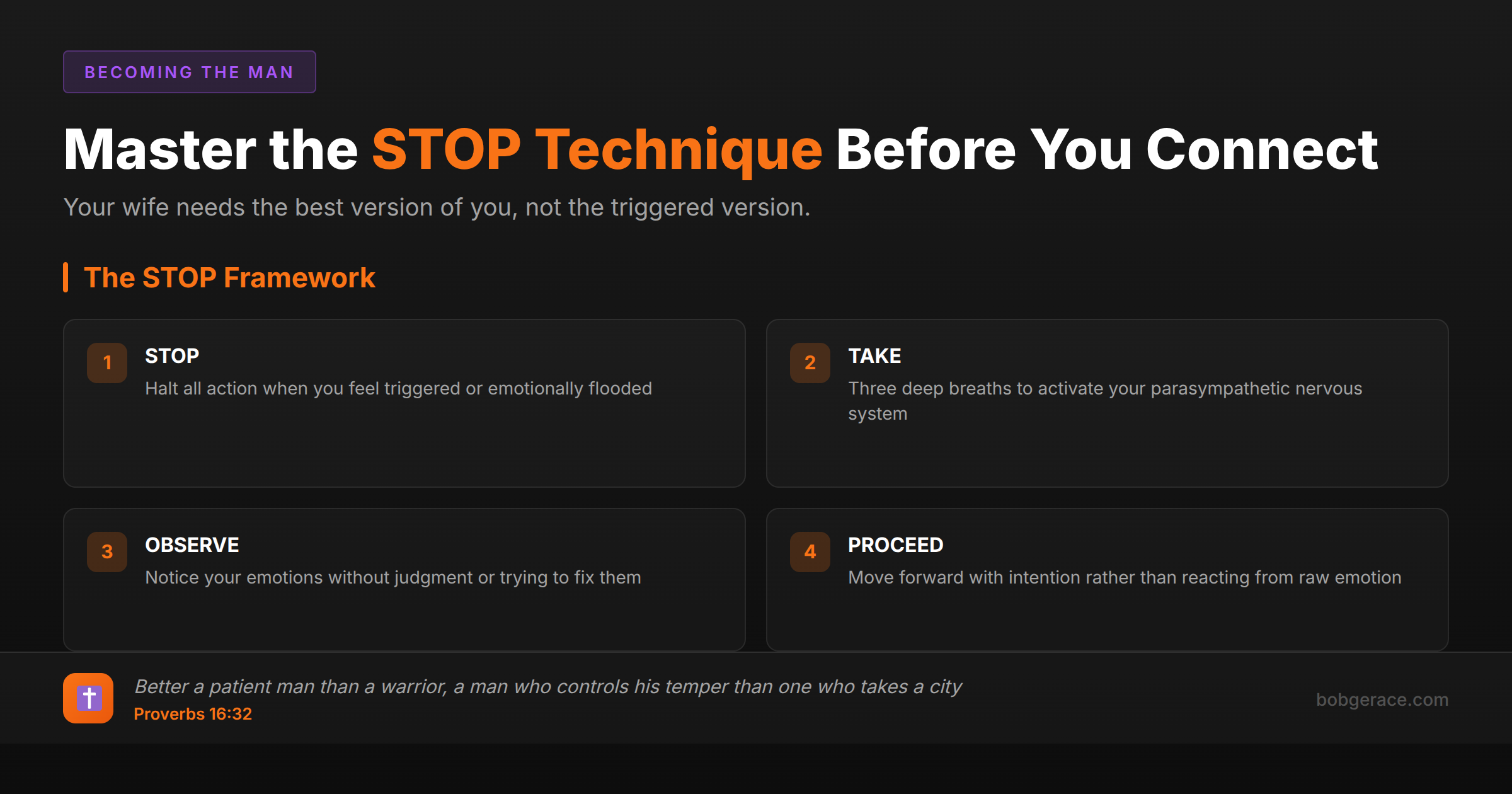
Self-regulation before connecting with your wife is about creating emotional space between trigger and response. Start with the STOP technique: Stop what you're doing, Take three deep breaths, Observe your emotions without judgment, and Proceed with intention. This isn't about stuffing emotions—it's about choosing your response rather than reacting from raw emotion. The key is recognizing that your wife needs the best version of you, not the triggered version. When you're emotionally flooded, your capacity for connection, empathy, and clear thinking plummets. Taking 5-10 minutes to regulate yourself isn't avoiding the issue—it's honoring both your wife and your marriage by showing up present and intentional.
The Full Picture
Self-regulation is the bridge between feeling and responding. Most men struggle with this because we've been conditioned to either explode or implode when emotions run high. Neither serves our marriages well.
When you're dysregulated—whether angry, hurt, frustrated, or overwhelmed—your brain literally changes. The prefrontal cortex (responsible for rational thinking) goes offline, and the amygdala (fight-or-flight center) takes over. In this state, you cannot effectively connect, communicate, or problem-solve.
The goal isn't to eliminate emotions. God gave you emotions for a reason. The goal is to feel them fully while choosing your response wisely. This is emotional maturity in action.
Start by identifying your triggers. What situations, words, or behaviors consistently push your buttons? Common triggers include feeling criticized, dismissed, controlled, or misunderstood. Once you know your triggers, you can prepare for them.
Create physical space when needed. There's no shame in saying, "I need ten minutes to collect myself so I can show up well for this conversation." This isn't running away—it's running toward maturity.
Use your body to regulate your emotions. Deep breathing activates your parasympathetic nervous system, literally calming your physiology. Cold water on your face, a brief walk, or gentle stretching can reset your system.
Practice self-compassion during this process. You're learning a new skill. Be patient with yourself while remaining committed to growth. Your wife will notice the difference when you show up regulated and present.
What's Really Happening
From a neurobiological perspective, emotional regulation is about managing your autonomic nervous system. When triggered, your sympathetic nervous system activates, flooding your body with stress hormones like cortisol and adrenaline. This hijack can last 20-90 minutes if left unchecked.
Effective self-regulation involves several key processes: emotional awareness (recognizing what you're feeling), cognitive reappraisal (reframing the situation), physiological regulation (calming your body), and behavioral control (choosing your actions).
Research shows that men often experience emotions as physical sensations first—tightness in the chest, clenched jaw, shallow breathing. Learning to read these early warning signs gives you a crucial window for intervention before full dysregulation occurs.
The '6-second rule' is particularly helpful: neurologically, the initial chemical rush of emotion peaks and begins to recede within six seconds. If you can avoid reactive responses during this window, you create space for more thoughtful action.
Polyvagal theory suggests that when we feel safe and regulated, we can access our 'social engagement system'—the neurobiological state optimal for connection and communication. Self-regulation isn't just about managing difficult emotions; it's about creating the internal conditions necessary for genuine intimacy and partnership.
What Scripture Says
Scripture consistently calls men to self-control and wise response rather than emotional reactivity. Proverbs 16:32 declares, "Better a patient man than a warrior, a man who controls his temper than one who takes a city." This isn't about suppressing emotions—it's about governing them wisely.
James 1:19 instructs us to be "quick to listen, slow to speak and slow to become angry." Notice the progression: listening first, thoughtful speech second, and anger management third. This is emotional regulation in biblical terms.
Proverbs 15:28 teaches that "the heart of the righteous weighs its answers, but the mouth of the wicked gushes evil." The word 'weighs' suggests careful consideration before response—exactly what self-regulation provides.
Galatians 5:22-23 lists self-control as a fruit of the Spirit. This isn't willpower alone—it's the result of walking in step with God's Spirit, allowing His character to shape your responses.
Ephesians 4:26-27 says, "In your anger do not sin: Do not let the sun go down while you are still angry, and do not give the devil a foothold." This acknowledges that anger itself isn't sinful, but our response to it can be. Self-regulation helps ensure your emotional responses honor God and serve your marriage.
Jesus modeled perfect emotional regulation—fully feeling human emotions while never sinning in His responses. He felt anger at injustice, grief at loss, and frustration with hardened hearts, yet always responded with perfect love and wisdom.
What To Do Right Now
-
1
Master the STOP technique: When triggered, Stop all action, Take three deep breaths, Observe your emotions without judgment, then Proceed with intention.
-
2
Create your regulation ritual: Develop a 5-10 minute routine (deep breathing, prayer, brief walk) that consistently helps you reset emotionally.
-
3
Identify your early warning signs: Learn to recognize physical sensations that signal rising emotions—tight chest, clenched jaw, shallow breathing.
-
4
Practice the 24-hour rule: For major conflicts, commit to waiting 24 hours before important discussions to ensure you're responding from wisdom, not reaction.
-
5
Use grounding techniques: Count five things you can see, four you can hear, three you can touch, two you can smell, one you can taste to return to the present moment.
-
6
Communicate your process: Let your wife know you're working on self-regulation and may need brief breaks during difficult conversations—this builds trust and understanding.
Related Questions
Ready to Master Emotional Regulation in Your Marriage?
Learning self-regulation is a skill that transforms not just your marriage, but your entire life. Let's work together to help you show up as the man and husband you want to be.
Work With Me →