Is my anger an attachment cry gone wrong?
6 min read
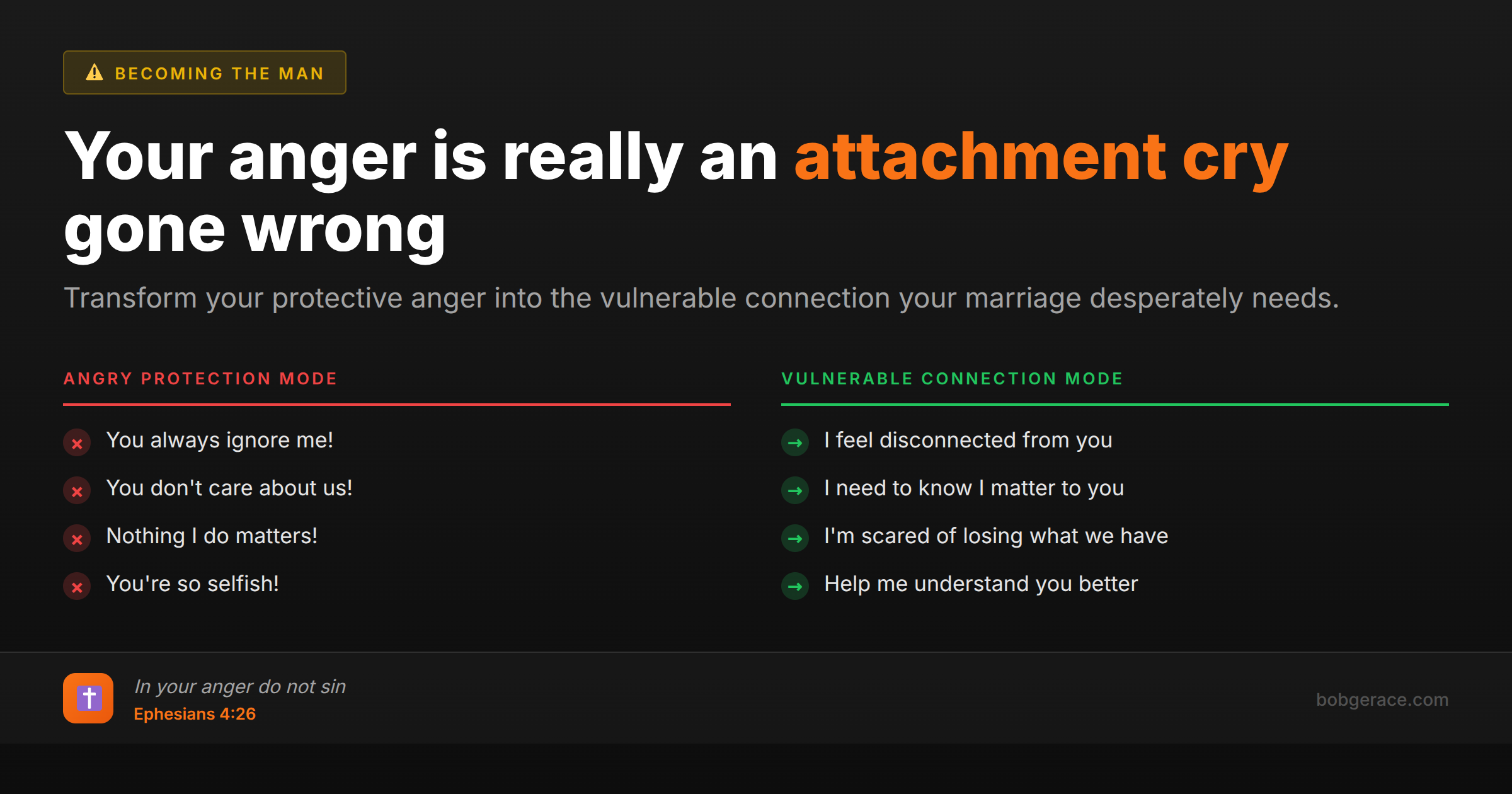
Yes, your anger is often an attachment cry that's been hijacked by frustration and fear. When we feel disconnected from our spouse, our nervous system interprets this as a threat to our most important bond. Instead of expressing vulnerability - 'I need you' or 'I'm scared of losing you' - we default to anger because it feels safer and more powerful. This protective anger actually pushes away the very person we're trying to reach, creating the exact disconnection we fear most. Understanding this pattern is the first step toward transforming your anger into authentic connection.
The Full Picture
Here's what's really happening when anger takes over your marriage: You're wired for connection, but operating from protection. Every human being has fundamental attachment needs - to feel seen, valued, and secure in their most important relationships. When these needs aren't met in marriage, your nervous system doesn't just notice - it sounds the alarm.
Think about the last time you exploded at your spouse. Strip away the surface issue - dishes, money, schedules, whatever - and ask yourself: *What was I really afraid of?* Was it being ignored? Feeling unimportant? Sensing distance growing between you? That fear is your attachment system trying to get your attention.
The problem is how we've learned to handle that fear. Instead of saying 'I feel disconnected from you and it scares me,' we say 'You never listen!' Instead of 'I need to know I matter to you,' we say 'You don't care about anything I say!' The vulnerable truth gets buried under layers of blame and criticism.
This happens because vulnerability feels risky when we're already feeling disconnected. Anger feels powerful, protective, like it might force our spouse to pay attention. But here's the cruel irony: anger activates your spouse's protection system too. Now you have two people in fight-or-flight mode, both desperately wanting connection but both attacking the very relationship they're trying to protect.
Your anger isn't the enemy - it's a messenger. It's telling you that something precious (your marriage bond) feels threatened. The question isn't whether you should feel angry, but whether you're going to let that anger drive the bus or use it as information about what you really need.
What's Really Happening
From an attachment perspective, anger in marriage often serves as a secondary emotion - a protective response that masks primary emotions like fear, sadness, or longing. When individuals feel their attachment bond is threatened, the nervous system activates what we call 'protest behaviors' - attempts to regain connection and security.
In secure attachment, these protests might involve direct communication: 'I'm feeling distant from you.' But when we're operating from insecure attachment patterns, anger becomes the go-to response because it feels less vulnerable than admitting fear or need. The angry partner is essentially saying 'Pay attention to me!' or 'Don't leave me!' but the message gets lost in the intensity.
Neurologically, when attachment distress activates our threat detection system, the amygdala hijacks rational thinking. Blood flow decreases to the prefrontal cortex, making it nearly impossible to access empathy, perspective-taking, or problem-solving skills. This is why couples can have the same fight repeatedly - they're not actually fighting about the dishes or the budget; they're fighting about connection and security.
The therapeutic goal isn't to eliminate anger but to help individuals recognize it as attachment information. When clients can identify the underlying attachment cry - 'I need to know you care' or 'I'm afraid we're drifting apart' - they can begin expressing their needs in ways that invite connection rather than defensiveness. This shift from secondary anger to primary vulnerability is often the breakthrough moment in marriage therapy.
What Scripture Says
Scripture gives us profound wisdom about anger and our deep need for connection. Ephesians 4:26-27 tells us, 'In your anger do not sin: Do not let the sun go down while you are still angry, and do not give the devil a foothold.' Notice God doesn't condemn anger itself - He warns us about what we do with it.
James 1:19-20 instructs us: 'Everyone should be quick to listen, slow to speak and slow to become angry, because human anger does not produce the righteousness that God desires.' This isn't about suppressing anger, but about pausing long enough to understand what's underneath it.
God designed us for relationship. Genesis 2:18 declares 'It is not good for man to be alone.' Our longing for connection, even our fear of losing it, reflects how God made us. The problem isn't the longing - it's how we handle the fear that comes when that connection feels threatened.
Proverbs 27:5-6 offers crucial insight: 'Better is open rebuke than hidden love. Wounds from a friend can be trusted, but an enemy multiplies kisses.' Sometimes our anger, when channeled properly, can actually serve love by addressing real issues. The key is speaking truth in love (Ephesians 4:15), not attacking from fear.
1 Corinthians 13:5 reminds us that love 'keeps no record of wrongs' and 'is not easily angered.' When we're secure in God's love and our spouse's commitment, we can risk vulnerability instead of defaulting to anger. Psalm 34:18 promises that 'The Lord is close to the brokenhearted' - including when that brokenheartedness shows up as misplaced anger in our marriages.
What To Do Right Now
-
1
Pause and breathe - When anger hits, take 5 deep breaths and ask: 'What am I really afraid of right now?'
-
2
Identify the attachment cry - Translate your anger: Instead of 'You always...' ask 'What do I need from my spouse?'
-
3
Own your vulnerability - Practice saying 'I feel disconnected' instead of 'You don't care about me'
-
4
Time your conversations - Don't try to resolve attachment issues when you're both activated. Cool down first.
-
5
Express needs, not demands - Say 'I need to feel important to you' rather than 'You need to pay attention to me'
-
6
Pray before you speak - Ask God to help you respond from love rather than fear, and to see your spouse's heart
Related Questions
- What's underneath the anger — fear, shame, hurt?
- What is 'secondary emotion' and is anger covering something?
- Why do I hurt the person I'm trying to keep?
- What does anxious attachment anger look like?
- How do I express need without rage?
- What is anxious attachment and am I doing it right now?
- Why does my pursuing make her pull away more?
- What attachment injuries did I experience?
Also find Bob on
Subscribe for weekly videos on Christian marriage.
Your Marriage Needs More Than Pattern Recognition
Understanding the attachment cry underneath your anger is one thing. Learning how to express it in your actual marriage—with your wife, in your specific dynamic—is another. A coach helps you make that translation.
Talk to Bob →