What does 'protest behavior' look like as rage?
6 min read
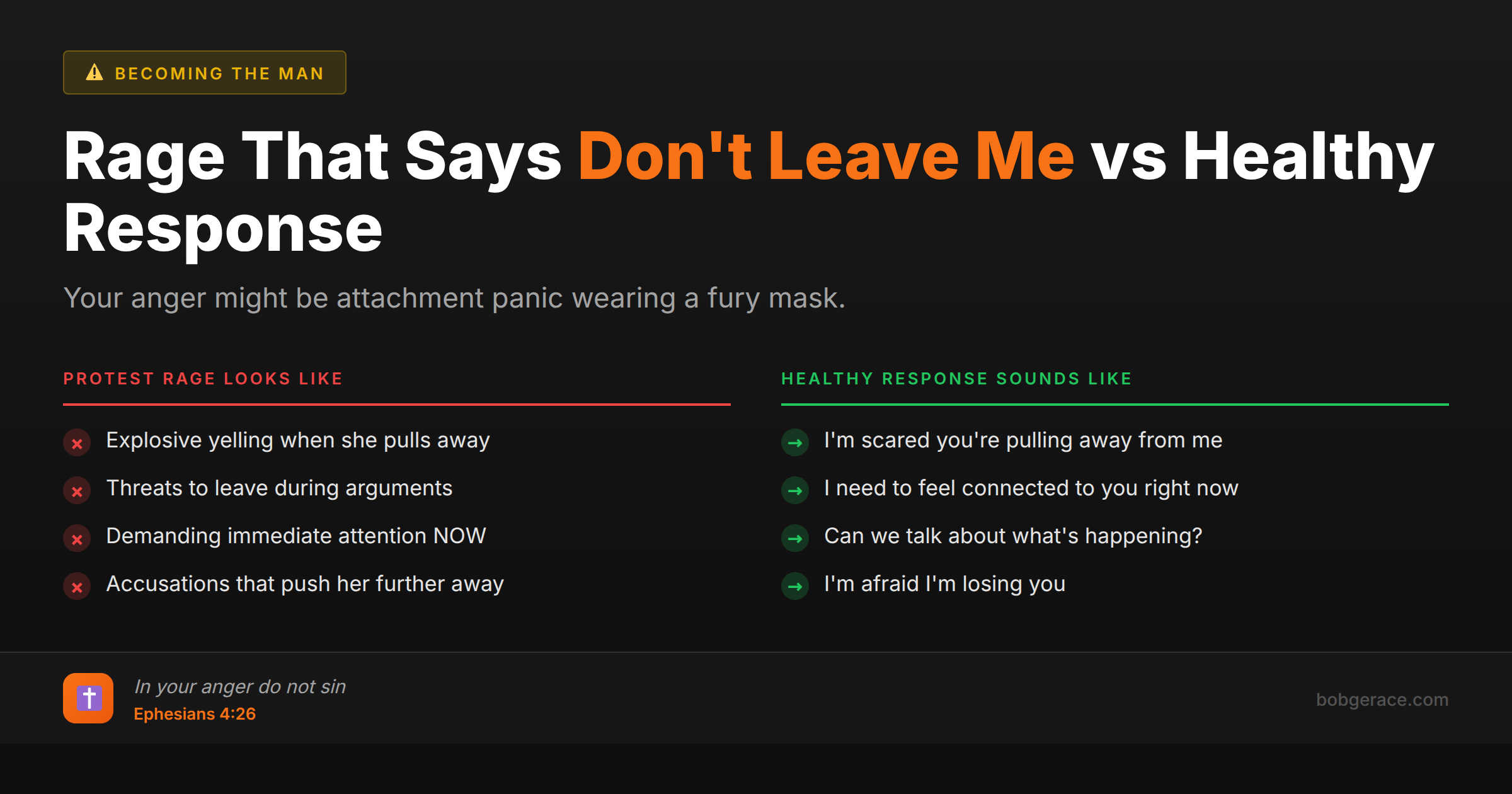
Protest behavior as rage is your attachment system's desperate attempt to reconnect when you feel your spouse pulling away or becoming unavailable. It shows up as explosive anger, yelling, accusations, threats to leave, or demanding immediate attention. This isn't just regular anger - it's primal panic disguised as fury. Your nervous system interprets emotional distance as a survival threat, triggering fight-or-flight responses that can seem completely disproportionate to the situation. The key difference is that protest rage always has an underlying message: 'Don't leave me' or 'I need you to see me.' It's attachment desperation wearing an angry mask. Understanding this doesn't excuse destructive behavior, but it helps you recognize what's really driving these intense reactions so you can address the root cause rather than just managing the symptoms.
The Full Picture
Protest behavior as rage is one of the most misunderstood dynamics in marriage. When your attachment system perceives threat - like your spouse being emotionally distant, dismissive, or unavailable - it can trigger what looks like explosive anger but is actually desperate attempts to reconnect.
Here's what protest rage typically looks like:
- Explosive reactions to seemingly small issues - Yelling or raised voices that feel out of control - Accusations like "You never listen" or "You don't care" - Threats to leave or end the relationship - Demanding immediate attention or resolution - Following your spouse around the house to continue the argument - Bringing up past hurts during current conflicts - Feeling panicked if they try to leave or take space
The key identifier is the underlying desperation. Regular anger says "I'm frustrated with this situation." Protest rage says "I'm terrified you're going to abandon me." It's your attachment system hitting the panic button and flooding your body with stress hormones.
This often happens when: - Your spouse withdraws emotionally during conflict - They're distracted by work, phones, or other priorities - You feel unheard or dismissed - There's been a rupture without repair - You're going through stressful life transitions
The irony is brutal: The very behavior designed to bring your spouse closer typically pushes them further away, creating a vicious cycle where your attachment fears become self-fulfilling prophecies.
What's Really Happening
From a clinical perspective, protest behavior as rage represents an activated attachment system responding to perceived threats to the primary relationship bond. When individuals with anxious attachment styles experience their partner as emotionally unavailable or withdrawing, their nervous system interprets this as a survival threat, triggering intense physiological and emotional responses.
The rage serves multiple unconscious functions: it's an attempt to re-engage the partner, express the depth of emotional pain, and paradoxically, test the security of the relationship. The intensity of the reaction often correlates with early attachment experiences and unresolved trauma around abandonment or emotional neglect.
Neurobiologically, the amygdala hijacks higher brain functions during these episodes, making rational communication nearly impossible. The person experiencing protest rage is genuinely flooded with stress hormones and operating from a place of perceived life-or-death urgency. This explains why logical appeals during these moments rarely work.
What's crucial to understand is that beneath the rage is profound vulnerability and fear. The angry partner isn't trying to be destructive - they're desperately trying to restore connection using the only tools their nervous system knows. However, this creates a pursue-withdraw cycle where the more one partner protests, the more the other withdraws, escalating the very disconnection they're trying to prevent.
Healing requires recognizing these patterns, developing emotional regulation skills, and creating secure communication pathways that address the underlying attachment needs rather than just managing the surface behaviors.
What Scripture Says
Scripture provides profound wisdom about anger, fear, and our deep need for connection that directly applies to understanding protest behavior.
First, God acknowledges that anger itself isn't sinful: *"In your anger do not sin: Do not let the sun go down while you are still angry"* (Ephesians 4:26). The issue isn't feeling angry when we're hurt or afraid - it's what we do with that anger.
The root of protest rage is often fear, which Scripture addresses directly: *"There is no fear in love. But perfect love drives out fear, because fear has to do with punishment. The one who fears is not made perfect in love"* (1 John 4:18). Our attachment fears stem from believing we might be rejected or abandoned.
God calls us to gentleness even in our pain: *"A gentle answer turns away wrath, but a harsh word stirs up anger"* (Proverbs 15:1). When we're flooded with protest rage, harsh words become weapons that wound rather than tools that heal.
Scripture also reminds us of our security in Christ: *"Never will I leave you; never will I forsake you"* (Hebrews 13:5). This divine promise can anchor us when human relationships feel threatening or unstable.
Finally, we're called to self-control: *"Like a city whose walls are broken through is a person who lacks self-control"* (Proverbs 25:28). While we may feel out of control during attachment panic, we're responsible for learning to manage our responses.
The goal isn't to eliminate all anger, but to express our needs and fears in ways that invite connection rather than destroy it.
What To Do Right Now
-
1
Recognize your protest patterns - Write down what triggers your rage responses and what you're really afraid of underneath the anger
-
2
Practice the pause - When you feel the rage building, physically step away and take 10 deep breaths before speaking
-
3
Name the fear, not just the anger - Instead of 'You never listen!' try 'I'm scared you don't care about what I'm saying'
-
4
Create a timeout agreement - Establish a respectful way either of you can take space when emotions are too high
-
5
Address your attachment wounds - Consider how past relationships or childhood experiences might be amplifying your current reactions
-
6
Seek professional help - If protest rage is damaging your marriage, work with a therapist who understands attachment theory
Related Questions
- What is 'amygdala hijack' and how do I interrupt it?
- What's underneath the anger — fear, shame, hurt?
- What is 'secondary emotion' and is anger covering something?
- Is my anger an attachment cry gone wrong?
- Why do I hurt the person I'm trying to keep?
- What does my rage communicate to her attachment system?
- What is anxious attachment and am I doing it right now?
- What does 'protest behavior' look like and am I doing it?
- Why does my pursuing make her pull away more?
- What is 'primal panic' and is that what she's been feeling?
Also find Bob on
Subscribe for weekly videos on Christian marriage.
Bring Your Rage to a Coach
If you're exploding at your wife and can't stop it on your own, talk to Bob. He'll help you see what's driving it in your specific marriage and build a plan that works for you.
Talk to Bob →