What does 'protest behavior' look like and am I doing it?
6 min read
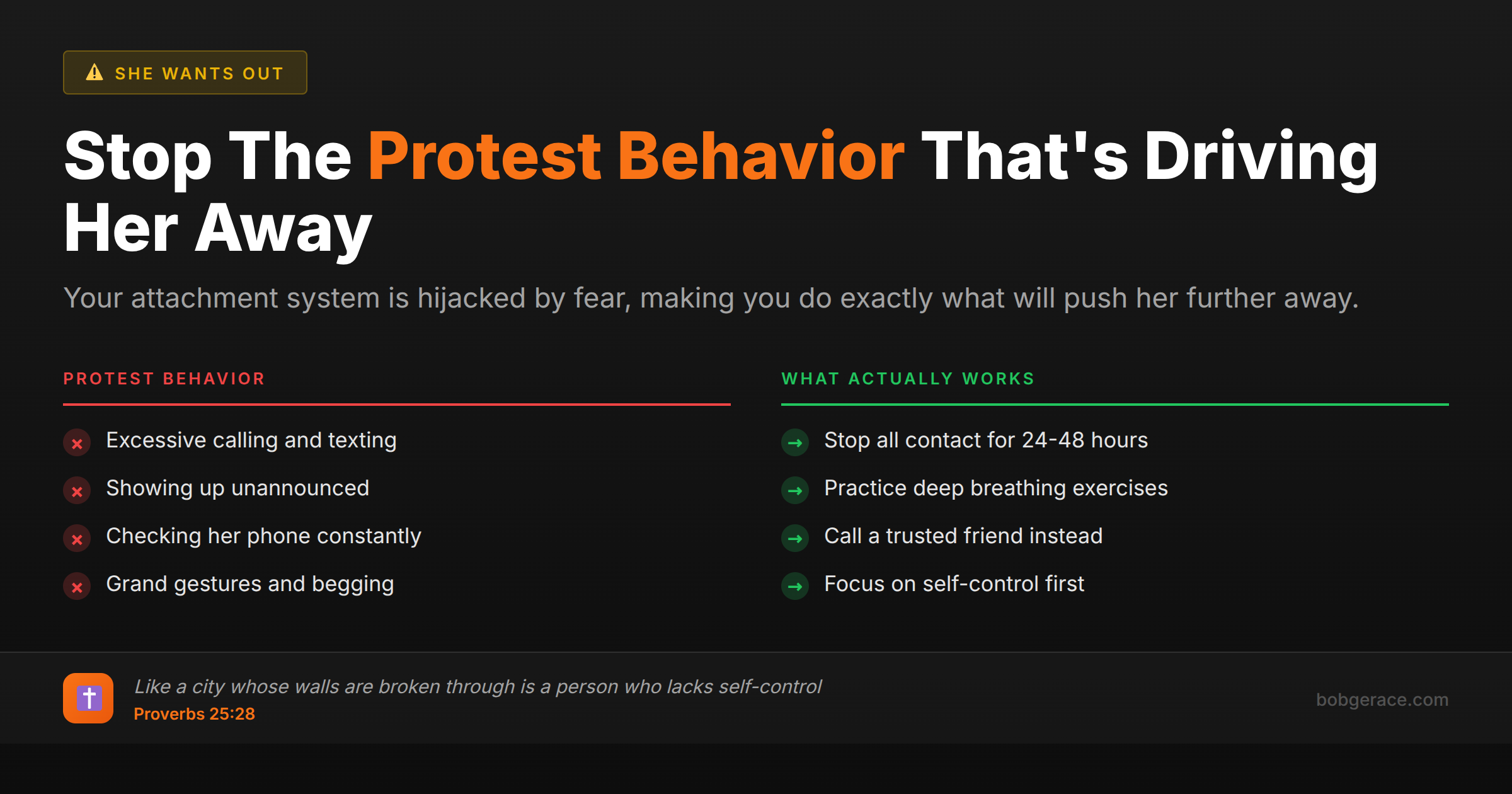
Protest behavior is your attachment system's desperate attempt to reconnect when you sense your wife pulling away. It looks like excessive calling, texting, showing up unannounced, grand gestures, or even explosive anger - all driven by panic at losing her. You're not crazy or weak; you're human. But here's the hard truth: protest behavior almost always backfires, pushing her further away when you need her closer. If you're constantly checking her phone, making dramatic declarations of change, or oscillating between begging and anger, you're likely in full protest mode. The irony is crushing - the harder you chase, the faster she runs. Your nervous system is hijacked by fear, making you do exactly what will confirm her worst fears about the relationship.
The Full Picture
Protest behavior emerges from your attachment system going into overdrive. When you sense disconnection from your primary attachment figure (your wife), your brain interprets this as a survival threat. The response is automatic and intense.
Common protest behaviors include: • Excessive calling, texting, or emailing • Showing up uninvited to "talk things through" • Making grand romantic gestures when she's asked for space • Explosive anger followed by desperate apologies • Checking her phone, social media, or tracking her movements • Threatening self-harm or dramatic declarations • Oscillating between rage and pleading • Bringing up past good times repeatedly • Making promises of immediate, dramatic change
Why it backfires: Your wife is likely already feeling overwhelmed by the relationship's problems. When you amp up the intensity through protest behavior, you confirm her fears that you can't handle emotional regulation. She experiences your desperation as pressure, not love.
The cruel irony is that protest behavior often creates the very abandonment it's trying to prevent. Your nervous system, designed to keep you safe, actually pushes away the person you most need. She begins to see you as unpredictable, overwhelming, or even unsafe - not because you're a bad person, but because your attachment system has been triggered into survival mode.
What's Really Happening
From an attachment theory perspective, protest behavior represents the first stage of attachment injury response. When the attachment bond feels threatened, the nervous system activates what researchers call the "attachment behavioral system" - a hardwired response designed to maintain proximity to our primary attachment figure.
This response follows a predictable pattern: protest, despair, then detachment. Most men get stuck in the protest phase, unable to understand why their efforts to reconnect are met with increased distance. The behavior is driven by the amygdala's threat detection system, which interprets relationship disconnection as a survival emergency.
Neurologically, you're experiencing: • Elevated cortisol and adrenaline levels • Compromised prefrontal cortex function (rational thinking) • Hyperactivation of the sympathetic nervous system • Disrupted sleep and appetite patterns
Research shows that attachment injuries activate the same brain regions as physical pain. You're literally experiencing the threat of loss as physical agony, which explains the intensity of your response. However, protest behavior typically reinforces avoidant patterns in your spouse, creating a pursue-withdraw dynamic that becomes increasingly destructive.
The key insight is that protest behavior serves a function - it's your attachment system working exactly as designed. But in adult relationships, especially during crisis, it often produces the opposite of its intended effect. Understanding this can help you develop self-compassion while taking responsibility for choosing different responses.
What Scripture Says
Scripture provides profound insight into managing our responses during relational crisis. Proverbs 25:28 tells us, "Like a city whose walls are broken through is a person who lacks self-control." When we're in protest mode, our emotional walls have been breached, leaving us vulnerable and reactive.
James 1:19-20 instructs us: "My dear brothers and sisters, take note of this: Everyone should be quick to listen, slow to speak and slow to become angry, because human anger does not produce the righteousness that God desires." This directly addresses the explosive anger often seen in protest behavior.
The principle of giving space is biblical. Proverbs 27:14 warns: "If anyone loudly blesses their neighbor early in the morning, it will be taken as a curse." Even good intentions, when delivered with wrong timing or intensity, can be received as pressure rather than love.
1 Peter 3:7 calls husbands to live with their wives "in an understanding way," showing honor and consideration. Protest behavior often fails this test, prioritizing our need for reassurance over our wife's need for space and respect.
Galatians 5:22-23 describes the fruit of the Spirit: "love, joy, peace, forbearance, kindness, goodness, faithfulness, gentleness and self-control." Notice that genuine love includes forbearance (patience under difficulty) and self-control - the opposite of protest behavior.
Philippians 4:6-7 offers the antidote to anxiety-driven responses: "Do not be anxious about anything, but in every situation, by prayer and petition, with thanksgiving, present your requests to God. And the peace of God, which transcends all understanding, will guard your hearts and your minds in Christ Jesus." This peace enables wise responses rather than reactive protest behavior.
What To Do Right Now
-
1
Stop all contact for 24-48 hours - no calls, texts, emails, or social media checking to break the protest cycle
-
2
Write down every behavior you've exhibited in the past week and honestly identify which ones qualify as protest behavior
-
3
Practice deep breathing exercises (4-7-8 breathing) three times daily to regulate your nervous system
-
4
Call a trusted male friend or counselor instead of reaching out to your wife when you feel the urge to protest
-
5
Create a specific plan for what you'll do when protest urges hit - physical exercise, prayer, journaling, or calling accountability
-
6
Apologize once for any protest behavior without justifying it, then commit to demonstrating change through consistent actions, not words
Related Questions
- What is 'anxious protest behavior' and am I doing it?
- I'm panicking and want to pursue her — is that my attachment style?
- Why do I feel like I'm going to die if she leaves?
- Why does my instinct to pursue backfire?
- What is anxious attachment and am I doing it right now?
- What's the difference between pursuing and chasing?
- What does 'protest behavior' look like as rage?
- Is my anger an attachment cry gone wrong?
- What does anxious attachment anger look like?
Also find Bob on
Subscribe for weekly videos on Christian marriage.
You Can't Calm This Alone
Protest behavior is a nervous system hijack, not a character flaw. A coach who knows your specific marriage can help you respond from strength when your wiring is screaming panic.
Talk to Bob →