Why do I hurt the person I'm trying to keep?
6 min read
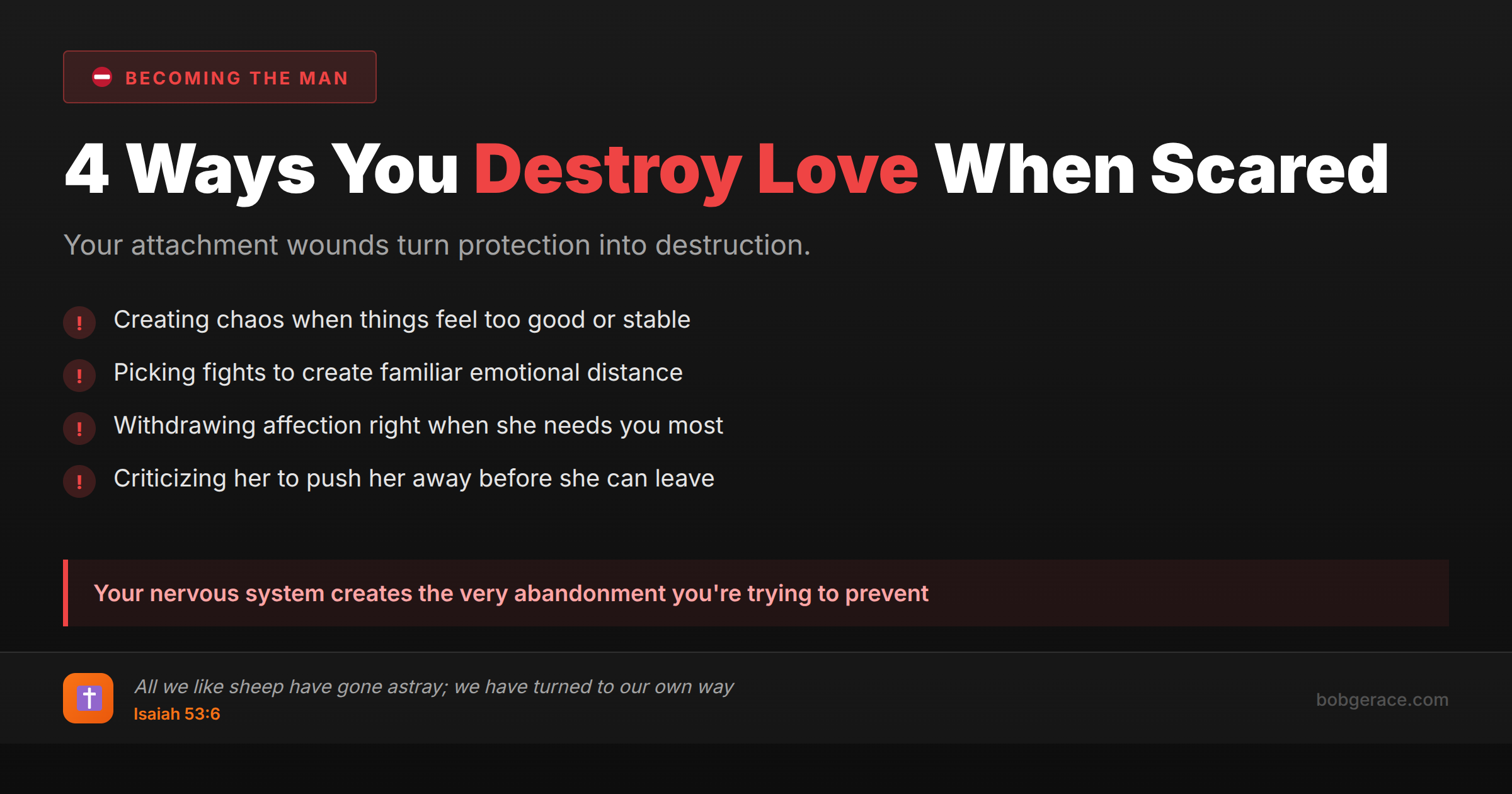
You hurt the person you're trying to keep because of deep attachment wounds that trigger your nervous system into survival mode. When you feel threatened by potential abandonment or rejection, your brain activates protective mechanisms that ironically push away the very person you need most. This isn't conscious sabotage - it's your wounded attachment system trying to control the outcome by creating distance before you can be rejected. This pattern often stems from childhood experiences where love felt conditional or unsafe. Your nervous system learned that closeness equals danger, so it creates chaos or conflict to return to a familiar state of emotional distance. The tragedy is that your desperate attempts to prevent abandonment actually create the very scenario you're trying to avoid.
The Full Picture
The cruel irony of attachment wounds is that they make us destroy what we most desperately want to protect. When you find yourself repeatedly hurting your spouse despite loving them deeply, you're witnessing the power of an dysregulated nervous system in action.
The Attachment Wound Cycle
Here's what's really happening: Your attachment system, formed in early childhood, operates like an internal alarm system. When you feel your spouse pulling away, being critical, or seeming distant, this system screams "DANGER!" Your nervous system floods with stress hormones, and you shift into survival mode.
In this state, you're no longer operating from your rational, loving self. Instead, you're a wounded child fighting for survival. You might become clingy and desperate, or you might become angry and attacking. You might withdraw completely or create drama to get attention. All of these behaviors push your spouse away, confirming your deepest fear that you're unlovable.
The Self-Fulfilling Prophecy
This creates a devastating self-fulfilling prophecy. Your attachment wound whispers, "They're going to leave you anyway, so protect yourself first." So you criticize before they can reject you. You withdraw before they can abandon you. You create conflict before they can disappoint you. You're trying to control the narrative, but you're actually writing the very story you're trying to avoid.
Why This Happens to Good People
This isn't about being a bad person or not loving your spouse enough. Attachment wounds are formed in our earliest relationships when our developing brains were learning what love and safety look like. If love came with conditions, chaos, or inconsistency, your nervous system learned to associate intimacy with threat.
The person you hurt isn't really your spouse - it's the parent who couldn't meet your needs, the caregiver who was inconsistent, or the early relationships that taught you that love isn't safe. Your spouse just happens to be the one standing closest when your wounded parts get triggered.
What's Really Happening
From a clinical perspective, this pattern represents what we call "attachment dysregulation" - a neurobiological response that happens below the level of conscious awareness. When your attachment system perceives threat, your autonomic nervous system shifts into hypervigilance or collapse, making healthy connection impossible.
The Neurobiology of Hurt
Your brain has two primary operating systems: the social engagement system (connection and safety) and the survival system (fight, flight, or freeze). Attachment wounds keep you chronically activated in survival mode, where your primary goal shifts from connection to self-protection. In this state, you literally cannot access the parts of your brain responsible for empathy, emotional regulation, and secure bonding.
The tragedy is that survival behaviors - criticism, defensiveness, stonewalling, or pursuing - are attachment injuries to your partner. Every time you operate from your wounded attachment system, you're inadvertently creating the very abandonment you're trying to prevent.
The Trauma Response in Marriage
What looks like intentional sabotage is actually a trauma response. Your nervous system has learned that intimacy equals danger, so it creates familiar chaos to regulate itself. This isn't conscious - it's an automatic survival mechanism designed to protect you from perceived threats.
Healing requires learning to recognize when your attachment system is activated and developing the capacity to self-regulate before you act from your wounds. This involves building awareness of your triggers, learning grounding techniques to calm your nervous system, and slowly rewiring your brain to associate intimacy with safety rather than threat. The goal isn't to never get triggered, but to respond from your regulated, adult self rather than your wounded child self.
What Scripture Says
Scripture speaks directly to this pattern of hurting those we love, revealing both the source of our brokenness and the path to healing. The Bible acknowledges that we're all wounded people capable of great harm, even to those closest to us.
The Reality of Our Brokenness
*"All we like sheep have gone astray; we have turned—every one—to his own way" (Isaiah 53:6)*. This verse captures the reality that our self-protective instincts often lead us away from love and connection, even when that's what we desperately want.
*"The heart is deceitful above all things, and desperately sick; who can understand it?" (Jeremiah 17:9)*. Our wounded hearts can deceive us into believing that hurting others will somehow protect us from hurt.
The Source of Healing
*"He heals the brokenhearted and binds up their wounds" (Psalm 147:3)*. God doesn't just forgive our harmful behaviors - He heals the attachment wounds that drive them. This healing often comes through the very relationships we're sabotaging.
*"Perfect love casts out fear" (1 John 4:18)*. The fear driving your destructive patterns can only be healed by experiencing perfect love - first from God, then through healthy human relationships.
The Call to Transformation
*"Be kind to one another, tenderhearted, forgiving one another, as God in Christ forgave you" (Ephesians 4:32)*. Healing requires extending to your spouse the same grace God extends to you, even when your wounded parts want to protect and defend.
*"Let us hold fast the confession of our hope without wavering, for he who promised is faithful" (Hebrews 10:23)*. Breaking these patterns requires hope that change is possible and that God is faithful to complete the healing work He's begun in you.
What To Do Right Now
-
1
Recognize Your Pattern: Write down the specific ways you hurt your spouse when you feel threatened. Awareness is the first step to breaking the cycle.
-
2
Identify Your Triggers: Notice what situations, words, or behaviors from your spouse activate your attachment wounds and survival responses.
-
3
Learn Your Warning Signs: Pay attention to physical sensations (tight chest, racing heart, shallow breathing) that signal your nervous system is becoming dysregulated.
-
4
Develop a Pause Practice: When triggered, take 5 deep breaths and ask yourself: 'Is this my wounded child responding or my mature adult?' Don't act until you can respond from your adult self.
-
5
Apologize and Repair: When you do hurt your spouse, take full responsibility without excuses. Say: 'My attachment wounds got triggered and I hurt you. That's on me, not you.'
-
6
Seek Professional Help: Attachment wounds require professional support to heal. Find a therapist who understands attachment theory and trauma-informed approaches to relationship healing.
Related Questions
- What is 'anger as control' vs. 'anger as pain'?
- Is my anger an attachment cry gone wrong?
- What does anxious attachment anger look like?
- What does my rage communicate to her attachment system?
- Why does my anger make her less safe not more attached?
- How do I express need without rage?
- What is anxious attachment and am I doing it right now?
- Why does my pursuing make her pull away more?
- What does 'protest behavior' look like and am I doing it?
- What's the pursue-withdraw cycle and how do I stop it?
Also find Bob on
Subscribe for weekly videos on Christian marriage.
You Don't Have to Figure This Out Alone
A coach who knows your marriage can help you see what's driving this pattern in your specific situation—and what to do about it today.
Talk to Bob →