She doesn't want to be touched
6 min read
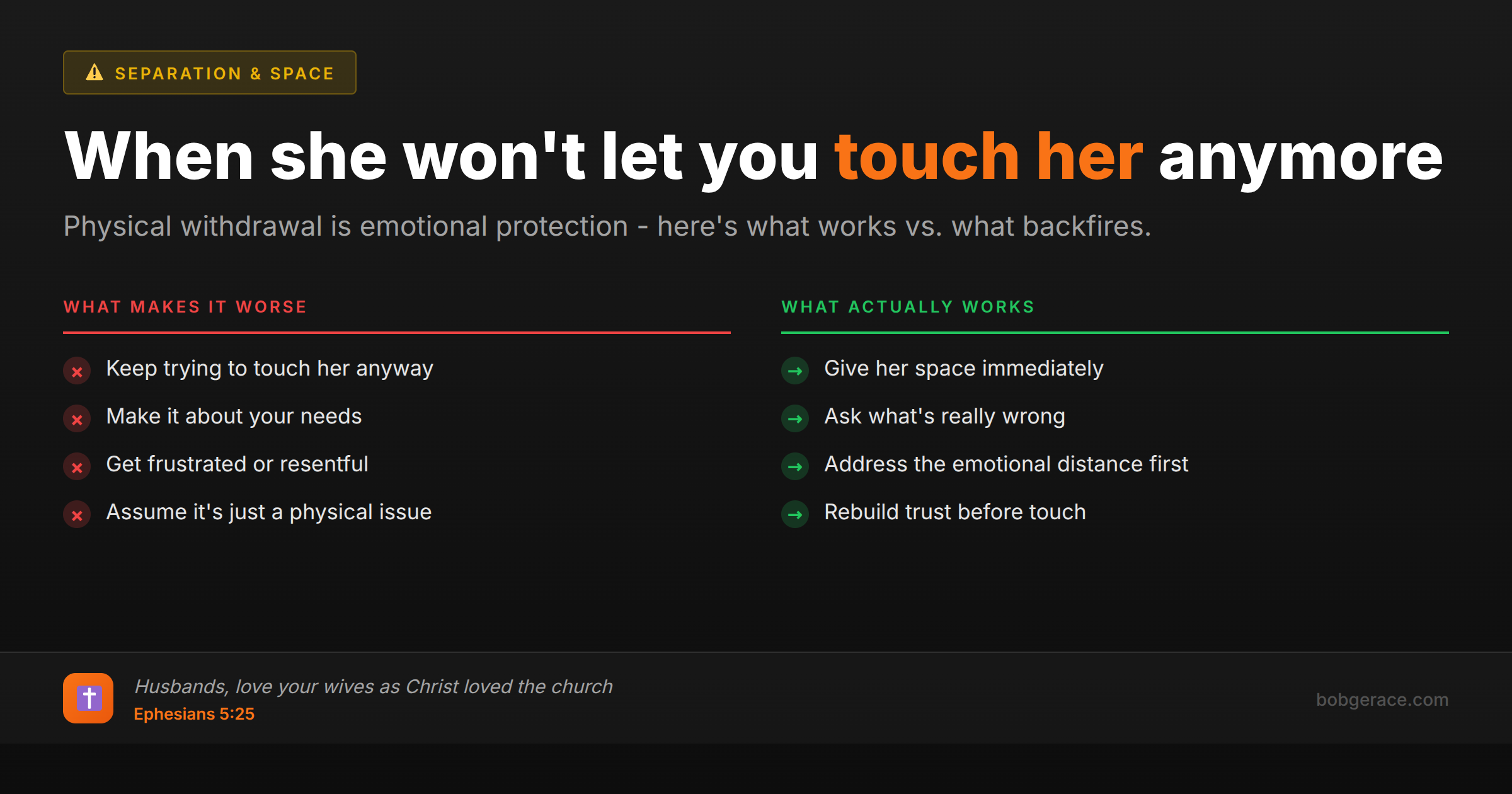
When your wife doesn't want to be touched, you're experiencing one of the most painful forms of marital rejection. This isn't just about physical affection - it's a symptom of deeper relational breakdown. Physical touch is a fundamental human need and a primary love language for many people. When it's withdrawn, it often indicates emotional hurt, unresolved conflict, or feeling unsafe in the relationship. The key is understanding that physical withdrawal is usually emotional protection. Something has happened that made her feel the need to create physical barriers. This could be accumulated resentment, feeling emotionally disconnected, past hurts that haven't healed, or feeling like touch only leads to sexual expectations. The solution isn't to push harder for physical contact, but to address the underlying emotional and relational issues that created this distance.
The Full Picture
When your wife pulls away from physical touch, you're facing one of marriage's most challenging dynamics. Physical touch isn't just nice to have - it's how we bond, connect, and feel loved. When it's gone, everything feels broken.
What's Really Behind the Withdrawal
Physical avoidance rarely starts with physical issues. It starts with emotional ones. She's not rejecting your body - she's protecting her heart. Something in your relationship dynamic has made physical closeness feel unsafe, unwanted, or burdensome.
Maybe she feels like every touch leads to sexual expectation. Maybe past conflicts have created walls. Maybe she feels emotionally neglected, so physical affection feels hollow. Maybe you've been critical, demanding, or inattentive in ways that shut down her desire for closeness.
The Vicious Cycle
Here's what typically happens: She pulls away physically. You feel rejected and pursue more. She feels pressured and pulls away further. You get frustrated or hurt and either become demanding or withdraw emotionally yourself. She feels even less safe. The cycle continues.
Meanwhile, both of you are starving for connection, but you're going about it in ways that create more distance. You want physical closeness to feel loved. She needs emotional safety to want physical closeness.
Why This Hurts So Much
Physical rejection hits us at a primal level. It triggers abandonment fears, questions about our desirability, and deep loneliness. You might find yourself feeling angry, desperate, or completely defeated. These feelings are normal, but how you handle them determines whether you'll break through this barrier or build it higher.
The Path Forward
The solution isn't to convince her to touch you or to withdraw your own affection in retaliation. The solution is to become the kind of man she feels safe being close to. This means addressing whatever created the emotional distance first.
What's Really Happening
From a clinical perspective, physical withdrawal in marriage typically stems from one of several underlying dynamics. First, there's often a mismatch in attachment styles - one partner seeks physical closeness for security while the other experiences it as overwhelming or intrusive.
The most common pattern I see is what we call 'touch saturation' - when one partner feels that all physical contact carries sexual or emotional expectations they're not ready to meet. This creates an all-or-nothing dynamic where even casual touch gets avoided to prevent misunderstanding.
There's also the 'emotional bank account' factor. When couples have unresolved conflicts, criticism patterns, or emotional disconnection, the brain actually starts associating physical touch with stress rather than pleasure. Her nervous system may literally be in a protective state that makes touch feel threatening rather than loving.
Another crucial factor is the difference between 'desire' and 'willingness.' She may still love you but not desire physical connection until emotional safety is restored. Many men interpret lack of desire as lack of love, which isn't accurate.
The neurological reality is that women's brains typically need emotional safety and connection to activate the systems that make physical touch desirable. When that safety is compromised, the brain prioritizes protection over connection. This isn't conscious rejection - it's how we're wired for survival.
Recovery requires patience and indirect approach. Direct requests for more touch usually backfire. Instead, focus on rebuilding emotional safety, addressing her concerns without defensiveness, and demonstrating change through consistent action rather than words.
What Scripture Says
Scripture gives us clear guidance on how to handle physical and emotional distance in marriage. The foundation is always love, patience, and sacrificial service.
Love Serves First
*"Husbands, love your wives as Christ loved the church and gave himself up for her"* (Ephesians 5:25). Christ didn't demand the church's affection - He served sacrificially until the church responded with love. Your role is to love her in ways that make her feel safe and cherished, not to demand physical affection.
*"Love is patient, love is kind. It does not envy, it does not boast, it is not proud. It does not dishonor others, it is not self-seeking, it is not easily angered, it keeps no record of wrongs"* (1 Corinthians 13:4-5). Patient love doesn't pressure or manipulate for physical connection.
Address the Heart Issues
*"Above all else, guard your heart, for everything you do flows from it"* (Proverbs 4:23). Her physical withdrawal is flowing from heart issues that need attention. What has wounded her heart? What has made her feel unsafe?
*"Therefore, if you are offering your gift at the altar and there remember that your brother or sister has something against you, leave your gift there in front of the altar. First go and be reconciled to them; then come and offer your gift"* (Matthew 5:23-24). You can't build physical intimacy on a foundation of unresolved hurt.
Lead with Humility
*"Do nothing out of selfish ambition or vain conceit. Rather, in humility value others above yourselves, not looking to your own interests but each of you to the interests of the others"* (Philippians 2:3-4). Ask yourself: Am I seeking physical connection for her benefit or just my own needs?
*"Be completely humble and gentle; be patient, bearing with one another in love"* (Ephesians 4:2). Rebuilding physical intimacy requires humble patience, not demanding your rights.
What To Do Right Now
-
1
Stop pursuing physical touch immediately - Give her space without making it about you or showing frustration
-
2
Ask what's really wrong - Have a conversation focused entirely on understanding her perspective without defending yourself
-
3
Address underlying issues - Deal with whatever conflicts, hurts, or patterns created the emotional distance first
-
4
Rebuild emotional connection - Focus on non-physical ways to connect - conversation, shared activities, acts of service
-
5
Change your approach to touch - When appropriate, offer affection with no expectations - hand on shoulder, brief hug goodbye
-
6
Be patient with the process - Physical intimacy will return when emotional safety is restored, but this takes time and consistency
Related Questions
- We haven't had sex in months/years
- She flinches when I reach for her
- Is our marriage sexless forever?
- What is 'sexual aversion' and does she have it?
- Could her sexual shutdown be trauma-related?
- How do I rebuild emotional intimacy first?
- Why does she seem numb/flat/dead inside?
- What does emotional co-regulation look like?
- How do I become a safe emotional presence?
- What does 'holding space' actually mean?
Also find Bob on
Subscribe for weekly videos on Christian marriage.
Your Marriage Isn't a Textbook Case
A coach who knows your specific story can see what's driving her withdrawal and what will actually work for you two. You don't have to keep guessing.
Talk to Bob →