How do I initiate when she always says no?
6 min read
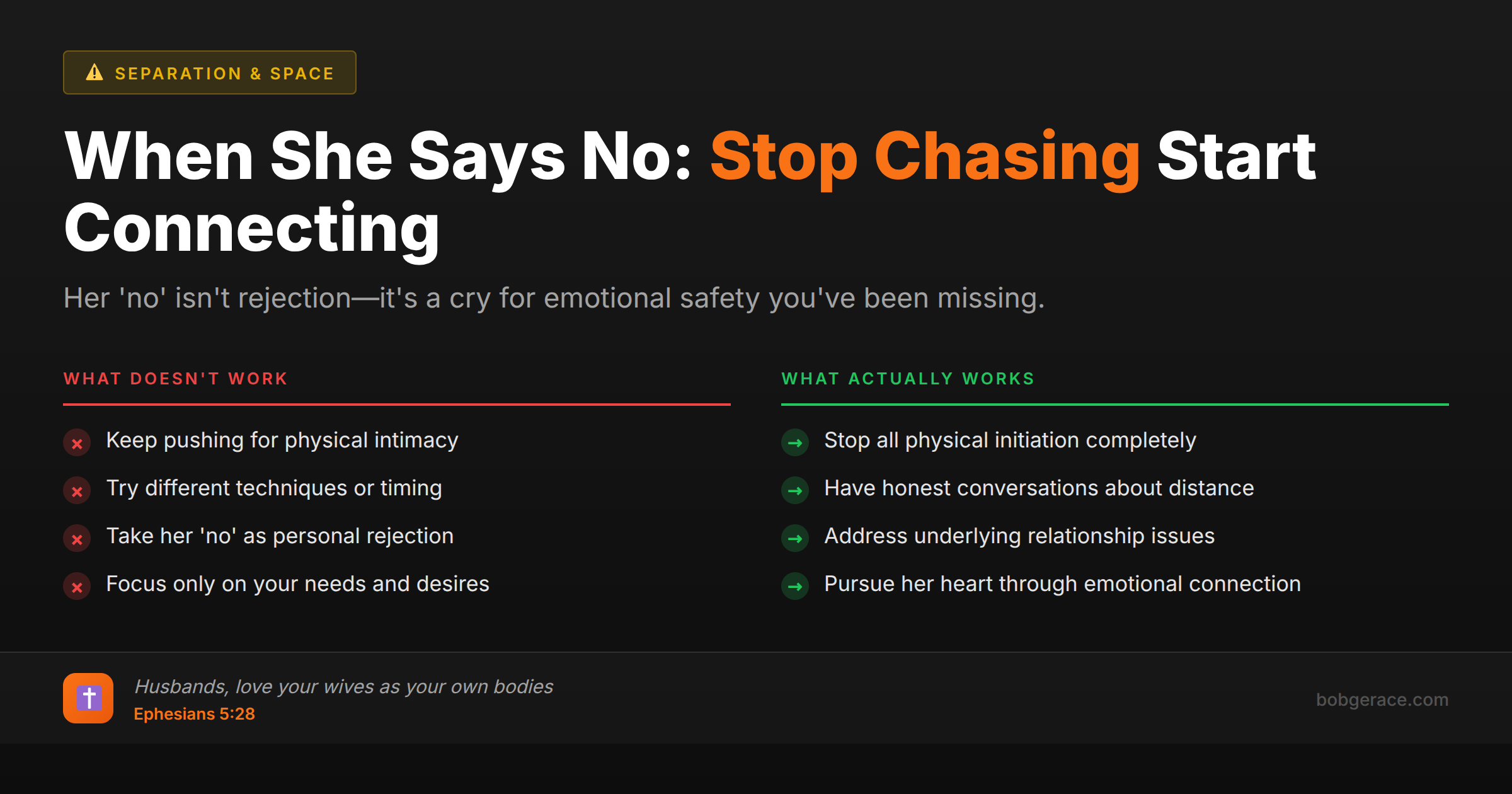
When your wife consistently says no to your advances, the answer isn't to keep pushing or try different techniques. It's to stop initiating altogether and start addressing why she's pulling away. Her "no" isn't about you personally - it's usually about feeling disconnected, overwhelmed, or emotionally unsafe. The path forward requires you to shift from pursuing physical intimacy to pursuing emotional connection. This means having honest conversations about what's happening in your relationship, addressing any underlying issues that have created distance, and rebuilding trust and safety. When a woman feels emotionally connected and secure, physical intimacy naturally follows.
The Full Picture
Here's what most men don't understand: when your wife consistently says no to physical intimacy, continuing to initiate is like trying to start a car with a dead battery. You can turn the key all you want, but nothing's going to happen until you address the real problem.
The cycle you're probably stuck in looks like this: You initiate, she says no, you feel rejected and frustrated, she feels pressured and pulls away further, creating even more distance between you. Every "no" makes you more desperate, and every initiation makes her feel more pressured.
Her "no" is actually communication. She's telling you something is wrong, but not with words. Maybe she feels like a roommate instead of a wife. Maybe she's overwhelmed and exhausted. Maybe past hurts haven't been addressed. Maybe she doesn't feel emotionally safe or connected to you.
The mistake most men make is thinking this is about technique or timing. They try initiating differently, at different times, or with different approaches. But you can't technique your way out of a connection problem.
What she needs from you right now isn't another advance - it's leadership. She needs you to recognize that something is broken and take responsibility for fixing it. This means having the difficult conversations, addressing the underlying issues, and rebuilding the foundation of your relationship.
The good news: When you stop chasing physical intimacy and start pursuing emotional connection, everything changes. When a woman feels truly seen, heard, valued, and safe with her husband, physical intimacy becomes something she desires, not something she avoids.
What's Really Happening
From a clinical perspective, persistent sexual rejection in marriage is rarely about the sexual act itself. It's typically a symptom of deeper relational dynamics that have created emotional distance and disconnection.
The neurobiological reality: When a woman feels emotionally unsafe or disconnected, her nervous system literally shuts down receptivity to physical intimacy. This isn't a conscious choice - it's an automatic protective response. The more pressure she feels, the stronger this response becomes.
Common underlying factors include: Unresolved conflict, feeling like her emotional needs aren't being met, overwhelming stress or responsibilities, past trauma, hormonal changes, or feeling objectified rather than cherished. Often, it's a combination of several factors.
The pursuit-distance pattern: When one partner pursues and the other distances, it creates a negative feedback loop. The pursuing partner's increased efforts trigger even more distancing behavior, creating what therapists call a "pursuer-distancer" dynamic.
What breaks the cycle: The pursuing partner must stop the pursuit and start addressing the underlying emotional disconnection. This requires genuine curiosity about her experience, validation of her feelings, and consistent demonstration of care for her as a whole person, not just as a source of physical intimacy.
Recovery is possible: When couples address the root emotional issues and rebuild genuine connection, physical intimacy typically returns naturally. However, this process requires patience, as trust and safety take time to rebuild.
What Scripture Says
Scripture gives us clear guidance on how to approach intimacy challenges in marriage, and it starts with understanding our role as husbands.
Ephesians 5:25-28 commands us: "Husbands, love your wives, just as Christ loved the church and gave himself up for her... In this same way, husbands ought to love their wives as their own bodies." This means putting her needs and well-being above your own desires.
1 Peter 3:7 instructs: "Husbands, in the same way be considerate as you live with your wives, and treat them with respect as the weaker partner and as heirs with you of the gracious gift of life, so that nothing will hinder your prayers." Notice the connection between how we treat our wives and our spiritual life.
1 Corinthians 13:4-5 defines love: "Love is patient, love is kind. It does not envy, it does not boast, it is not proud. It does not dishonor others, it is not self-seeking, it is not easily angered, it keeps no record of wrongs." This is the standard for how we should approach our wives, especially during difficult seasons.
Philippians 2:3-4 calls us to: "Do nothing out of selfish ambition or vain conceit. Rather, in humility value others above yourselves, not looking to your own interests but each of you to the interests of the others."
The biblical approach isn't to demand your rights, but to serve sacrificially. When you lead with Christ-like love - patient, kind, not self-seeking - you create the environment where intimacy can flourish naturally.
Galatians 6:7 reminds us: "Do not be deceived: God cannot be mocked. A man reaps what he sows." If you sow pressure and demand, you'll reap distance. If you sow love and service, you'll reap connection.
What To Do Right Now
-
1
Stop all physical initiation immediately - Give her space to breathe and reset the dynamic between you
-
2
Have an honest conversation - Ask her what's really going on and listen without defending or problem-solving
-
3
Address any underlying issues - Deal with unresolved conflicts, stress factors, or hurt feelings that may be creating distance
-
4
Focus on emotional connection - Pursue her heart through meaningful conversations, quality time, and genuine care
-
5
Demonstrate consistent love - Show her through your actions that you value her as a person, not just for physical intimacy
-
6
Be patient and persistent - Rebuilding trust and connection takes time; stay committed to the process without expecting immediate results
Related Questions
- She doesn't want to be touched
- We haven't had sex in months/years
- She flinches when I reach for her
- What kills female sexual desire in marriage?
- What's the relationship between emotional safety and sexual desire?
- How do I pursue without pressuring?
- How do I become emotionally intelligent?
- How do I listen without fixing?
- What does 'holding space' actually mean?
- How do I reclaim our intimacy?
Also find Bob on
Subscribe for weekly videos on Christian marriage.
This Pattern Has a Story Behind It
A coach who knows your marriage can help you see what's actually driving her no—and what rebuilding connection looks like in your specific situation.
Talk to Bob →