What does 'pause before responding' do neurologically?
6 min read
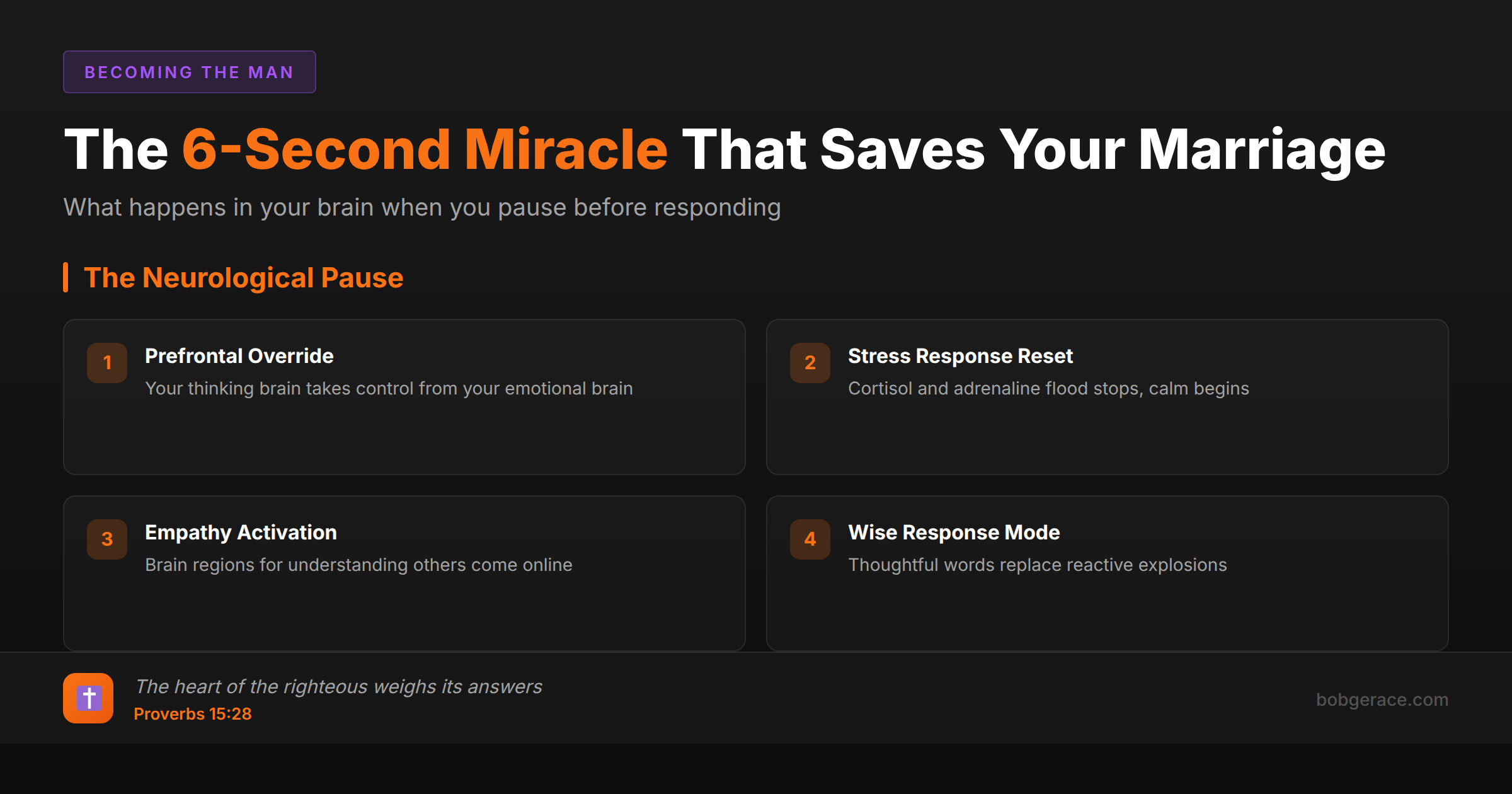
When you pause before responding, you're literally giving your prefrontal cortex time to override your limbic system's fight-or-flight response. This 6-20 second pause allows your brain to shift from reactive mode to reflective mode, engaging the areas responsible for decision-making, empathy, and impulse control. Neurologically, the pause interrupts the automatic stress response that floods your system with cortisol and adrenaline. Instead, it activates your parasympathetic nervous system, which calms your body and mind. This creates space for the anterior cingulate cortex to process emotions more effectively, leading to responses that are thoughtful rather than reactive.
The Full Picture
Your brain is wired for survival, not successful marriage conversations. When your spouse says something that triggers you, your amygdala - the brain's alarm system - hijacks your rational thinking in milliseconds. This 'amygdala hijack' floods your system with stress hormones and prepares you for battle, not intimate dialogue.
Here's what happens without the pause: Your limbic system takes control, your heart rate spikes, blood flow redirects away from your prefrontal cortex (where wisdom lives), and you respond from a place of perceived threat. You're literally operating from a less evolved part of your brain.
The pause changes everything. When you deliberately pause, you're engaging what neuroscientists call 'cognitive control.' You're manually shifting your brain from System 1 thinking (fast, automatic, emotional) to System 2 thinking (slow, deliberate, rational). This isn't just feel-good psychology - it's measurable brain activity.
The pause activates your prefrontal cortex, which houses executive functions like: - Impulse control - Emotional regulation - Perspective-taking - Working memory - Planning and decision-making
It also engages the anterior cingulate cortex, which helps you: - Monitor conflicts between different brain regions - Regulate emotional responses - Maintain attention and focus - Process social emotions
The physical changes are immediate: Your breathing deepens, heart rate stabilizes, muscle tension releases, and stress hormone production slows. You're creating optimal conditions for connection instead of conflict. This isn't about suppressing your emotions - it's about responding to them wisely.
What's Really Happening
From a clinical neuroscience perspective, the pause is one of the most powerful interventions we can teach couples. What we're really doing is helping people build new neural pathways - literally rewiring their brains for better relationships.
The concept of neuroplasticity tells us that our brains can change throughout our lives. Every time you choose to pause instead of react, you're strengthening the neural connections that support emotional regulation. You're making it easier to pause the next time.
I often explain to couples that the pause works because it interrupts what we call the 'negativity cascade.' Research shows that once negative emotions reach a certain threshold, they tend to spiral. The pause creates what psychologist Daniel Siegel calls 'the space between stimulus and response' - that's where your power lies.
What's fascinating is that the pause doesn't just benefit the person doing it. Mirror neurons in our brains cause us to unconsciously mimic the emotional states of others. When one partner pauses and becomes calmer, it actually helps regulate the other partner's nervous system too.
The key is making the pause long enough for meaningful neurological change to occur. Six seconds is the minimum - that's how long it takes for the initial chemical flood of fight-or-flight hormones to begin receding. But 20-30 seconds is ideal for full prefrontal cortex engagement.
This practice becomes easier with repetition because you're literally building stronger 'executive control' muscles in your brain. Couples who consistently practice pausing report not just better communication, but increased emotional intimacy and trust.
What Scripture Says
Scripture has always understood what neuroscience is now proving - there's incredible power in the pause. God's wisdom about our internal responses preceded our understanding of brain chemistry by thousands of years.
Proverbs 15:28 tells us, *'The heart of the righteous weighs its answers, but the mouth of the wicked gushes folly.'* This weighing is exactly what the neurological pause allows - time for wisdom to override impulse.
Proverbs 29:11 warns that *'Fools give full vent to their rage, but the wise bring calm in the end.'* The pause is how we choose wisdom over foolishness, allowing our prefrontal cortex to bring that calm.
James 1:19 provides the perfect formula: *'Everyone should be quick to listen, slow to speak and slow to become angry.'* Being 'slow to speak' isn't just good advice - it's a neurological strategy that allows our brains to function optimally.
Ecclesiastes 3:7 reminds us there is *'a time to be silent and a time to speak.'* The pause helps us discern which time is which, engaging our God-given capacity for wisdom and discernment.
Proverbs 16:32 declares, *'Better a patient man than a warrior, a man who controls his temper than one who takes a city.'* The pause is how we exercise that control - not through willpower alone, but by working with how God designed our brains.
God created your brain with the capacity for this kind of self-regulation. The pause isn't just a technique - it's stewarding the neurological gifts He's given you for the sake of love.
What To Do Right Now
-
1
Practice the 'STOP' technique: When triggered, literally say 'STOP' in your mind and take three deep breaths
-
2
Count to ten slowly before responding to any emotionally charged statement from your spouse
-
3
Use physical cues: Touch your heart, feel your feet on the ground, or gently press your tongue to the roof of your mouth
-
4
Create a pause phrase: 'Let me think about that' or 'Give me a moment' to buy yourself processing time
-
5
Practice daily: Use small irritations throughout the day to strengthen your pause muscle for bigger moments
-
6
Discuss the pause with your spouse: Agree that either partner can call for a pause without it being seen as avoidance
Related Questions
- What is 'amygdala hijack' and how do I interrupt it?
- What's happening in my brain when I rage?
- How do I stay in prefrontal cortex during conflict?
- How do I widen the gap between stimulus and response?
- What is 'window of tolerance' and how do I widen mine?
- How do I stay connected when my body wants to fight?
- What's happening to my nervous system right now?
- What is 'hypervigilance' and why am I doing it?
- How do I regulate when my body is in fight-or-flight?
- What does 'window of tolerance' mean and why am I outside it?
Also find Bob on
Subscribe for weekly videos on Christian marriage.
Ready to use this in your marriage?
Knowing the neuroscience doesn't mean you'll pause when your wife says the thing that floods you. A coach helps you apply this to your actual fights.
Talk to Bob →