What do I do that activates her defense?
6 min read
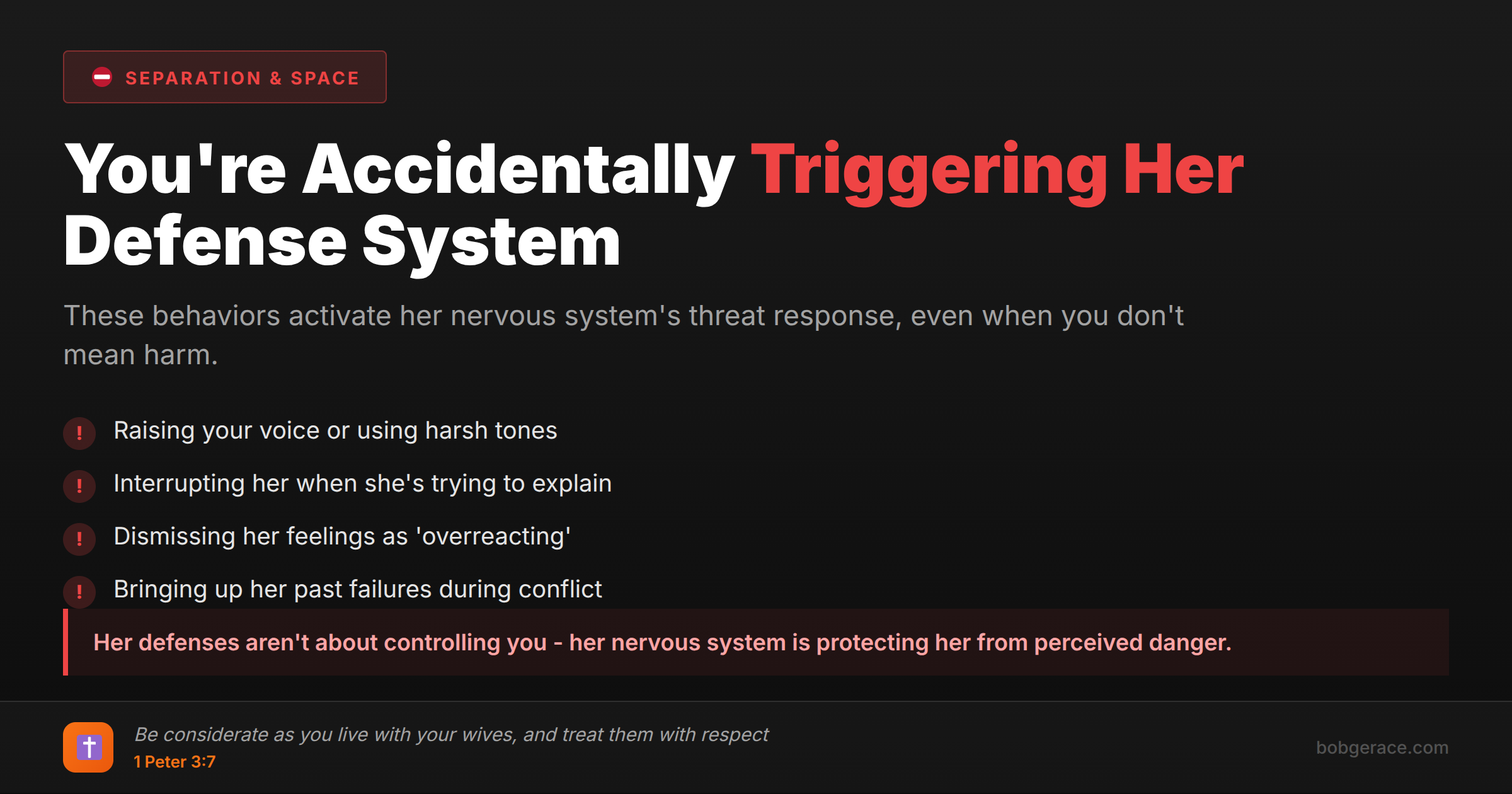
Your wife's defenses activate when she perceives threat, even if you don't intend any harm. Common triggers include: raising your voice, interrupting her, dismissing her feelings, bringing up past failures, using accusatory language, or overwhelming her with logic when she's emotional. Her nervous system doesn't distinguish between physical and emotional threats - it just responds to protect her. The key insight is that her defensive response isn't about controlling you or being difficult. Her polyvagal system is doing exactly what it's designed to do: detect danger and activate protection. When you understand this, you can shift from being frustrated by her defenses to becoming curious about what made her feel unsafe in the first place.
The Full Picture
Here's what most husbands miss: your wife's defensive responses aren't personal attacks - they're survival mechanisms. Her nervous system is constantly scanning for safety or threat, and certain behaviors consistently signal danger to her brain.
The most common defense triggers include:
- Volume and tone escalation - Even slightly raised voices activate her fight-or-flight response - Interrupting or talking over her - This signals that her voice doesn't matter - Dismissive body language - Eye rolls, sighs, turning away, or checking your phone - Bringing up her past mistakes - This feels like character assassination - Using absolute language - "You always" or "You never" statements - Overwhelming her with logic when she's expressing emotions - Defensive counter-attacks when she brings up concerns
Here's the crucial part: Her brain doesn't care about your intentions. It only responds to what it perceives as threatening. You might think you're being reasonable, but if your delivery activates her defense system, your message gets lost completely.
The polyvagal system operates below conscious awareness. By the time she's defensive, her nervous system has already decided you're a threat. This is why trying to logic your way through her defenses never works - you're trying to reach her thinking brain when her survival brain is in control.
The good news? Once you understand these triggers, you can learn to approach her in ways that signal safety instead of threat. This isn't about walking on eggshells - it's about becoming a skilled communicator who knows how to reach her heart.
What's Really Happening
From a polyvagal perspective, your wife's defensive responses originate in her autonomic nervous system, specifically through Dr. Stephen Porges' hierarchy of survival responses. When her neuroception - the unconscious detection of safety or threat - identifies danger cues in your interaction, it triggers predictable physiological responses.
The three-stage cascade looks like this:
1. Social engagement shutdown - She stops making eye contact, her facial expressions flatten, and she withdraws from connection 2. Sympathetic activation - Fight-or-flight kicks in, leading to raised voice, defensive arguments, or emotional reactivity 3. Dorsal vagal collapse - If the threat persists, she may shut down completely, becoming silent, numb, or emotionally unavailable
Common neuroceptive triggers in marriage include: - Facial expressions that appear angry or disgusted - Voice prosody that sounds critical or contemptuous - Body positioning that feels dominating or dismissive - Interaction patterns that remind her nervous system of past relational trauma
The critical insight: Her nervous system often responds to your emotional state, not just your words. If you're internally frustrated, anxious, or disconnected, she'll likely detect these cues through micro-expressions, vocal changes, and energetic shifts - even if you think you're hiding them well.
Successful repair requires co-regulation - helping both nervous systems return to a state of safety and connection. This happens through intentional cues of safety: warm eye contact, gentle voice tone, open body language, and patient presence that allows her system to reset.
What Scripture Says
Scripture calls husbands to create environments of safety and honor for their wives, not activate their defenses through harsh or threatening behavior.
"Husbands, in the same way be considerate as you live with your wives, and treat them with respect as the weaker partner and as heirs with you of the gracious gift of life, so that nothing will hinder your prayers." (1 Peter 3:7)
The word "considerate" means to live with understanding and knowledge. God calls you to study your wife's responses and learn what creates safety versus threat in your relationship.
"A gentle answer turns away wrath, but a harsh word stirs up anger." (Proverbs 15:1)
This isn't just good advice - it's describing how the nervous system works. Gentle communication literally calms the defensive response, while harshness activates it.
"Be kind and compassionate to one another, forgiving each other, just as in Christ God forgave you." (Ephesians 4:32)
Kindness and compassion are safety cues to the nervous system. When your wife feels genuinely cared for, her defenses naturally lower.
"Above all else, guard your heart, for everything you do flows from it." (Proverbs 4:23)
Your internal state matters. If your heart harbors resentment, frustration, or disconnection, it will leak out through your tone, body language, and energy - triggering her defensive responses.
"In your anger do not sin: Do not let the sun go down while you are still angry." (Ephesians 4:26)
Unresolved anger creates a threatening atmosphere. Address conflicts quickly and completely, restoring safety to your relationship.
"Let your conversation be always full of grace, seasoned with salt, so that you may know how to answer everyone." (Colossians 4:6)
Grace-filled communication creates the safety your wife's nervous system craves.
What To Do Right Now
-
1
Monitor your volume and tone - Record yourself during a mock conversation to hear how you actually sound when discussing difficult topics
-
2
Practice the 6-second rule - When you feel defensive or frustrated, pause for six seconds to let your nervous system reset before responding
-
3
Check your body language - Keep arms uncrossed, maintain gentle eye contact, and position yourself at her level rather than standing over her
-
4
Eliminate absolute language - Replace "you always" and "you never" with specific, recent examples using "I" statements
-
5
Validate before problem-solving - When she's emotional, reflect back what you hear before offering solutions or explanations
-
6
Create a safety phrase - Agree on a word or phrase either of you can use to pause the conversation when defenses are rising
Related Questions
- What signals threat to her nervous system?
- Am I a threat to her system right now?
- What would help her ventral vagal (social engagement)?
- How do I become a safe presence again?
- What did I do that made vulnerability feel unsafe?
- What is defensiveness in Gottman's Four Horsemen?
- What does my rage communicate to her attachment system?
- Why does my anger make her less safe not more attached?
- What does emotional attunement look like?
Also find Bob on
Subscribe for weekly videos on Christian marriage.
Ready to apply this to your actual marriage?
A coach who knows your specific patterns can show you what you're missing in real time. Bring your situation to Bob.
Talk to Bob →