What is 'dorsal vagal' state?
6 min read
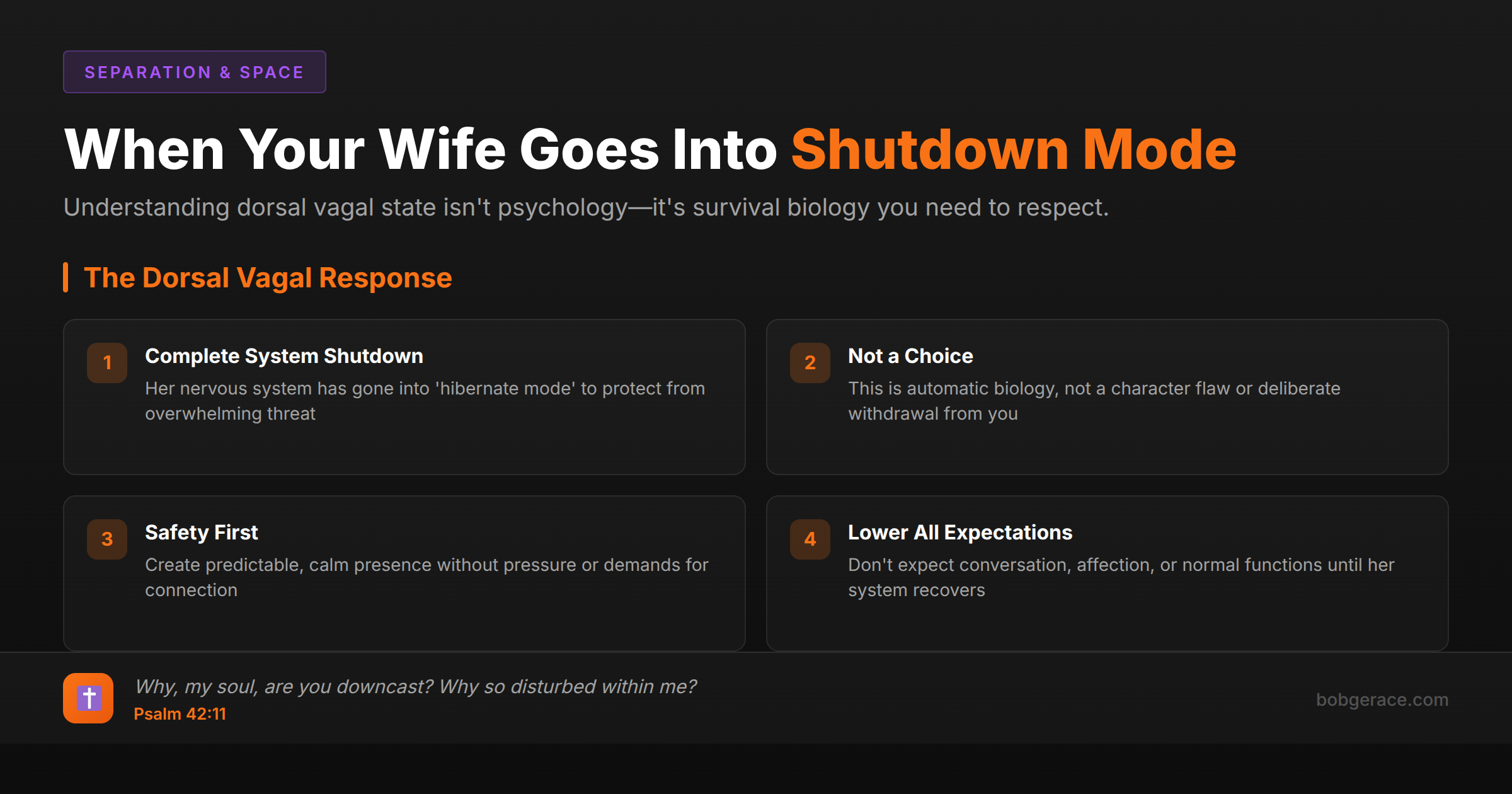
Dorsal vagal state is your nervous system's most primitive survival response - complete shutdown and withdrawal. When your wife is in this state, she's not just upset or angry; her body has literally gone into 'hibernate mode' to protect itself from what it perceives as overwhelming threat or stress. This isn't a choice she's making. It's an automatic biological response that happens when the nervous system becomes so overwhelmed that it shuts down non-essential functions, including emotional connection, communication, and even hope. She may appear numb, lifeless, or completely disengaged. Understanding this helps you respond with compassion rather than frustration, because you're dealing with a neurobiological state, not a character flaw.
The Full Picture
The dorsal vagal state represents the deepest level of nervous system shutdown in Stephen Porges' Polyvagal Theory. Think of it as your body's final emergency protocol when all other coping mechanisms have failed.
When your wife enters this state, her dorsal vagal complex - the oldest part of the vagus nerve - takes control. This system evolved to help us survive life-threatening situations by essentially 'playing dead.' Heart rate slows, breathing becomes shallow, and the body conserves energy by shutting down anything deemed non-essential - including the capacity for connection, hope, and emotional engagement.
In marriage, this often happens after prolonged periods of conflict, feeling unheard, or experiencing repeated emotional injuries without repair. Her nervous system has decided that engagement is dangerous and withdrawal is survival. She's not choosing to be distant; she's literally neurobiologically incapable of connection in this moment.
Signs of dorsal vagal state include: - Appearing numb or emotionally flat - Giving minimal responses or going completely silent - Seeming physically present but mentally 'gone' - Loss of interest in activities she once enjoyed - Difficulty making decisions, even simple ones - Looking exhausted despite adequate sleep - Expressing hopelessness about the relationship
This state can last hours, days, or even months depending on the severity of what triggered it and how her nervous system is supported in recovery. The key insight is that logic, reasoning, and emotional appeals won't work when someone is in dorsal vagal shutdown. Her nervous system needs safety and regulation before higher-level functions like communication and connection can come back online.
What's Really Happening
From a clinical perspective, dorsal vagal activation is one of the most misunderstood responses in relationships. Many partners interpret this shutdown as defiance, manipulation, or lack of caring - but neurobiologically, it's the exact opposite. It's a system so overwhelmed by caring and pain that it has to shut down to survive.
The dorsal vagal complex is unmyelinated, meaning it responds slowly and primitively. When activated, it hijacks more evolved nervous system functions. This is why your wife might seem like a different person - because neurologically, she is operating from a completely different system than her usual self.
What triggers this state varies, but common patterns include: feeling chronically misunderstood, experiencing repeated criticism without repair, facing what feels like impossible relationship demands, or accumulating stress without adequate co-regulation from her partner.
The recovery process is equally important to understand. You cannot think, argue, or convince your way out of dorsal vagal state. The nervous system must be gently coaxed back through safety, predictability, and co-regulation. This often requires what I call 'therapeutic presence' - being consistently calm, non-demanding, and emotionally available without expecting immediate reciprocation.
In my clinical experience, partners who understand and respect this neurobiological reality create the conditions for natural recovery. Those who take it personally or try to force engagement often inadvertently prolong the shutdown state.
What Scripture Says
Scripture provides profound wisdom for understanding and responding to states of deep emotional withdrawal and overwhelm.
Psalm 42:11 captures the experience: *'Why, my soul, are you downcast? Why so disturbed within me? Put your hope in God, for I will yet praise him, my Savior and my God.'* Even the psalmist experienced seasons of profound internal disturbance and emotional flatness.
Isaiah 42:3 describes God's gentle approach to those who are overwhelmed: *'A bruised reed he will not break, and a smoldering wick he will not snuff out.'* When someone is in dorsal vagal state, they are like a bruised reed - fragile and needing the gentlest touch, not pressure or demands.
Galatians 6:2 calls us to *'Carry each other's burdens, and in this way you will fulfill the law of Christ.'* When your wife is in shutdown, she cannot carry her emotional load alone. Your calling is to help bear the weight without expecting immediate reciprocation.
1 Peter 3:7 instructs husbands to *'be considerate as you live with your wives, and treat them with respect as the weaker partner and as heirs with you of the gracious gift of life.'* This doesn't mean women are weak, but that in this vulnerable state, they need extra consideration and protection.
Ecclesiastes 3:7 reminds us there is *'a time to be silent and a time to speak.'* Dorsal vagal state is often a time for silence, presence, and patient waiting rather than words and action.
Matthew 11:28-29 offers hope: *'Come to me, all you who are weary and burdened, and I will give you rest. Take my yoke upon you and learn from me, for I am gentle and humble in heart, and you will find rest for your souls.'* Recovery from shutdown requires this kind of gentle, patient love.
What To Do Right Now
-
1
Stop trying to fix or change her - Accept that her nervous system needs time to recover without pressure or demands
-
2
Create consistent safety - Be predictable, calm, and non-reactive in your presence and responses to reduce her system's hypervigilance
-
3
Lower all expectations temporarily - Don't expect conversation, affection, or normal relationship functions until her nervous system comes back online
-
4
Offer practical support without strings - Handle household tasks, make decisions, and remove burdens without expecting gratitude or reciprocation
-
5
Stay physically present but emotionally non-demanding - Be available without hovering, and don't take her withdrawal as personal rejection
-
6
Get your own support - Work with a coach or counselor to process your frustration and learn specific co-regulation techniques for helping her system recover
Related Questions
- Is she in shutdown, not choosing coldness?
- What signals threat to her nervous system?
- What do I do that activates her defense?
- What would help her ventral vagal (social engagement)?
- How do I co-regulate with someone who won't engage?
- What does safety look like to her nervous system?
- What is 'window of tolerance' and how do I widen mine?
- What's happening to my nervous system right now?
- What does nervous system regulation look like?
- How do I regulate my own system?
Also find Bob on
Subscribe for weekly videos on Christian marriage.
Your Marriage Needs Calibrated Moves
When her nervous system is this locked down, generic advice breaks things. A coach who knows your specific situation can tell you what to do Monday morning.
Talk to Bob →