What does 'neuroception of danger' mean?
6 min read
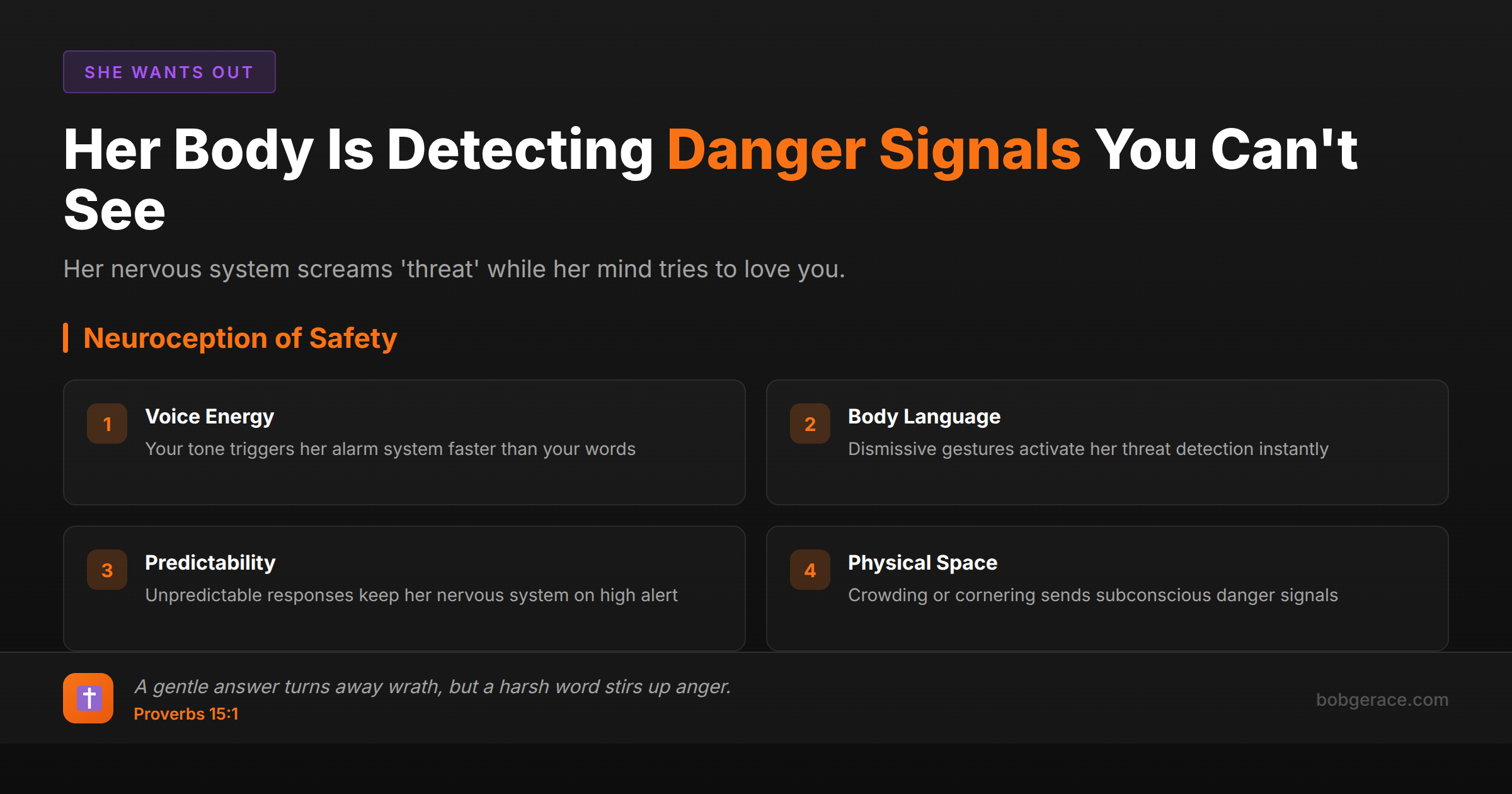
Neuroception of danger is your wife's nervous system acting like a smoke detector - constantly scanning for threats below her conscious awareness. When her nervous system picks up on anger in your voice, dismissiveness in your body language, or unpredictability in your responses, it triggers a danger signal even if you're not intentionally being threatening. This isn't about logic or conscious thought. Her nervous system might be screaming 'danger' while her mind is trying to have a normal conversation with you. When this happens repeatedly, she starts feeling chronically unsafe in the relationship, which explains why she might be pulling away or considering leaving even during 'good' times.
The Full Picture
Neuroception was discovered by Dr. Stephen Porges as part of his Polyvagal Theory. It's your nervous system's unconscious detection of safety or danger - happening faster than conscious thought and more powerful than logic.
Think of it like this: your wife's nervous system is constantly asking "Am I safe right now?" It's reading:
• Your tone of voice - even slight irritation registers as threat • Your facial expressions - microexpressions of contempt or anger • Your body posture - tension, crossed arms, or aggressive positioning • Your breathing patterns - shallow or rapid breathing signals stress • The energy you bring - rushed, impatient, or emotionally dysregulated states
Here's what most men miss: you can say all the right words while your nervous system broadcasts danger. Your wife might not even know why she feels unsafe - she just knows something feels 'off.'
The tricky part is that once her nervous system detects danger, it activates protective responses: • Fight (criticism, defensiveness, anger) • Flight (withdrawal, shutting down, avoiding) • Freeze (going numb, disconnecting emotionally)
When you see these responses and react with frustration or confusion, you're actually confirming her nervous system's danger assessment. It becomes a cycle where your confusion about her 'overreaction' creates more unsafe energy, which triggers more protective responses.
This explains why she might say 'you scare me' even when you're not yelling or being physically aggressive. Her nervous system is responding to subtle cues that signal emotional or relational danger.
What's Really Happening
From a clinical perspective, neuroception operates through the autonomic nervous system, specifically what Porges calls the 'neuroception of safety' versus the 'neuroception of danger.' This process occurs in the brainstem and limbic system - areas that developed evolutionarily to keep us alive, not to maintain happy marriages.
When a wife's nervous system chronically detects danger signals from her husband, several neurobiological changes occur. Her sympathetic nervous system becomes hyperactivated, flooding her system with stress hormones like cortisol and adrenaline. Over time, this creates a state of chronic hypervigilance where she's constantly scanning for the next threat.
This is particularly relevant in marriages where there's been a history of emotional volatility, unpredictability, or what I call 'stealth aggression' - subtle forms of control, dismissiveness, or emotional intimidation that don't look obviously abusive but still trigger the nervous system's alarm bells.
What's crucial to understand is that trauma isn't required for neuroception of danger to activate. Even in marriages without abuse, patterns of emotional unsafety can sensitize the nervous system. Research shows that women, on average, have more sensitive threat-detection systems, likely due to evolutionary factors related to protecting offspring.
The therapeutic goal isn't to convince her that she's 'wrong' about feeling unsafe - it's to help both partners understand that her nervous system is giving her accurate information about the emotional climate of the relationship. When husbands learn to regulate their own nervous systems and consistently demonstrate safety through their energy, tone, and presence, wives' systems can begin to downregulate and return to a state of calm connection.
What Scripture Says
Scripture speaks directly to this principle of creating safety through our presence and words. Proverbs 15:1 says, 'A gentle answer turns away wrath, but a harsh word stirs up anger.' This isn't just about volume - it's about the energy and spirit behind our communication that others' hearts detect.
Ephesians 4:29 instructs us: 'Do not let any unwholesome talk come out of your mouths, but only what is helpful for building others up according to their needs, that it may benefit those who listen.' This verse recognizes that our words carry power to either build up or tear down, and that we're responsible for the impact of our communication.
1 Peter 3:7 specifically addresses husbands: 'Husbands, in the same way be considerate as you live with your wives, and treat them with respect as the weaker partner and as heirs with you of the gracious gift of life, so that nothing will hinder your prayers.' The word 'considerate' here implies a careful awareness of how our actions and energy affect our wives.
Proverbs 27:14 warns: 'If anyone loudly blesses their neighbor early in the morning, it will be taken as a curse.' Even good intentions delivered with wrong energy or timing can be received as harmful - a perfect picture of how neuroception works.
Galatians 5:22-23 lists the fruits of the Spirit: 'But the fruit of the Spirit is love, joy, peace, forbearance, kindness, goodness, faithfulness, gentleness and self-control.' Notice that gentleness and self-control are specifically mentioned - these create the safe energy that allows love to be received.
God calls us to be aware of not just our intentions, but the impact of our presence on others, especially our wives.
What To Do Right Now
-
1
Monitor your nervous system before engaging - take three deep breaths and check your energy level
-
2
Lower your voice volume and slow down your speech pace during conversations
-
3
Soften your facial expression and unclench your jaw when talking with your wife
-
4
Create physical space - don't crowd or corner her during difficult conversations
-
5
Ask permission before discussing heavy topics instead of ambushing her with serious talks
-
6
Practice the 24-hour rule - wait a day before responding when you feel triggered or defensive
Related Questions
- Why does her nervous system need space from me?
- Am I a threat to her system right now?
- How do I become a safe presence again?
- What is 'co-regulation' and why can't we do it?
- What happens neurologically when she sees my number pop up?
- How does chronic stress affect her capacity for connection?
- What is 'window of tolerance' and how do I widen mine?
- What does nervous system regulation look like?
- What is 'freeze' in polyvagal terms?
- What does 'dorsal vagal shutdown' look like in marriage?
Also find Bob on
Subscribe for weekly videos on Christian marriage.
Ready to Apply This to Your Marriage?
Understanding her nervous system is one thing. Calibrating your actual responses to her specific triggers—in real time, under pressure—is where most guys get stuck. A coach helps you see what you can't see alone.
Talk to Bob →