What is 'co-regulation' and why can't we do it?
5 min read
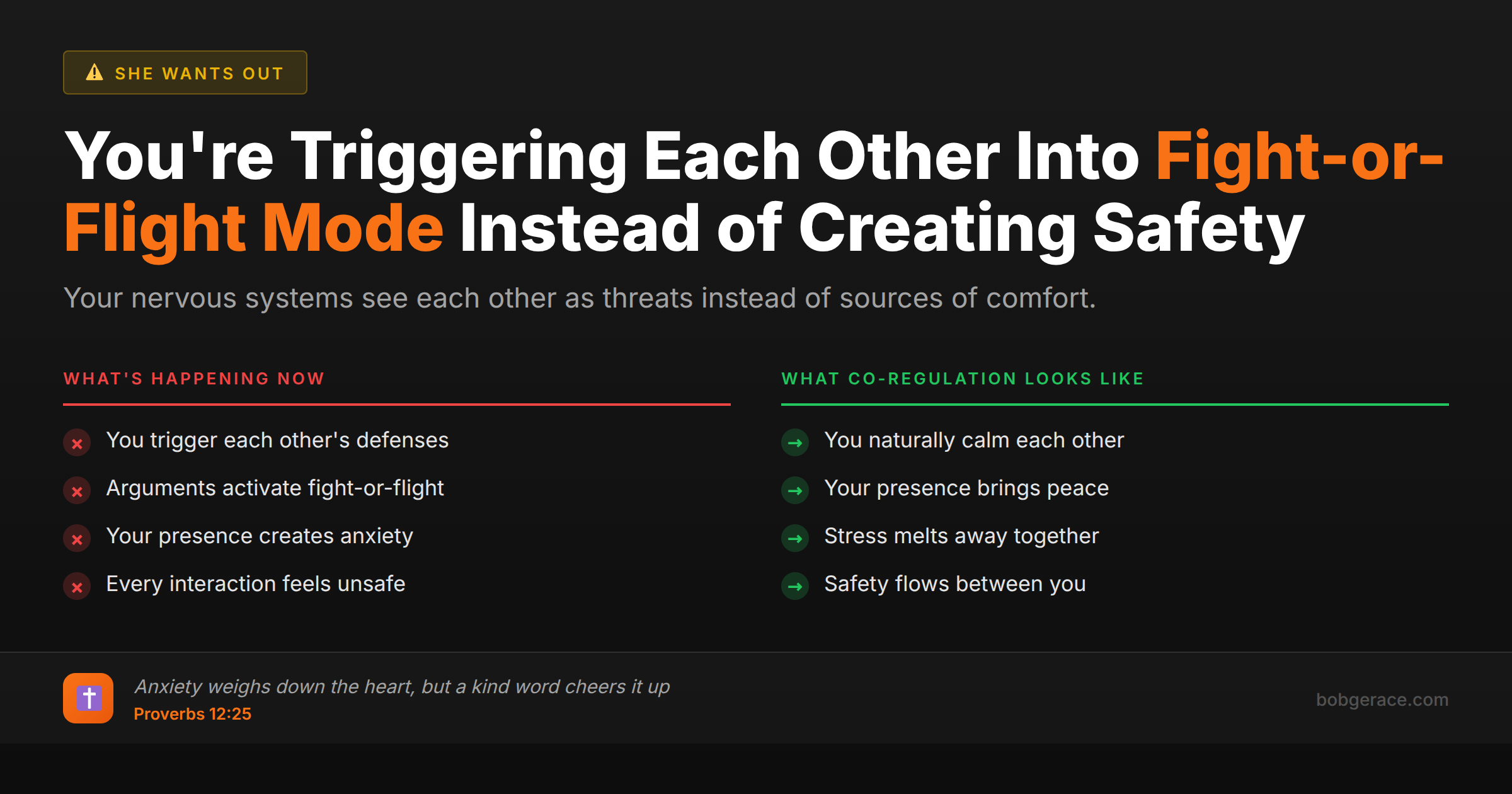
Co-regulation is when two people's nervous systems work together to create calm and safety. In healthy marriages, you and your wife would naturally help each other move from stress to peace just by being together. But right now, the opposite is happening - you're triggering each other into fight-or-flight mode instead of soothing each other back to calm. This isn't happening because you don't love each other. It's happening because your nervous systems have learned to see each other as threats rather than sources of comfort. Every argument, every disappointment, every moment of feeling unsafe with each other has trained your bodies to go into defensive mode when you're together. The good news? This can be rebuilt, but it requires understanding how your nervous system works and taking specific steps to create safety again.
The Full Picture
Co-regulation is one of the most important concepts in marriage that nobody talks about. When you first fell in love, you and your wife naturally co-regulated. Her presence made you feel calmer. Your attention made her feel secure. You could literally feel each other's energy shift when you were together.
What healthy co-regulation looks like: • She comes home stressed, you hold her, and she physically relaxes • You're anxious about work, she listens without fixing, and your breathing slows • During conflict, one of you can pause and help bring the temperature down • Your presence together creates more peace than either of you feels alone
What's happening instead: • She walks in the room and your chest tightens • You try to connect and she physically recoils • Every conversation feels like walking through a minefield • You both feel more stressed together than apart
This shift didn't happen overnight. It's the result of accumulated hurt, broken trust, and nervous systems that have been repeatedly activated without proper repair. Your wife's nervous system now associates you with danger, not safety. And yours does the same with her.
The most damaging part? You're both trying harder, which is making it worse. When you sense her pulling away, you pursue more intensely. When she feels pursued, she defends more fiercely. This creates a cycle where you're constantly triggering each other's threat detection systems.
Understanding this isn't about blame - it's about recognizing that you're both stuck in a biological pattern that requires intentional intervention to change.
What's Really Happening
From a neurobiological perspective, co-regulation is rooted in our autonomic nervous system - specifically the interplay between our sympathetic (fight/flight) and parasympathetic (rest/digest) branches. Research by Dr. Stephen Porges on Polyvagal Theory shows us that humans are wired for connection, and our nervous systems are constantly scanning for safety or threat cues from others.
In distressed marriages, we see a phenomenon called 'autonomic dysregulation.' Both partners exist in chronic states of hypervigilance or shutdown. The wife's nervous system may be stuck in dorsal vagal shutdown (disconnection, numbness) or sympathetic activation (anxiety, anger). The husband often oscillates between sympathetic activation (pursuing, trying harder) and dorsal shutdown (withdrawing, giving up).
What makes this particularly challenging is that trauma responses are contagious. When one partner is dysregulated, mirror neurons and emotional contagion cause the other partner to match that state. This is why arguments escalate so quickly and why even simple conversations feel dangerous.
The research is clear: successful couples learn to co-regulate through what Dr. John Gottman calls 'physiological self-soothing.' This involves developing awareness of your own nervous system state, learning to self-regulate first, and then gradually rebuilding the capacity for mutual regulation.
Crucially, the person who has caused the most harm to the relationship's sense of safety - typically through betrayal, emotional unavailability, or chronic conflict - needs to take the lead in creating new patterns of safety. This isn't punishment; it's biological reality. The nervous system that feels most threatened will be the last to relax.
What Scripture Says
Scripture consistently points to the calming, stabilizing power of love and presence. Proverbs 12:25 tells us, "Anxiety weighs down the heart, but a kind word cheers it up." This is co-regulation in action - our words and presence have the power to shift another person's internal state.
1 John 4:18 reminds us that "perfect love drives out fear, because fear has to do with punishment." In marriage, when fear dominates the relationship, love cannot flourish. Your wife's nervous system is likely stuck in fear mode, and your job is to consistently demonstrate that you are safe, not threatening.
Philippians 4:7 speaks of "the peace of God, which transcends all understanding, will guard your hearts and your minds in Christ Jesus." This supernatural peace isn't just individual - it's meant to flow through us to others. When we're grounded in God's peace, we become conduits of that same peace to our spouses.
Ecclesiastes 4:12 says, "Though one may be overpowered, two can defend themselves. A cord of three strands is not quickly broken." Healthy co-regulation creates this kind of strength - two people whose combined emotional regulation is stronger than what either could achieve alone.
Galatians 6:2 calls us to "carry each other's burdens." This isn't just about practical help - it's about helping carry the emotional and physiological weight of stress, anxiety, and pain. When we co-regulate well, we literally help our spouse carry burdens they couldn't bear alone.
The call here isn't just to biblical principles but to biblical transformation - allowing God to work through you to create the kind of presence that brings peace rather than turmoil to your marriage.
What To Do Right Now
-
1
Practice 4-7-8 breathing (inhale 4, hold 7, exhale 8) twice daily to train your own nervous system regulation
-
2
Stop pursuing when you sense her pulling away - give her nervous system space to settle before attempting connection
-
3
Lower your voice and slow your speech during any tense conversation - your tone directly impacts her nervous system
-
4
Create predictable routines that signal safety - same morning coffee routine, consistent bedtime, regular check-ins
-
5
Ask permission before physical affection - 'Would a hug help right now?' respects her autonomic boundaries
-
6
Practice the 24-hour rule - wait a full day before addressing conflicts to ensure both nervous systems have reset
Related Questions
- Why does her nervous system need space from me?
- Am I a threat to her system right now?
- What does 'neuroception of danger' mean?
- How do I become a safe presence again?
- What happens neurologically when she sees my number pop up?
- How does chronic stress affect her capacity for connection?
- What does nervous system regulation look like?
- How do I regulate my own system?
- How do I self-regulate before I connect?
Also find Bob on
Subscribe for weekly videos on Christian marriage.
Your Marriage Needs a Different Calibration
Co-regulation breaks differently in every marriage. A coach who knows your specific story can see what you can't see alone—and help you rebuild safety at the pace your wife actually needs.
Talk to Bob →