How do I become a safe presence again?
6 min read
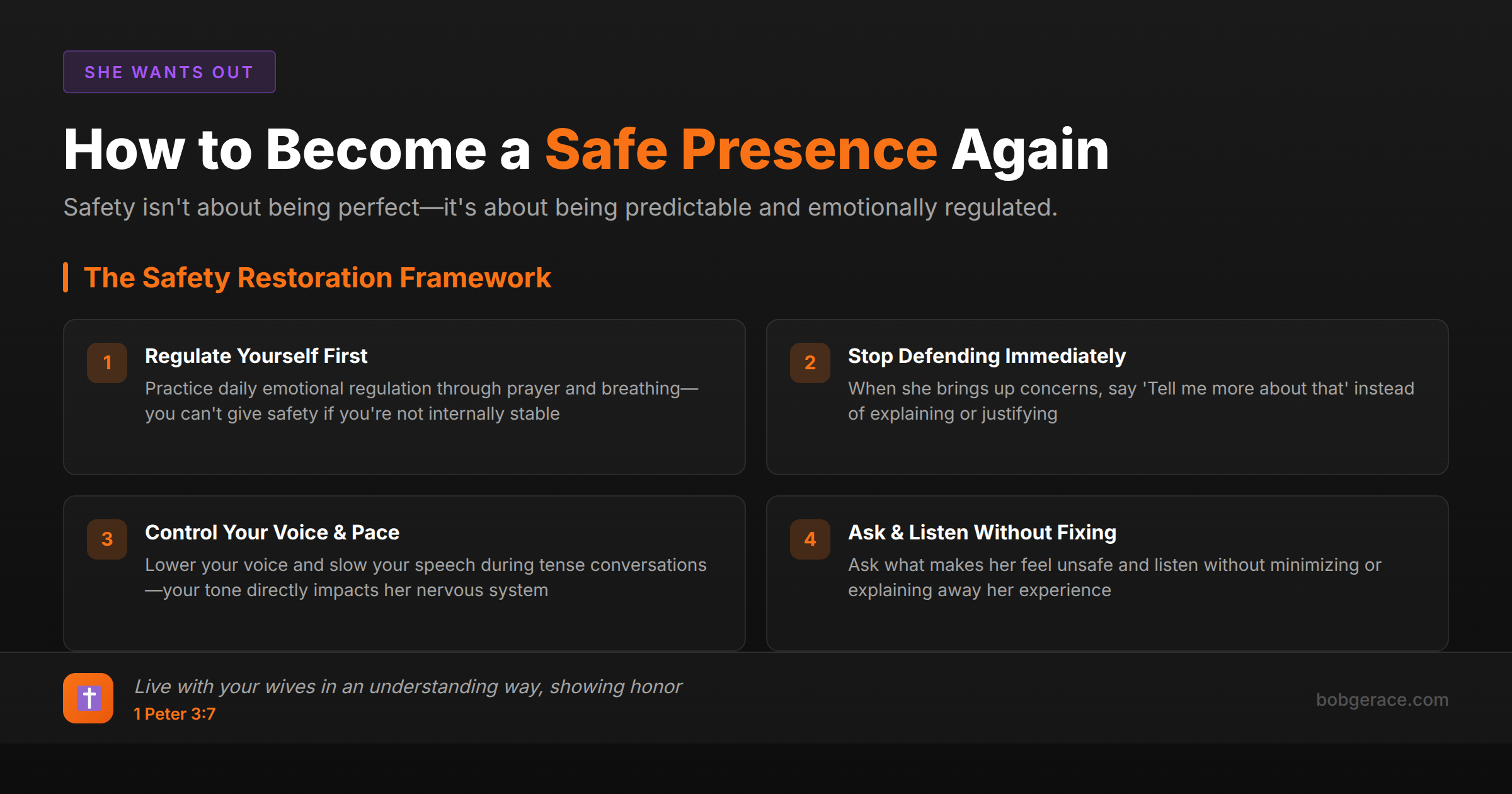
Becoming a safe presence again starts with understanding that safety isn't about being perfect—it's about being predictable, regulated, and emotionally stable. Your wife's nervous system is likely in a chronic state of hypervigilance because of past patterns of emotional volatility, defensiveness, or unpredictability from you. The path back to safety requires you to become someone who doesn't add stress to her world. This means managing your own emotional reactions first, staying calm when she's upset, and proving through consistent actions over time that you won't blow up, shut down, or make everything about you. Safety is rebuilt through hundreds of small moments where you show up regulated, present, and focused on her well-being rather than defending yourself.
The Full Picture
When your wife says she doesn't feel safe with you, she's not necessarily talking about physical safety—though that's obviously crucial too. She's talking about emotional and nervous system safety. Her body has learned to brace for impact whenever conflict arises or stress enters the relationship.
This happens because over months or years, patterns developed where:
• You became defensive when she brought up concerns • Your emotions became unpredictable—she never knew which version of you she'd get • Conversations escalated rather than leading to resolution • You made her concerns about you instead of really hearing her • She had to manage your emotions on top of her own
Her nervous system learned that you weren't a safe harbor in the storm—you were often part of the storm itself. Now, even when you're trying to do better, her body is still braced for the old patterns.
The mistake most men make is thinking they can talk their way back to safety or prove it through grand gestures. But safety is built through consistency in small moments. It's built when she brings up something difficult and you stay calm. When she's having a hard day and you don't make it about you. When conflict arises and you remain regulated instead of reactive.
Becoming safe again means becoming someone who adds calm to chaos rather than adding chaos to chaos. It means she can trust that bringing concerns to you won't result in drama, defensiveness, or emotional labor for her.
What's Really Happening
From a nervous system perspective, your wife's brain has likely shifted into a chronic state of hypervigilance around you. The polyvagal theory, developed by Dr. Stephen Porges, explains how our autonomic nervous system constantly scans for safety or threat. When someone has repeatedly experienced emotional volatility or unpredictability from their partner, their nervous system begins to classify that person as a potential threat.
This isn't a conscious choice—it's a biological response. Her nervous system has learned that interactions with you might result in emotional dysregulation, conflict, or the need to manage your emotions. Even when you're genuinely trying to change, her body may still respond with fight, flight, or freeze responses because the neural pathways of threat detection are still active.
Research on attachment and emotional safety shows that rebuilding nervous system safety requires what Dr. Dan Siegel calls 'earned security.' This happens through consistent, predictable, and emotionally regulated interactions over time. Your wife's nervous system needs to experience you as a source of co-regulation—someone who helps her nervous system calm down rather than rev up.
The good news is that neuroplasticity allows these patterns to change. Through repeated experiences of safety, her nervous system can learn to reclassify you as safe. However, this process requires patience, consistency, and your own nervous system regulation. You cannot give what you don't have—if you're emotionally dysregulated, you cannot provide co-regulation for her.
What Scripture Says
Scripture calls husbands to be a source of safety and security for their wives. Ephesians 5:28-29 says, 'Husbands ought to love their wives as their own bodies. He who loves his wife loves himself. After all, no one ever hated their own body, but they feed and care for their body, just as Christ does the church.' This care includes emotional and psychological safety.
1 Peter 3:7 instructs husbands to 'live with your wives in an understanding way, showing honor to the woman as the weaker vessel, since they are heirs with you of the grace of life.' The word 'understanding' here implies deep knowledge and sensitivity to her needs, including her need for emotional safety.
Proverbs 31:11 describes the virtuous woman whose 'husband's heart safely trusts her.' But this verse also implies the reciprocal—that she should be able to safely trust his heart as well. Trust and safety go hand in hand in marriage.
James 1:19 provides practical guidance: 'Let every person be quick to hear, slow to speak, slow to anger.' This is foundational to becoming emotionally safe. Being quick to hear means truly listening without immediately defending. Being slow to speak means thinking before responding. Being slow to anger means managing your emotional reactions.
Galatians 5:22-23 lists the fruits of the Spirit: 'love, joy, peace, patience, kindness, goodness, faithfulness, gentleness, self-control.' Notice that self-control is listed as a fruit of the Spirit—it's not optional for Christian men. These qualities create the emotional environment where safety can flourish.
What To Do Right Now
-
1
Practice emotional regulation daily through prayer, meditation, or breathing exercises—you cannot give safety if you're not internally regulated
-
2
Stop defending yourself immediately when she brings up concerns and instead say, 'Tell me more about that'
-
3
Lower your voice and slow your speech during any tense conversation—your tone and pace directly impact her nervous system
-
4
Ask her specifically what makes her feel unsafe and listen without explaining, justifying, or minimizing her experience
-
5
Commit to staying present and engaged during difficult conversations instead of shutting down or walking away
-
6
Demonstrate consistency in small daily interactions—how you respond to minor stress reveals your emotional stability
Related Questions
- What signals threat to her nervous system?
- What does safety look like to her nervous system?
- Am I a threat to her system right now?
- What does 'neuroception of danger' mean?
- What would help her ventral vagal (social engagement)?
- How do I co-regulate with someone who won't engage?
- What does emotional attunement look like?
- How do I become a safe emotional presence?
- What does 'holding space' actually mean?
Also find Bob on
Subscribe for weekly videos on Christian marriage.
Rebuilding Safety in Your Specific Marriage
You don't have to figure out what 'regulated and predictable' looks like in your marriage by trial and error. A coach who knows your story can help you see what's actually breaking trust and what will rebuild it.
Talk to Bob →