I don't hit her but I still scare her
6 min read
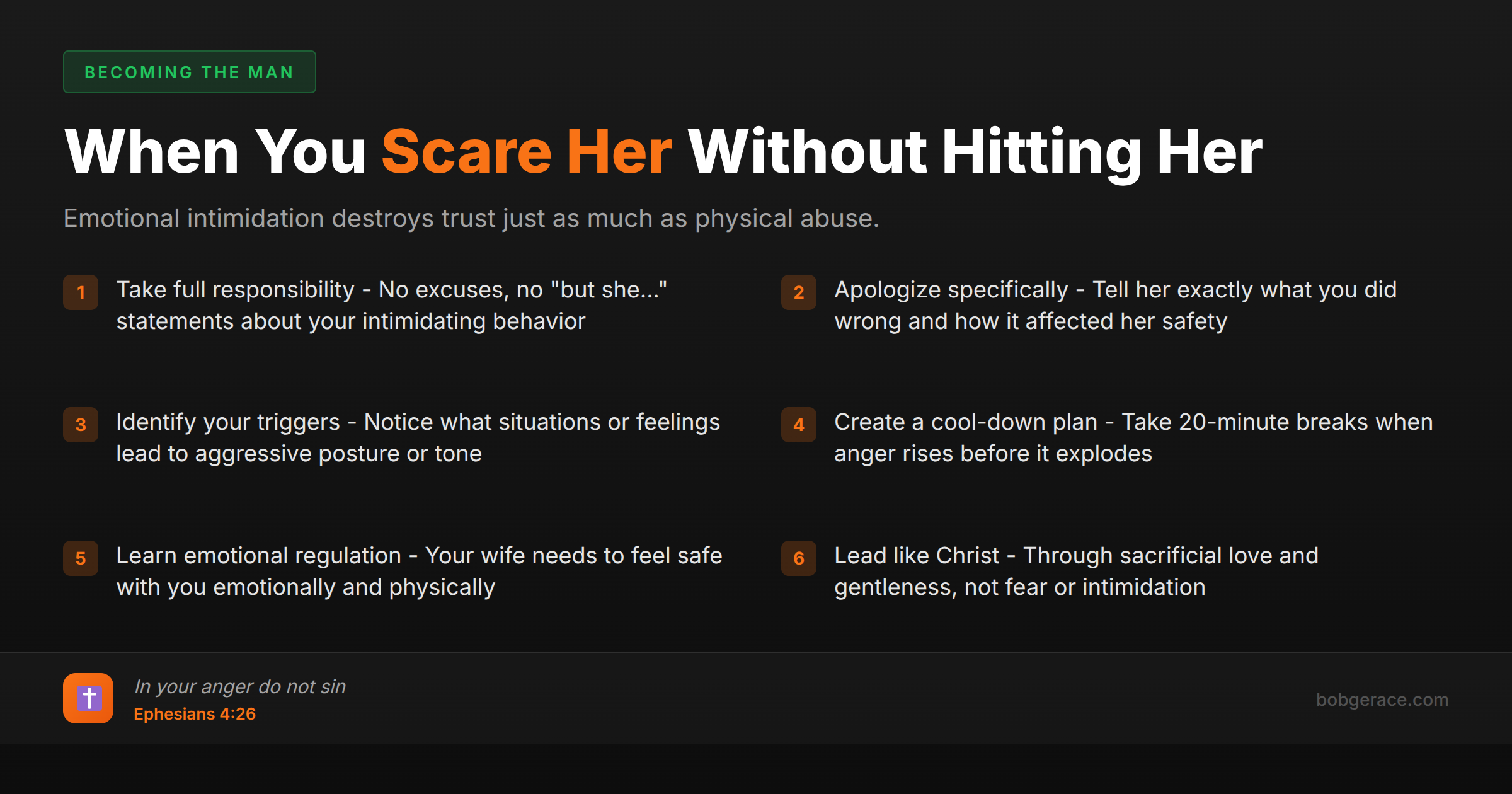
Brother, I'm grateful you recognize this pattern. When you scare your wife without physical violence, you're using emotional intimidation - and it's just as damaging to your marriage. Your raised voice, aggressive posture, or threatening presence creates fear that breaks down trust and intimacy. This isn't about her being "too sensitive." It's about you learning to manage your emotions before they explode. The fact that you see this means you can change it. Your wife needs to feel safe with you - emotionally and physically. That safety is the foundation of everything good in your marriage.
The Full Picture
Let's be crystal clear: intimidation without physical contact is still abuse. When you yell, slam doors, punch walls, loom over her, or use your size and voice to create fear, you're weaponizing your presence. Your wife's nervous system doesn't distinguish between a raised fist and a raised voice when she feels threatened.
Many men minimize this because "at least I don't hit her." That's like saying "at least I don't use a knife" while holding a loaded gun. The damage to trust, intimacy, and your wife's sense of safety is profound. She may walk on eggshells, avoid certain topics, or shut down emotionally to protect herself.
The cycle looks like this: Something triggers your anger → you escalate with intimidating behavior → she withdraws or complies out of fear → you feel temporarily in control → guilt sets in → you minimize or justify → nothing changes → the pattern repeats.
Your wife isn't overreacting. She's responding normally to abnormal behavior. When the person who should be her safest place becomes a source of fear, it creates trauma bonds and erodes the foundation of your marriage. She may still love you, but love mixed with fear creates confusion and pain that can last for years.
The good news? Recognizing this pattern is the first step toward change. You have the power to become the safe haven she needs instead of the storm she fears.
What's Really Happening
From a clinical perspective, emotional intimidation creates similar neurological responses to physical threats. When your wife feels scared, her nervous system activates fight-flight-freeze responses, flooding her body with stress hormones. Over time, this chronic activation can lead to anxiety, depression, and trauma symptoms.
What's particularly damaging is the cognitive dissonance - loving someone who also frightens you creates internal conflict that's difficult to resolve. Many women in these situations blame themselves, thinking they're "too sensitive" or need to "handle him better."
For the intimidating partner, this behavior often stems from poor emotional regulation skills learned in childhood. You may have grown up in a home where anger was expressed through intimidation, or you never learned healthy ways to process intense emotions. The temporary sense of control you feel when others back down reinforces the pattern.
Breaking this cycle requires developing emotional awareness and regulation skills. You need to learn to recognize your anger before it escalates, understand what's beneath the anger (often hurt, fear, or feeling unheard), and develop new ways to communicate these deeper feelings. This isn't about suppressing anger - it's about expressing it in ways that bring you closer together rather than driving you apart.
What Scripture Says
God's design for marriage is clear: "Husbands, love your wives as Christ loved the church" (Ephesians 5:25). Christ never used fear or intimidation. He led through sacrificial love, gentleness, and serving others' needs above His own.
"In your anger do not sin" (Ephesians 4:26). God doesn't condemn anger itself - it's a normal human emotion. But He calls us to handle it without sinning against others. Using intimidation to control or silence your wife is sin, period.
Peter instructs husbands to "live with your wives in an understanding way, showing honor to the woman as the weaker vessel" (1 Peter 3:7). "Weaker vessel" doesn't mean inferior - it means you're called to use your strength to protect and honor her, not to create fear.
"A gentle answer turns away wrath, but a harsh word stirs up anger" (Proverbs 15:1). Your tone and approach set the temperature for every conversation. Gentleness isn't weakness - it's strength under control.
"Be kind to one another, tenderhearted, forgiving one another" (Ephesians 4:32). If you can't be tenderhearted with your wife, who can you be tender with? She should receive your best self, not your worst.
God calls you to be a safe harbor for your wife, not the storm she needs shelter from. When you intimidate her, you're failing in your most basic calling as a husband.
What To Do Right Now
-
1
Take full responsibility - No excuses, no "but she..." statements. Own your intimidating behavior completely.
-
2
Apologize specifically - Tell her exactly what you did wrong and how it affected her. Don't expect immediate forgiveness.
-
3
Identify your triggers - Notice what situations, feelings, or topics lead to intimidating behavior. Write them down.
-
4
Create a cool-down plan - When you feel anger rising, take a 20-minute break. Tell her "I need to cool down, I'll be back."
-
5
Learn your warning signs - Recognize early signals of escalating anger: tense muscles, raised voice, pacing, aggressive thoughts.
-
6
Get professional help - Find a counselor who specializes in anger management. This pattern won't change without skilled intervention.
Related Questions
- I can't control my anger
- Why do I rage at the people I love?
- I said things I can't take back
- How do I stop exploding?
- What's underneath my anger?
- What is 'amygdala hijack' and how do I interrupt it?
- She shuts down when I try to connect
- What did I do that made vulnerability feel unsafe?
- How do I become a safe person again?
Also find Bob on
Subscribe for weekly videos on Christian marriage.
This Pattern Won't Fix Itself
You know you're scaring her. A coach who knows your specific triggers and your actual marriage can help you stop before the next 30 days cement this damage.
Talk to Bob →