What if he's working hard but I still feel unsafe?
5 min read
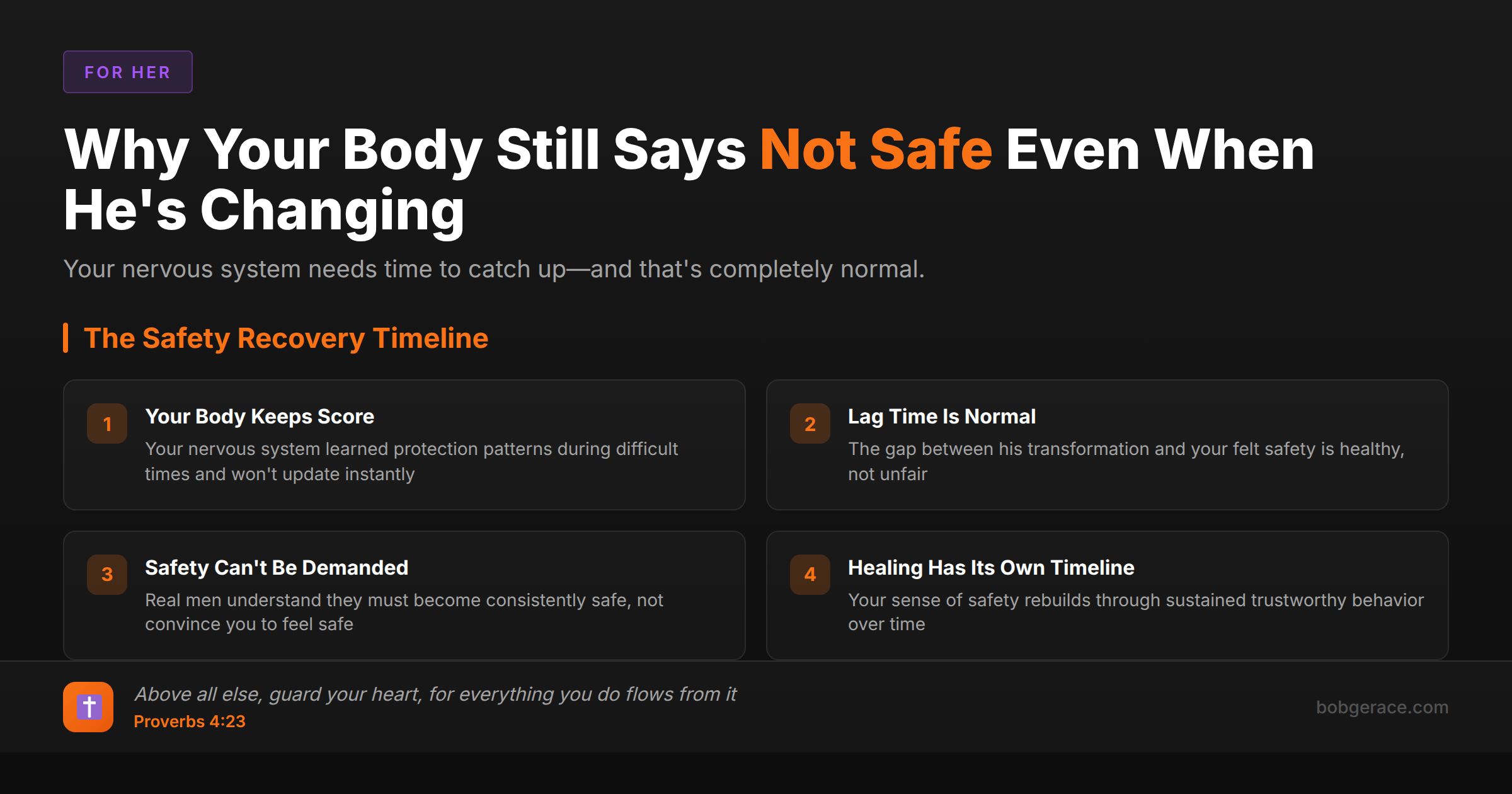
Your feeling of being unsafe isn't a verdict on his effort—it's information about your own healing process. The nervous system that learned to protect you during difficult times doesn't update instantly just because circumstances begin changing. This lag between his transformation and your felt sense of safety is completely normal and actually healthy. Your body has been keeping score. It learned that certain patterns led to pain, and it developed protective responses accordingly. Those responses served you well. Now, even if his behavior is genuinely changing, your nervous system needs time and consistent evidence before it will stand down from high alert. This doesn't mean you're being unfair or that his effort doesn't count. It means healing happens on its own timeline, and yours matters as much as his. A man who understands genuine transformation will recognize that your sense of safety isn't something he can demand or argue into existence—it's something that rebuilds through sustained, trustworthy behavior over time. The coaching he's receiving addresses this directly: his job is to become consistently safe, not to convince you to feel safe. Those are different things, and confusing them undermines both.
The Full Picture
You're watching him put in genuine effort. You can see he's trying, maybe harder than he ever has before. And yet something in you remains guarded, vigilant, unconvinced. You might even feel guilty about this—wondering if you're being unfair or sabotaging the very progress you've wanted to see.
Here's what's actually happening: your conscious mind and your nervous system operate on different timelines. Your conscious mind can observe his changes, acknowledge his effort, and even believe in his sincerity. But your nervous system—the part of you that governs your felt sense of safety—learned its lessons through repeated experience, and it doesn't update based on observation alone. It needs its own accumulation of evidence before it will revise its protective posture.
This isn't a character flaw or a failure of forgiveness. It's basic neurobiology. Your body learned that certain cues predicted pain or disappointment or betrayal. It developed finely-tuned threat detection to protect you. That system doesn't shut off because your husband read a book or started attending coaching. It shuts off—gradually, carefully—when consistent new data overwrites the old programming.
The coaching methodology he's engaged in teaches men this exact distinction. His job isn't to make you feel safe through convincing arguments or displays of effort. His job is to become actually safe—consistently, over time, in ways that eventually register in your nervous system as trustworthy. Demanding that you feel safe before you're ready is itself an unsafe behavior, and the program addresses this directly.
Men in genuine transformation learn to hold space for their wives' legitimate caution. They come to understand that rebuilding safety is measured in their consistent behavior, not in their wives' emotional response to it. This is a profound shift from the typical male instinct to fix, convince, or become frustrated when effort doesn't produce immediate relational results.
Your sense of unsafety, even amid his genuine effort, serves an important function. It protects you from premature vulnerability. It ensures that trust is rebuilt on actual evidence rather than wishful thinking. It gives his transformation the time it needs to prove itself sustainable.
What matters during this season is that he can tolerate your continued caution without demanding, manipulating, or pressuring you into feeling differently. A man whose transformation is real will understand that your nervous system is doing exactly what it should do, and he'll commit to providing the sustained safety that eventually allows it to stand down.
Clinical Insight
The phenomenon you're experiencing has a name in trauma-informed psychology: the nervous system's protective lag. When someone has experienced repeated relational harm, their autonomic nervous system develops conditioned responses that operate faster than conscious thought. These responses served a protective function and don't simply disappear because circumstances change.
Polyvagal theory, developed by Dr. Stephen Porges, helps explain this. Your nervous system constantly scans for cues of safety and danger (a process called "neuroception") and shifts your physiological state accordingly. After sustained relational stress, the system becomes calibrated toward threat detection. Even genuine safety signals may not register as such until the system has accumulated sufficient contradictory evidence.
This is why "I've changed" statements are neurologically insufficient. Your nervous system doesn't respond to verbal declarations—it responds to repeated experiences of actual safety over time. The research suggests that felt safety typically lags behavioral change by months or even years, depending on the duration and severity of the original wounding.
Crucially, this protective lag is not pathological. It's adaptive. A nervous system that updated instantly based on claims rather than evidence would leave you perpetually vulnerable to repeated harm. Your continued sense of unsafety reflects a system working correctly, not one that's broken.
The coaching framework incorporates this understanding by teaching men that their wives' felt safety is a lagging indicator of their actual transformation. Men learn to track leading indicators (their own behavior, //blog.bobgerace.com/christian-marriage-accountability-why-going-solo-fails/:accountability feedback, internal state) rather than demanding that their wives provide evidence of feeling safer as validation for their effort. This removes pressure from the wife and places responsibility where it belongs: on the man's consistent, verifiable behavior over time.
Biblical Framework
Scripture treats the heart as something requiring protection, not something obligated to open on demand. Proverbs 4:23 counsels, "Above all else, guard your heart, for everything you flow from it." This isn't a verse about being closed off—it's wisdom about being appropriately careful with something precious.
The biblical narrative shows God Himself working within human limitations regarding trust. After Israel's repeated unfaithfulness, God didn't demand immediate trust when offering restoration. Through the prophets, He demonstrated consistent faithfulness over time, allowing His people's confidence to rebuild through accumulated evidence of His character.
Jesus' interaction with Thomas after the resurrection is instructive. Thomas declared he wouldn't believe without direct evidence. Jesus didn't rebuke him for requiring proof—He provided it. "Put your finger here; see my hands" (John 20:27). Jesus met Thomas where he was, offering the evidence his doubt required.
Similarly, a husband in genuine transformation doesn't demand that his wife believe before she has evidence. He provides consistent evidence and allows her faith in his change to rebuild at its own pace. This is actually more Christlike than insisting on trust he hasn't yet earned.
The biblical concept of sanctuary—a safe place set apart for healing—applies to what you need now. Exodus describes how the tabernacle had boundaries, protocols, and gradual approaches to the Holy of Holies. Not everything was immediately accessible to everyone. Your heart's boundaries during this season serve a similar sacred purpose: protecting something valuable while healing occurs.
A husband who truly understands the biblical call to love his wife "as Christ loved the church" (Ephesians 5:25) will recognize that Christ's love is characterized by patience, not pressure. His transformation should create conditions for your safety to emerge, not demands that it hurry up.
Practical Guidance
-
1
Name the lag without shame: Tell yourself and him if needed: 'My nervous system needs time to catch up. That's not punishment—it's biology.'
-
2
Identify your specific safety signals: What would actually help you feel safer over time? Consistency? Space? Specific behaviors? Knowing this helps both of you.
-
3
Notice the micro-moments: Sometimes safety rebuilds in small instances: he kept his word about something minor, he didn't escalate when he could have.
-
4
Reject pressure to feel different: If anyone—including him—pressures you to 'just trust already,' recognize that pressure itself is an unsafe behavior.
-
5
Seek support for your own healing: Your nervous system recalibration may benefit from professional support, regardless of what he's doing in his process.
-
6
Separate observation from obligation: You can observe and acknowledge his effort without being obligated to feel safer than you actually feel yet.
Related Questions
- What does he hear about me in your coaching?
- How long does real change actually take?
- What if I see effort but not results yet?
- How will I know if it's actually working?
- What if he's only doing this to keep me from leaving?
- Is he just learning to manipulate me better?
- How do I know if he's really changing?
- Is he manipulating me or actually different?
- What are the markers of genuine behavior change?
- How do I become a safe emotional presence?
Also find Bob on
Subscribe for weekly videos on Christian marriage.
Think This Could Help Your Husband?
If you believe your husband could benefit from the structured transformation process we offer, share this with him. Real change is possible when men commit to the work.
Learn About the Program →