How will I know if it's actually working?
5 min read
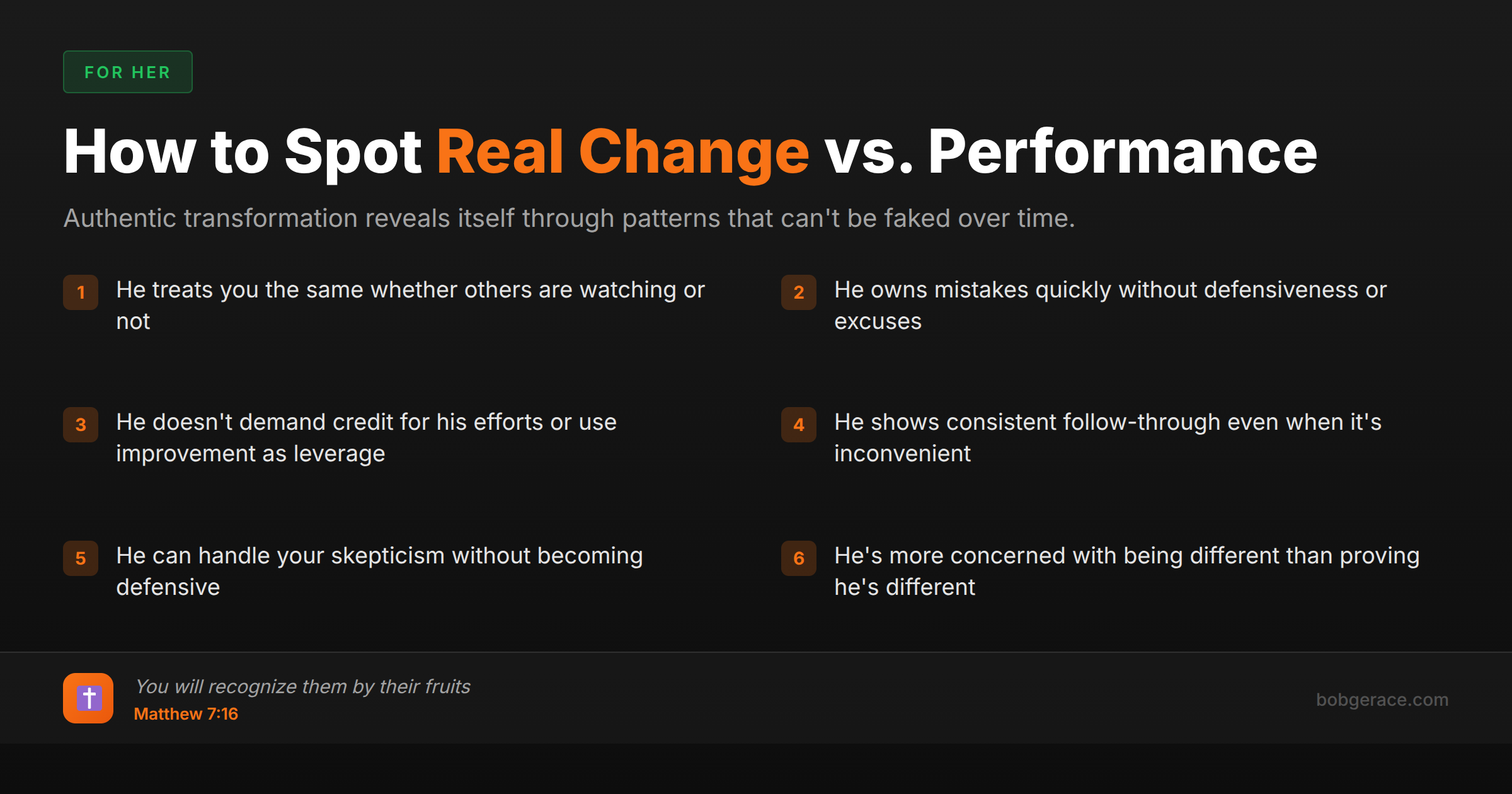
Real transformation reveals itself through specific, observable patterns that are difficult to fake over time. You'll know it's working when you see consistency across contexts—he treats you the same whether others are watching or not, whether he's stressed or relaxed, whether you've acknowledged his efforts or not. Genuine change shows up in how he handles failure, not just success. A man who's truly transforming will own his mistakes quickly, without defensiveness or excuse-making. He won't demand credit for improvement or use his effort as leverage in disagreements. He'll be more concerned with actually being different than with proving he's different. The coaching process includes specific behavioral markers tracked through daily accountability with other men—not just self-reported feelings, but observable actions. Over time, you should see increasing emotional regulation, reduced reactivity, more consistent follow-through on commitments, and a growing ability to prioritize your experience even when it's inconvenient for him. Perhaps most tellingly, authentic transformation produces a man who can tolerate your skepticism without becoming defensive about it. He understands that trust is rebuilt through sustained evidence, not argued into existence.
The Full Picture
After experiencing broken promises and short-lived changes, you've earned the right to be skeptical about whether this time is different. You need concrete indicators—not just feelings or promises—to know whether transformation is actually occurring. Here's what genuinely working change looks like in practice.
First, look for consistency rather than intensity. A man performing change will have dramatic good days followed by disappointing setbacks. A man undergoing real transformation will show steady, gradual improvement with occasional stumbles that he handles differently than before. The pattern matters more than any single instance.
Second, watch how he responds to your doubt. A performing man needs your belief to sustain his effort—when you express skepticism, he becomes defensive, hurt, or resentful. A transforming man can tolerate your doubt because his change isn't dependent on your approval. He's doing this because he needs to become a different man, whether or not you're watching or cheering.
Third, notice whether his change extends beyond your relationship. Real transformation affects how he treats everyone—coworkers, service people, his family of origin, strangers. If he's only different with you, that's performance. Genuine character change is comprehensive.
Fourth, observe his relationship with accountability. Is he actively engaged with other men who challenge him, or is he isolated and self-directed? The coaching methodology requires daily accountability with a brotherhood of men in similar situations. Men who are genuinely changing lean into this accountability; men who are performing resist or resent it.
Fifth, track his handling of stress and conflict. Old patterns reassert themselves most strongly under pressure. A man in genuine transformation will still struggle in difficult moments, but you'll see him catch himself faster, recover more quickly, and take ownership more readily than before.
Sixth, look for appropriate humility. A transforming man doesn't announce his growth or demand recognition. He understands that talking about change is far easier than living it, and he's more interested in accumulating evidence than making claims.
The Four Theater framework used in this coaching provides specific benchmarks for each stage of transformation. Theater 4 (crisis) has different markers than Theater 3 (early change), which differs from Theater 2 (sustained progress). Understanding that transformation is staged helps you recognize progress even when he hasn't reached the destination.
Finally, trust your gut—but give it sufficient data. Your instincts about him are valuable precisely because of your history together. But instincts need time to adjust to new information. Give yourself permission to watch, gather evidence, and let your sense of whether it's working be informed by accumulated observation rather than any single moment.
Clinical Insight
Behavioral psychology distinguishes between compliance (external behavior change driven by consequences) and internalization (genuine value change that produces intrinsic motivation). This distinction is critical for assessing whether transformation is "actually working."
Compliant change is context-dependent—the new behavior appears when rewards or punishments are present and disappears when they're absent. Internalized change persists across contexts because the person has genuinely adopted new values, not just new strategies.
Research on sustainable behavior change identifies several reliable indicators of internalization: the person can articulate why the change matters to them personally (not just how it benefits others), they maintain the behavior even when unobserved, they recover more quickly from lapses, and they show increasing automaticity (the new behavior requires less conscious effort over time).
The coaching methodology addresses this through identity-level work rather than just behavior modification. Teaching a man to "act differently" produces compliance at best. Helping a man understand who he needs to become—and why that matters for his own integrity and purpose—produces internalization.
Daily accountability with peers serves a crucial clinical function: it creates consistent observation from people who understand the work and can detect performance versus genuine engagement. These men hold each other accountable not for perfect behavior but for honest effort. A man cannot sustain fake transformation in that environment for long.
Neurologically, genuine transformation shows up as reduced activation in threat-response centers (amygdala) and increased prefrontal cortex engagement during triggering situations. While you can't scan his brain, you can observe the behavioral correlates: faster //blog.bobgerace.com/christian-marriage-recovery-theater-3-breakthrough/:recovery from emotional reactions, more measured responses to provocations, and greater capacity for perspective-taking even in heated moments.
Biblical Framework
Scripture provides remarkably practical guidance for discerning genuine transformation from mere appearance. Jesus taught that "you will recognize them by their fruits" (Matthew 7:16)—not by their words, intentions, or promises, but by the actual produce of their lives over time.
The fruit metaphor is instructive. Fruit takes time to develop and cannot be rushed or faked. An apple tree doesn't produce apples by trying hard on any given day—it produces apples by being healthy over seasons. Similarly, the "fruit of the Spirit" described in Galatians 5:22-23 (love, joy, peace, patience, kindness, goodness, faithfulness, gentleness, self-control) emerges from spiritual health, not performance.
James was characteristically direct about this: "Show me your faith apart from your works, and I will show you my faith by my works" (James 2:18). He understood that genuine internal change necessarily manifests in observable behavior. Faith that doesn't produce different living isn't genuine faith.
The biblical concept of repentance ("metanoia") means a fundamental change of mind that redirects the entire life, not mere regret or behavior modification. John the Baptist challenged people to "bear fruit in keeping with repentance" (Matthew 3:8)—recognizing that true repentance produces evidence.
Second Corinthians 7:10-11 distinguishes "godly grief" from "worldly grief." Worldly grief produces regret about consequences. Godly grief produces "earnestness," "eagerness to clear oneself," and "zeal"—observable characteristics of a genuinely changed orientation.
As you discern whether his transformation is real, you're doing exactly what Scripture commends: watching for fruit while extending appropriate time for it to develop. This isn't faithlessness—it's wisdom.
Practical Guidance
-
1
Create a private progress journal: Note specific observations over weeks and months. Pattern recognition requires data, and memory is unreliable during emotional seasons.
-
2
Watch for ownership of failure: When he falls short, does he make excuses, blame circumstances, or quickly own it? How he handles missteps reveals more than how he handles successes.
-
3
Notice his relationship to credit: A performing man seeks acknowledgment and becomes resentful without it. A transforming man does the work regardless of recognition.
-
4
Observe stress responses: Old patterns emerge most clearly under pressure. Track whether his transformation holds during difficult days or dissolves when tested.
-
5
Ask his brotherhood: If appropriate, ask him what his accountability partners are observing. Men in genuine transformation often have feedback from brothers who see them clearly.
-
6
Trust incremental evidence: Don't wait for one dramatic proof. Let many small observations accumulate into a clear picture over time.
Related Questions
- What does he hear about me in your coaching?
- How long does real change actually take?
- What should I expect during this process?
- What if I see effort but not results yet?
- What if he's working hard but I still feel unsafe?
- Is he just learning to manipulate me better?
- How do I know if he's really changing?
- What are the markers of genuine behavior change?
- What distinguishes remorse from guilt?
Also find Bob on
Subscribe for weekly videos on Christian marriage.
Think This Could Help Your Husband?
If you believe your husband could benefit from the structured transformation process we offer, share this with him. Real change is possible when men commit to the work.
Learn About the Program →