Should we be doing couples work too?
5 min read
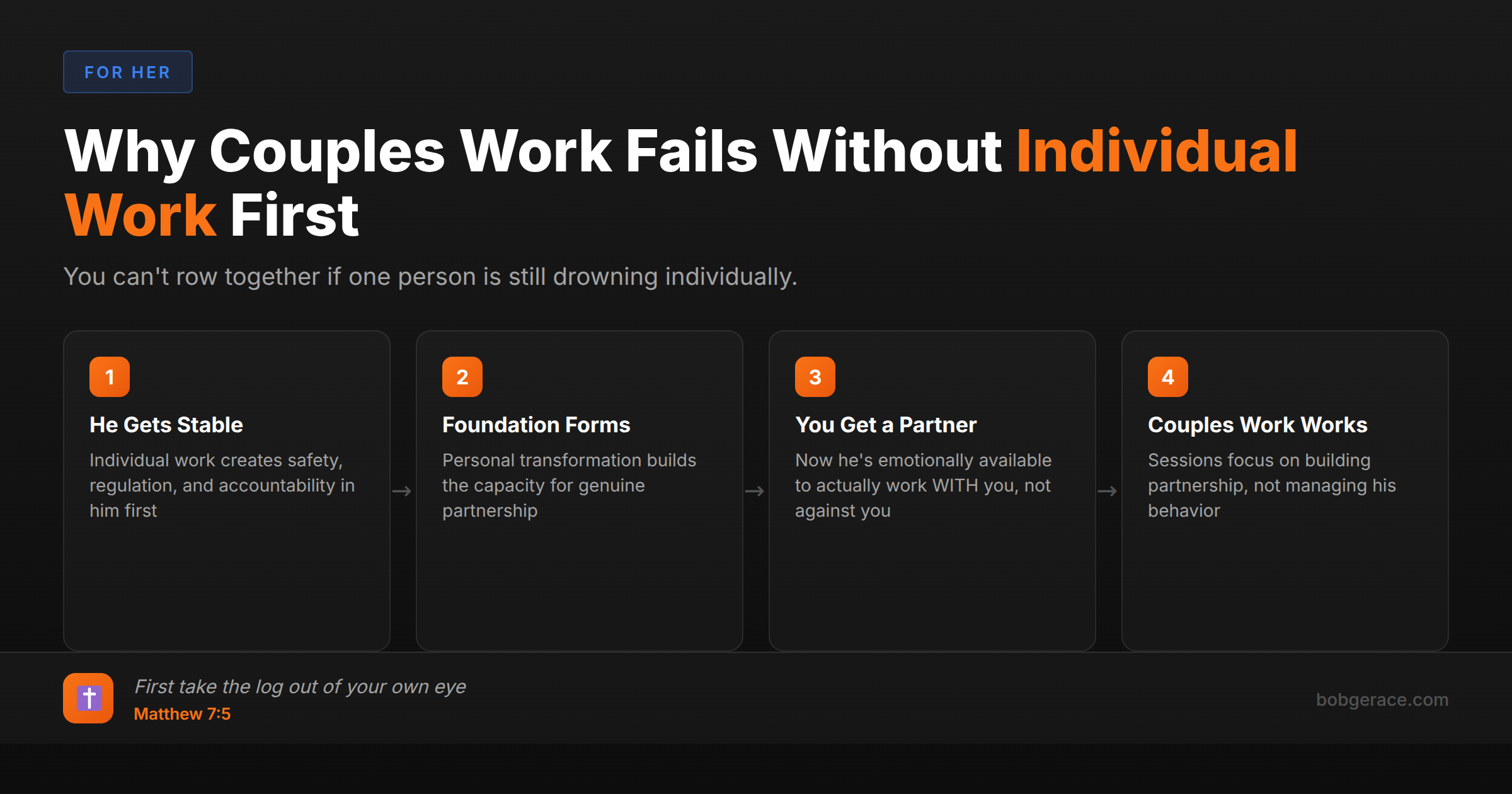
This question reflects exactly the right instinct—you want to work on the marriage, not just watch from the sidelines. But here's what research and experience consistently show: couples work is significantly more effective when both individuals have done sufficient personal work first. Think of it this way: couples counseling is like putting two people in a boat and teaching them to row together. That's extremely difficult if one or both people are drowning individually. The drowning person needs to get stabilized before they can effectively partner in rowing. The coaching your husband is engaged in focuses on his individual transformation first precisely because attempting to work on "the marriage" before he's addressed his own patterns typically produces frustrating cycles where couples sessions become about managing his behavior rather than building genuine partnership. This doesn't mean you wait indefinitely or that your input doesn't matter. It means there's an optimal sequence: he becomes a safe, regulated, accountable man first—then you have a genuine partner to do couples work with. Many couples find that significant individual transformation makes formal couples work almost unnecessary, while couples work attempted prematurely often fails. The right time for couples work is when he's stable enough to truly partner with you in it.
The Full Picture
You want to actively participate in restoring your marriage, not just wait for him to become a different person. That desire is legitimate and healthy. Many women in your position feel like they're on the outside of a process happening to them rather than with them, and they want a venue where their voice, experience, and input directly shape the recovery.
Here's why the timing of couples work matters so much: traditional couples counseling operates on an assumption that both partners are equally capable of showing up, hearing each other, regulating their emotions, and doing the work between sessions. When that assumption holds, couples work can be powerful. When it doesn't—when one partner lacks the self-awareness, emotional regulation, or accountability structures to follow through—couples work often becomes an expensive exercise in frustration.
Worse, premature couples work can actually set back recovery. Sessions become about managing his reactions rather than addressing relationship dynamics. You end up mediating, accommodating, or walking on eggshells even in therapy. The counselor may inadvertently enable his patterns by treating the marriage as equally troubled rather than addressing his specific needed growth.
The coaching methodology addresses this directly by focusing on his individual transformation first. A man who has developed emotional regulation, daily accountability habits, and genuine self-awareness becomes a completely different partner to do couples work with. The man who shows up after several months of consistent individual work is far more capable of actually hearing you, taking responsibility, and making changes than the man who showed up at the beginning of crisis.
This approach—individual transformation first, couples work second—isn't about excluding you. It's about ensuring that when couples work does happen, it's built on a foundation that can sustain it. Many couples find that after sufficient individual work, their ability to communicate and repair improves so dramatically that formal couples counseling becomes less necessary. Others choose to do couples work after individual progress and find it remarkably more effective.
The principle is staging: Foundation, then structure, then finishing work. Trying to do finishing work on a cracked foundation just creates beautiful surfaces that won't last. His individual transformation is foundational. Couples work is structure and finish. The sequence matters.
In the meantime, your voice matters. The coaching framework includes ways for your perspective to be heard and integrated, even before formal couples work begins. His transformation should be informed by your experience, not happening in a vacuum disconnected from your reality.
Clinical Insight
Research on couples therapy effectiveness consistently identifies pre-treatment individual functioning as a primary predictor of outcomes. Studies show that couples where one or both partners have unaddressed individual issues (emotional dysregulation, unprocessed trauma, characterological patterns) have significantly lower success rates in couples therapy than couples where individual issues have been stabilized first.
This finding has led many clinicians to recommend a sequential approach: individual stabilization, then couples work. Dr. John Gottman's research at the University of Washington found that couples therapy has limited effectiveness when attempted during acute //blog.bobgerace.com/christian-marriage-crisis-desperation-weakness/:crisis before individual emotional regulation has improved.
The mechanism isn't mysterious: couples work requires both partners to tolerate discomfort, hear difficult feedback, take responsibility, and implement changes between sessions. These capacities are exactly what individual work develops. Attempting couples work before these capacities exist often produces sessions where one partner's dysregulation dominates, the therapist becomes a referee, and little productive work occurs.
The coaching approach incorporates daily accountability structures specifically because weekly couples sessions are insufficient for building new neural patterns. Change requires consistent repetition over time—not ninety minutes of insight followed by a week of unchanged behavior. By establishing daily accountability habits in individual work, men develop the follow-through capacity that makes subsequent couples work viable.
Additionally, the brotherhood accountability component addresses a common couples therapy limitation: the therapist only sees what happens in session. Brothers in daily contact observe the full picture—how he handles stress, whether he's doing the work, where his patterns still emerge. This level of accountability exceeds what any weekly therapy session can provide.
Biblical Framework
Scripture consistently emphasizes individual transformation as the foundation for relational restoration. Jesus' teaching in Matthew 7:3-5 about removing the log from one's own eye before addressing the speck in another's isn't just about judgment—it's about the sequence of relational repair. Individual work precedes partnership work.
The Apostle Paul's instruction to "work out your own salvation" (Philippians 2:12) before his instructions about community life reflects this same principle. Personal spiritual development creates capacity for healthy relationship. Attempting to skip personal development and jump straight to relational repair violates the biblical pattern.
This doesn't mean marriage isn't important—Scripture is clear that it is. But the biblical pattern shows that strong marriages are built by two people individually committed to becoming who God calls them to be. Ephesians 5 famously addresses marriage, but it does so after four chapters addressing individual identity in Christ, individual spiritual growth, and individual character development.
The concept of "one flesh" (Genesis 2:24) sometimes gets misapplied to suggest that couples must always work together. But two unhealthy individuals becoming "one flesh" creates an unhealthy union. The biblical vision is two whole people—each individually walking with God—joining in partnership. The wholeness comes first.
Prayer for your marriage is appropriate and powerful during this season. But prayer that asks God to fix "the marriage" without addressing the individuals in it misunderstands how transformation works. God transforms people, and transformed people create transformed marriages. The sequence is consistent throughout Scripture.
Your patience while he does individual work isn't passive—it's trust in a process that follows biblical wisdom about how restoration actually happens.
Practical Guidance
-
1
Focus on his foundation first: Ask about his progress in individual work rather than pushing for couples sessions. A strong foundation makes future couples work far more effective.
-
2
Identify your own needs: While he does his work, consider what you might need individually—counseling, support groups, time with trusted friends who understand.
-
3
Trust the staging: Think of individual work as building the capacity for couples work. It's not avoiding the marriage—it's preparing to address it effectively.
-
4
Keep communication channels open: Even without formal couples counseling, you can share observations and needs. His coach can help him hear and integrate your input.
-
5
Recognize readiness signals: When he consistently takes ownership, regulates emotions, and maintains accountability without prompting, couples work becomes viable and valuable.
-
6
Choose couples work timing wisely: When you do begin, select a counselor informed by his specific transformation work to ensure continuity rather than starting over.
Related Questions
- What is this program actually teaching him?
- What are the Four Theaters he keeps mentioning?
- How long does real change actually take?
- What should I expect during this process?
- What's my role in his transformation?
- How do I support without taking over?
- What does affair recovery therapy look like?
- What does quality coaching/therapy include?
- What are the stages of change work?
- How involved should I be in his process?
Also find Bob on
Subscribe for weekly videos on Christian marriage.
Think This Could Help Your Husband?
If you believe your husband could benefit from the structured transformation process we offer, share this with him. Real change is possible when men commit to the work.
Learn About the Program →