How long does real change actually take?
5 min read
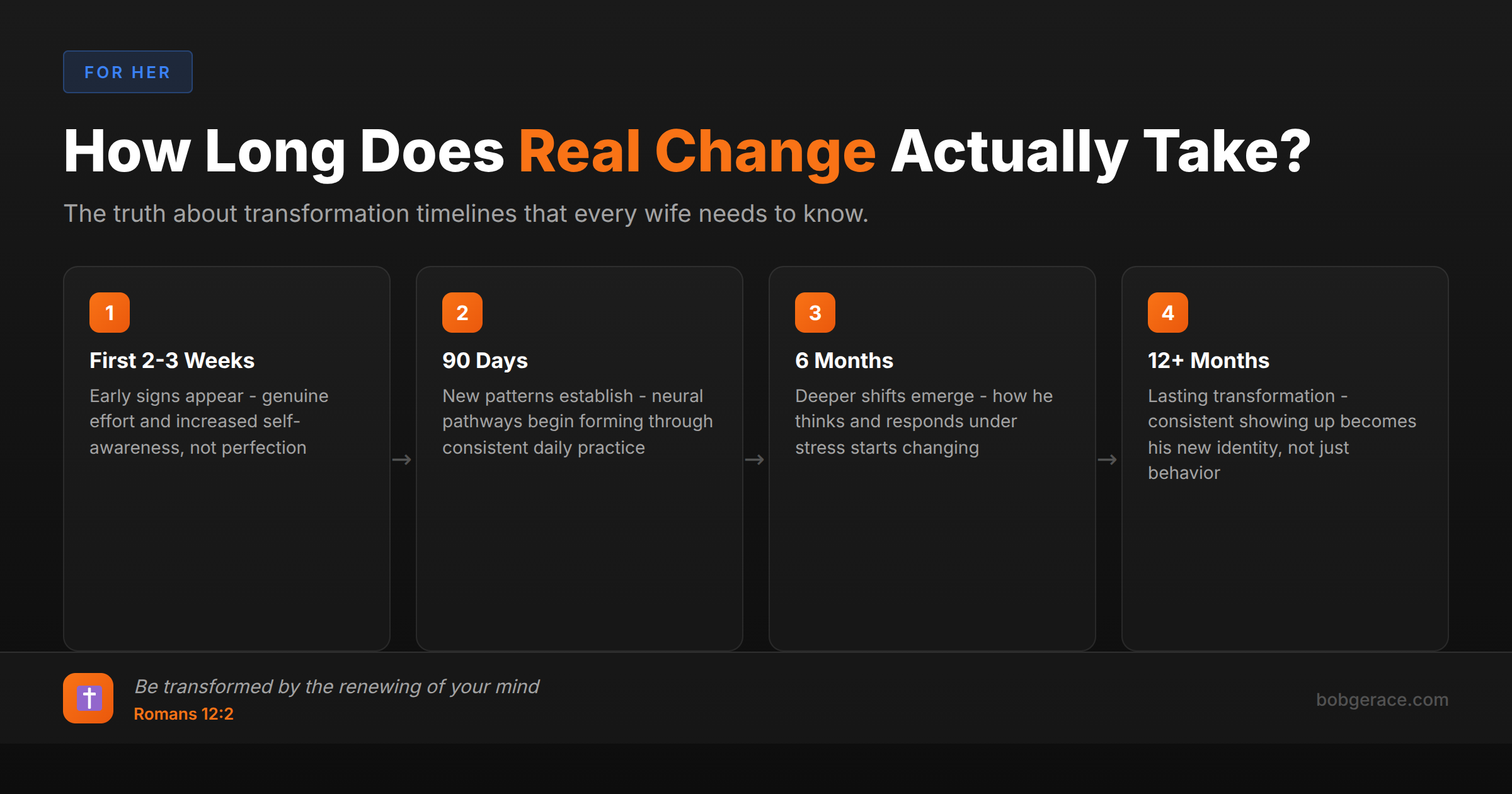
Real change—the kind that lasts—typically requires 90 days to establish new patterns, with deeper transformation continuing over 6-12 months. This isn't because men are slow or resistant; it's because genuine change involves rewiring deeply ingrained neural pathways, not just modifying surface behaviors. Quick fixes fail precisely because they skip this foundational work. What you've likely seen before were attempts at behavior modification—white-knuckling through changed actions without addressing the underlying identity and beliefs driving those behaviors. That's why it didn't last. The process your husband is in works differently. It builds new neural pathways through daily practice, creates accountability structures that catch drift before it becomes disaster, and addresses the root causes rather than symptoms. You'll likely see early signs within the first few weeks—not perfection, but genuine effort and increased self-awareness. The deeper shifts in how he thinks, responds under stress, and shows up consistently take longer. But because they're built on a solid foundation, they actually hold.
The Full Picture
The question of timing is deeply personal for you, and understandably so. You've been waiting—perhaps for years—hoping something would finally work. You've watched him make promises, start strong, then gradually slide back into old patterns. Each cycle has cost you something: hope, trust, emotional energy you can't easily recover. So when you ask how long this takes, you're really asking whether this time will be different.
Here's what the research and experience tell us: sustainable behavioral change follows predictable stages, and rushing through them guarantees failure. The first 30 days focus on pattern interruption—breaking the automatic responses that have caused damage. This is often the most visible phase; you may notice him pausing before reacting, catching himself mid-sentence, or handling triggers differently than before.
Days 30-60 involve building new neural pathways. This is where daily practice matters enormously. The brain physically changes through repeated behavior—new connections strengthen while unused ones weaken. This is also the phase where many men hit a wall. The initial motivation fades, the work feels tedious, and old patterns whisper that they were easier. This is exactly why daily accountability and brotherhood support exist: to carry men through the valley between early enthusiasm and established habit.
Days 60-90 begin cementing new patterns as default responses. The man who had to consciously choose patience now finds it more natural. The reactive anger that once felt automatic now feels foreign. This doesn't mean perfection—it means the trajectory has genuinely shifted.
Beyond 90 days, deeper transformation continues. Identity-level change—how he sees himself as a husband, father, and man—takes longer to fully integrate. But by this point, you're building on solid ground rather than sand.
What makes this timeline meaningful rather than just another promise? Daily touchpoints that catch small drifts before they become patterns. Brotherhood accountability from men who've walked this road and recognize the warning signs. Systematic tracking that shows both him and his coach exactly where progress is happening and where resistance remains. And perhaps most importantly, addressing the why beneath the what—the core beliefs and wounds driving behavior, not just the behavior itself.
You deserve to know that the timeline isn't arbitrary. It's based on how human beings actually change at the neurological and identity level. And while 90 days might feel like a long time when you're hurting, it's remarkably short compared to years of repeating the same cycles.
Clinical Insight
Behavioral psychology distinguishes between compliance and internalization—and this distinction explains why previous attempts likely failed. Compliance means doing the right thing because of external pressure: avoiding consequences, appeasing a spouse, or following rules. Internalization means doing the right thing because it aligns with who you've become. Only internalized change persists when external pressure decreases.
Research by James Prochaska on the Stages of Change model reveals that lasting transformation moves through predictable phases: pre-contemplation, contemplation, preparation, action, and maintenance. Most quick-fix approaches jump straight to action without adequate preparation, which is why relapse rates exceed 80% for most behavioral interventions.
Neuroplasticity research confirms that new neural pathways require consistent repetition over extended periods. Dr. Jeffrey Schwartz's work on brain-based change demonstrates that 8-12 weeks of daily practice fundamentally alters brain structure—not just behavior patterns. This isn't motivational theory; it's observable neuroscience.
The methodology your husband is engaged in accounts for these realities. Daily engagement creates the repetition neuroplasticity requires. The Four //blog.bobgerace.com/character-integration-christian-marriage-theater-success/:Theater staging system meets men exactly where they are rather than demanding immediate perfection. Progressive challenges build capacity rather than overwhelming it. And regular assessment ensures that surface compliance doesn't masquerade as genuine change.
This is why sustainable transformation has a timeline. Not because men are incapable of faster change, but because the brain and identity simply don't rewire overnight. Respecting this reality isn't making excuses—it's building something that actually lasts.
Biblical Framework
Scripture presents transformation as a process, not an event. Romans 12:2 speaks of being 'transformed by the renewing of your mind'—and the Greek word used is metamorphoo, from which we get metamorphosis. A caterpillar doesn't become a butterfly instantly; it undergoes complete cellular restructuring inside the cocoon. The process cannot be rushed without destroying the result.
Galatians 5:22-23 describes the fruit of the Spirit—love, joy, peace, patience, kindness, goodness, faithfulness, gentleness, self-control. Notice the metaphor: fruit. Fruit requires seasons. A farmer plants seeds, tends soil, provides water, removes weeds, and waits. Demanding instant harvest produces nothing. The same principle applies to spiritual and character growth.
Consider also Israel's wilderness journey. The physical distance from Egypt to Canaan was an eleven-day walk. God chose a forty-year timeline instead. Why? Because leaving Egypt was quick, but getting Egypt out of them took longer. The external circumstances changed immediately; the internal transformation required a generation. God wasn't being cruel—He was being thorough.
James 1:4 instructs: 'Let perseverance finish its work so that you may be mature and complete, not lacking anything.' The word 'finish' implies duration. Perseverance isn't perseverance if it's over quickly. The testing of faith, James says, produces steadfastness—but only if allowed to complete its work.
Your husband is in a process God designed to take time. This isn't delay; it's how lasting change actually happens. The timeline isn't an obstacle to hope—it's evidence that something real is being built.
Action Steps
-
1
Look for trajectory rather than perfection—is the overall direction improving even when individual moments falter?
-
2
Note specific changes you observe, however small—these are evidence the process is working.
-
3
Resist the urge to set arbitrary deadlines that create pressure rather than support progress.
-
4
Remember that sustainable change protects you better than quick compliance that inevitably fades.
-
5
Ask him what he's learning rather than testing whether he's 'fixed' yet.
-
6
Consider that the time this takes is actually investment in your future, not delay of it.
Related Questions
- What should I expect during this process?
- What if I see effort but not results yet?
- What is this program actually teaching him?
- What if he's only doing this to keep me from leaving?
- What if he's working hard but I still feel unsafe?
- What does real transformation look like?
- How long does recovery take?
- What is the typical betrayal trauma recovery timeline?
- How long until new behaviors become automatic?
Also find Bob on
Subscribe for weekly videos on Christian marriage.
Think This Could Help Your Husband?
If you believe your husband could benefit from the structured transformation process we offer, share this with him. Real change is possible when men commit to the work.
Learn About the Program →