What are the stages of change work?
6 min read
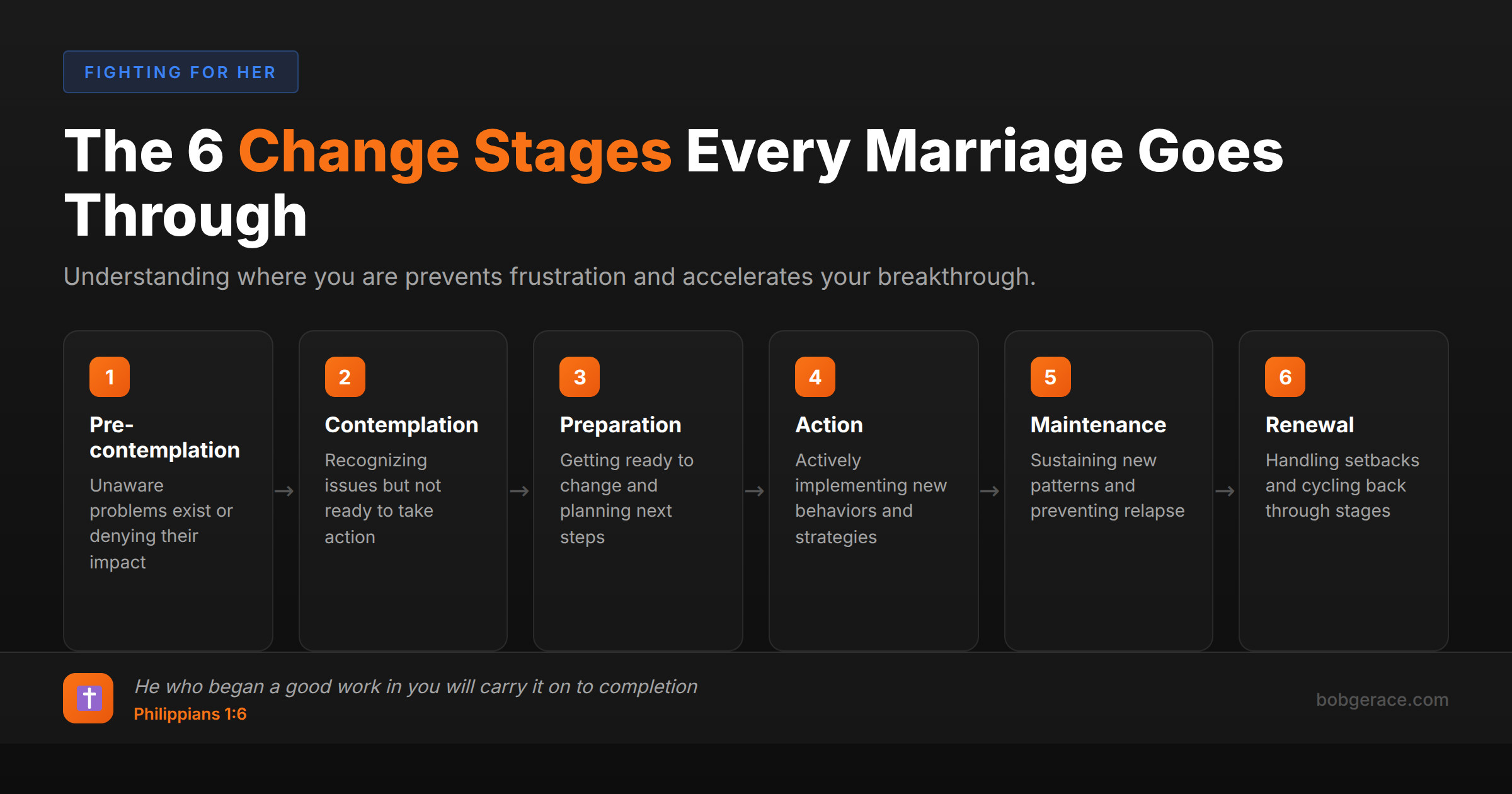
Change work in marriage follows six distinct stages: Pre-contemplation (unaware of problems), Contemplation (recognizing issues but not ready to act), Preparation (getting ready to change), Action (actively implementing new behaviors), Maintenance (sustaining new patterns), and Relapse/Renewal (handling setbacks). Understanding these stages helps you navigate your transformation journey with realistic expectations. Most women cycle through these stages multiple times before achieving lasting change. Each stage requires different strategies and support. Knowing where you are prevents frustration and helps you take appropriate next steps toward healing your marriage.
The Full Picture
Change doesn't happen overnight—it follows a predictable pattern. The Transtheoretical Model of Change, developed by researchers Prochaska and DiClemente, reveals six stages every person goes through when making significant life changes, including transforming their marriage.
Stage 1: Pre-contemplation - You're unaware there's a problem or in denial about its severity. Many women stay here for years, believing their husband will eventually change or that things aren't "that bad."
Stage 2: Contemplation - You recognize problems exist but aren't ready to take action. You might research, read books, or talk to friends, but you're still weighing pros and cons of change.
Stage 3: Preparation - You're getting ready to take action within the next month. This involves planning, gathering resources, setting dates, and telling supportive people about your intentions.
Stage 4: Action - You're actively implementing new behaviors and strategies. This stage requires the most time and energy as you practice new communication patterns, set boundaries, or change how you respond to conflict.
Stage 5: Maintenance - You've sustained new behaviors for at least six months. The focus shifts from active change to preventing relapse and integrating new patterns into daily life.
Stage 6: Relapse/Renewal - Most people experience setbacks. This isn't failure—it's part of the process. You learn from what happened and re-enter the cycle with new knowledge and strategies.
What's Really Happening
The brain resists change because it requires more energy than maintaining familiar patterns. This neurological reality explains why transformation feels so difficult, even when you desperately want things to improve. Each stage activates different neural networks and requires specific therapeutic interventions.
During Pre-contemplation, the prefrontal cortex (responsible for self-awareness) shows minimal activation around relationship issues. Women often experience cognitive dissonance—simultaneously knowing something's wrong while minimizing its impact. This isn't weakness; it's a protective mechanism.
Contemplation activates the anterior cingulate cortex, creating internal conflict between desire for change and fear of consequences. Many women get stuck here because this stage feels productive (you're thinking about change) without requiring vulnerable action.
The Action stage shows the most dramatic brain changes. New neural pathways form while old patterns weaken through lack of use. This creates temporary emotional dysregulation—you might feel worse before feeling better. Understanding this prevents premature abandonment of effective strategies.
Maintenance involves strengthening new neural networks until they become default responses. The critical factor isn't willpower—it's environmental design. Women who successfully maintain changes create supportive contexts that make new behaviors easier than old ones.
What Scripture Says
God's Word reveals that transformation is both a process and His work in us. Scripture acknowledges the stages of change while emphasizing God's role in our growth.
Philippians 1:6 - "Being confident of this, that he who began a good work in you will carry it on to completion until the day of Christ Jesus." God initiated your desire for change and will complete it. You're not alone in this process.
2 Corinthians 3:18 - "And we all, who with unveiled faces contemplate the Lord's glory, are being transformed into his image with ever-increasing glory, which comes from the Lord, who is the Spirit." Transformation happens gradually ("ever-increasing") as we focus on Christ.
Romans 12:2 - "Do not conform to the pattern of this world, but be transformed by the renewing of your mind." Change requires both stopping old patterns and actively renewing thought processes—exactly what the stages of change describe.
James 1:4 - "Let perseverance finish its work so that you may be mature and complete, not lacking anything." The process requires patience and persistence. Each stage serves a purpose in your development.
Isaiah 43:19 - "See, I am doing a new thing! Now it springs up; do you not perceive it?" Sometimes you're in preparation or action stages without recognizing God's work. Trust the process even when progress feels slow.
1 Thessalonians 5:24 - "The one who calls you is faithful, and he will do it." Your responsibility is obedience to the next step; God's faithfulness ensures the outcome.
What To Do Right Now
-
1
Identify your current stage by honestly assessing your readiness to take specific action within the next 30 days
-
2
Match your strategies to your stage—if you're in contemplation, focus on education rather than forcing action steps
-
3
Create environmental supports for your target stage, such as removing obstacles and adding accountability systems
-
4
Develop stage-specific coping strategies for common challenges like decision fatigue in preparation or isolation in action
-
5
Build a support network that understands the change process and can encourage appropriate next steps
-
6
Plan for relapse by identifying triggers and creating recovery strategies before you need them
Related Questions
- What does 'the work' actually mean?
- What should he be working on in order?
- What does integration mean vs. just learning?
- What does quality coaching/therapy include?
- How long does real transformation take?
- What does good homework look like?
- What are the 'stages of change'?
- What is 'transformational learning'?
- How long does it take to rewire the brain?
- What makes change sustainable vs. temporary?
Also find Bob on
Subscribe for weekly videos on Christian marriage.
Know the stages. Still stuck in yours.
A coach sees where you're actually stalling in your marriage—not just the theory. Bob calibrates to your specific situation and gets you unstuck.
Talk to Bob →